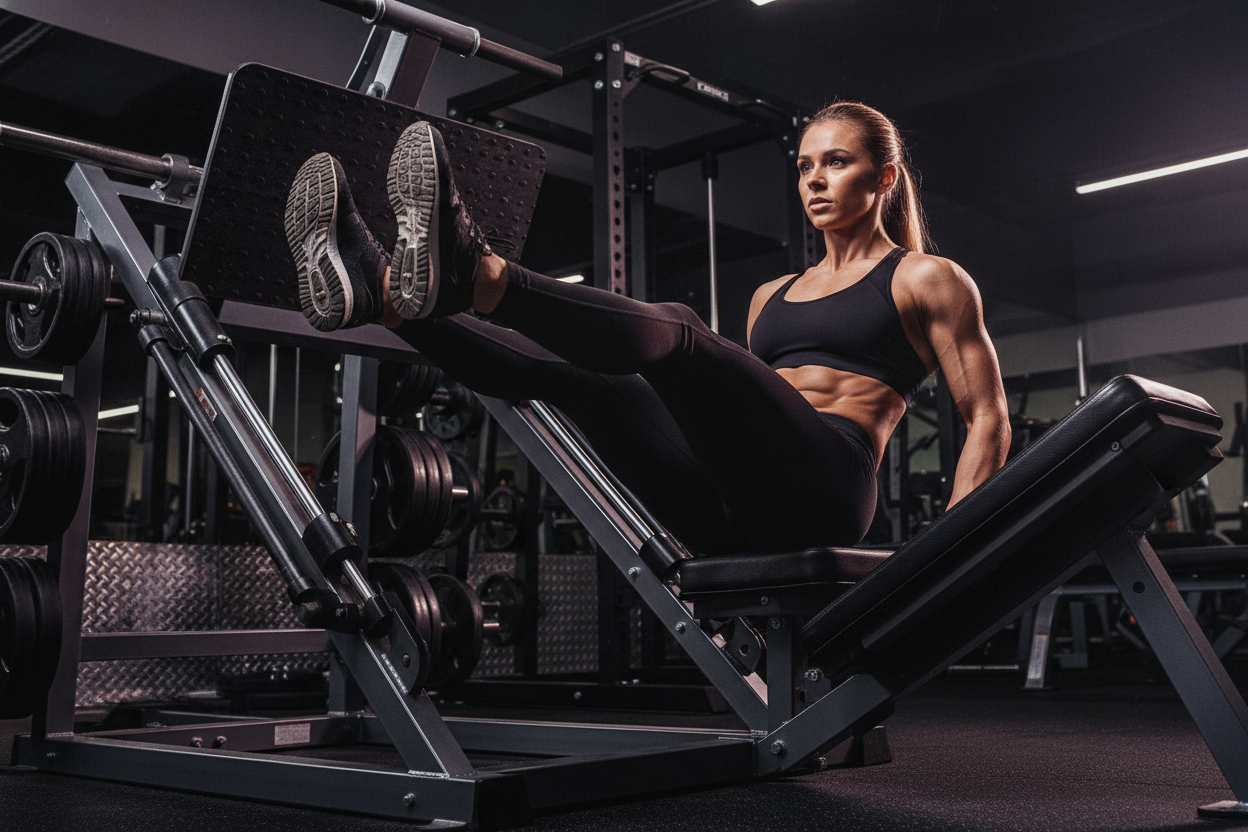
The Wide Stance Fix: How to Work Inner Thigh on Leg Press
Most lifters treat the leg press as a pure quad-builder. They load up the plates, place their feet shoulder-width apart, and piston away. While that’s great for the front of your legs, you are missing a massive opportunity if you ignore foot positioning.
If you are trying to figure out how to work inner thigh on leg press, the secret isn't a different machine—it’s geometry. By manipulating your stance width and toe angle, you can shift the mechanical tension from your vastus lateralis (outer quad) to your adductor magnus (inner thigh).
Here is the biomechanics breakdown and the specific technique you need to target that stubborn inner thigh area without switching stations.
Key Takeaways: The "Sumo" Setup
- Go Wide: Place your feet wider than shoulder-width to increase adductor activation.
- Rotate Out: Turn your toes out at a 45-degree angle (external rotation).
- Prioritize Depth: The inner thigh muscles (adductors) work hardest in the stretched position at the bottom of the rep.
- Mind Muscle Connection: Focus on pushing through your heels and preventing your knees from caving inward.
The Science: Does Leg Press Work Inner Thigh?
The short answer is yes, but only if you ask it to. The query "does leg press work inner thigh" often comes from people who feel the movement entirely in their quads. This happens because the standard stance biases the quadriceps.
However, your adductor magnus is a powerful hip extensor. When you widen your stance, you put the adductors in a position where they must stretch more to accommodate the descent. This stretch under load is the primary driver for hypertrophy (muscle growth) in this region. You aren't isolating the muscle like you would on a seated adductor machine, but you are hitting it with significantly heavier loads.
Step-by-Step: The Sumo Leg Press Technique
To specifically target the inner thigh on leg press, you need to adopt what powerlifters call a "Sumo" stance. Here is how to execute it safely.
1. Foot Placement
Place your feet high on the platform and wide. Your heels should be near the outer edges of the plate. High placement reduces knee flexion (less quad) and increases hip flexion (more glute and adductor).
2. The Angle
Turn your toes outward. Think of a clock face: your left foot points to 10 or 11, and your right foot points to 1 or 2. This external rotation aligns your knees with your toes, which is crucial for engaging the inner thigh.
3. The Descent
Unlock the safety bars and lower the weight slowly. As the sled comes down, focus on driving your knees outward. Do not let them cave in. You should feel a deep stretch in your groin area at the bottom of the movement.
Contrast: Leg Press Outer Thigh vs. Inner Thigh
To understand the difference, it helps to know the opposite setup. If you were targeting the leg press outer thigh (the "sweep" of the quad), you would keep your feet narrow and lower on the platform.
The narrow stance forces the outer quads to take the brunt of the load. The wide stance forces the load onto the hips and adductors. Mixing both variations into your leg day ensures balanced development and prevents muscular imbalances that can lead to knee pain.
My Training Log: Real Talk on Adductor Training
I distinctly remember the first time I actually committed to the wide-stance press. I had been skipping the "sus" looking adductor machine because the gym was crowded, so I decided to tweak my leg press instead.
Here is the reality check: I had to drop the weight significantly. I’m talking stripping off at least two plates per side. When I tried to use my normal "ego" weight with a wide stance, my hips felt like they were locked in cement. The range of motion was terrible.
The specific sensation you need to look for is an uncomfortable stretch right at the insertion point near the groin. It feels completely different from the burning sensation of a quad pump. Also, watch out for the lower back. I noticed that if my feet were too high, my butt started to lift off the seat pad (the "butt wink"), which is a one-way ticket to a herniated disc. I had to grip the handles specifically hard to keep my hips glued down. The soreness the next day wasn't in my thighs; it was that deep, waddling soreness that tells you you actually hit the adductors.
Conclusion
You don't need a specialized machine to build impressive legs. Learning how to work inner thigh on leg press is simply a matter of widening your base and controlling the eccentric (lowering) portion of the rep.
Remember, the leg press is a tool. How you use it determines the result. Drop the weight, widen the stance, and chase the stretch rather than the rep count.
Frequently Asked Questions
Is the wide stance leg press better than the adductor machine?
They serve different purposes. The adductor machine isolates the muscle for metabolic stress. The wide stance leg press allows you to overload the muscle with heavier weights, which is generally better for strength and mass, but it recruits other muscles simultaneously.
How low should I go on the leg press for inner thighs?
Go as deep as your mobility allows without your lower back rounding off the pad. The deeper you go, the more you stretch the adductors, leading to better activation. If your heels lift, you've gone too low.
Can foot placement cause knee pain?
Yes, if your knees do not track over your toes. When using a wide stance with toes pointed out, your knees must also push out. If your feet are wide but your knees cave inward (valgus collapse), you risk injury.