
The Underrated Hip Adductor Workout for Bulletproof Inner Thighs
Most lifters treat their inner thighs as an afterthought. You might throw in a few sets on the seated machine at the end of a leg day, checking your phone while mindlessly opening and closing your legs. But if you are looking for functional strength, injury prevention, or athletic power, a dedicated hip adductor workout is non-negotiable.
The adductors are the unsung heroes of pelvic stability. When they are weak, your squats suffer, your knees cave in, and your risk of a groin strain skyrockets. The good news? You don't need a gym membership or heavy machinery to strengthen them. You can build serious resilience right in your living room.
Key Takeaways: Quick Summary
- The King of Home Moves: The Copenhagen Plank is the gold standard for adductor strength.
- Function over Aesthetics: Training adductors improves squat depth and knee stability.
- No Equipment Needed: Bodyweight adductor exercises like lateral lunges and lying leg lifts are highly effective.
- Frequency matters: Aim for 2-3 sessions per week for optimal hypertrophy and stability.
Why Your Inner Thighs Are Failing You
The adductor group isn't just there to bring your legs together. These muscles—the adductor magnus, longus, brevis, pectineus, and gracilis—act as major stabilizers for the pelvis. When you run, cut, or squat, they work in tandem with the glutes to keep your femur aligned.
If you ignore adductor muscle exercises at home, you create a strength imbalance. Your outer hips (abductors) get tight, your inner thighs stay weak, and eventually, your lower back or knees pay the price. To fix this, we need to move beyond simple isolation and focus on compound, stability-focused movements.
The Ultimate Adductor Workout at Home
You don't need a machine to isolate these muscles. In fact, standing adductor exercises and floor-based variations often provide a better stimulus because they force you to stabilize your core simultaneously.
1. The Copenhagen Plank
This is arguably the single most effective thigh adductor exercise you can do without weights. It places high tension on the adductor through an isometric hold.
How to do it: Lie on your side. Place your top foot on a chair, bench, or couch. Lift your hips until your body forms a straight line. The bottom leg should hover off the floor. If this is too hard, bend the top knee and place the shin on the bench to shorten the lever arm.
2. The Sliding Lateral Lunge
This dynamic move stretches the adductor under load (eccentric strength), which is critical for preventing injuries. This is a staple for any effective hip adductor at home routine.
How to do it: Stand on a smooth surface (wood or tile). Place a towel under one foot. Slide that foot out to the side while squatting down on the stationary leg. Keep your chest up. Pull the sliding leg back in using your inner thigh muscles to return to the start.
3. Lying Adductor Lifts
For pure isolation, leg adductor exercises home routines should include this floor variation. It targets the muscle without putting stress on the knee joint.
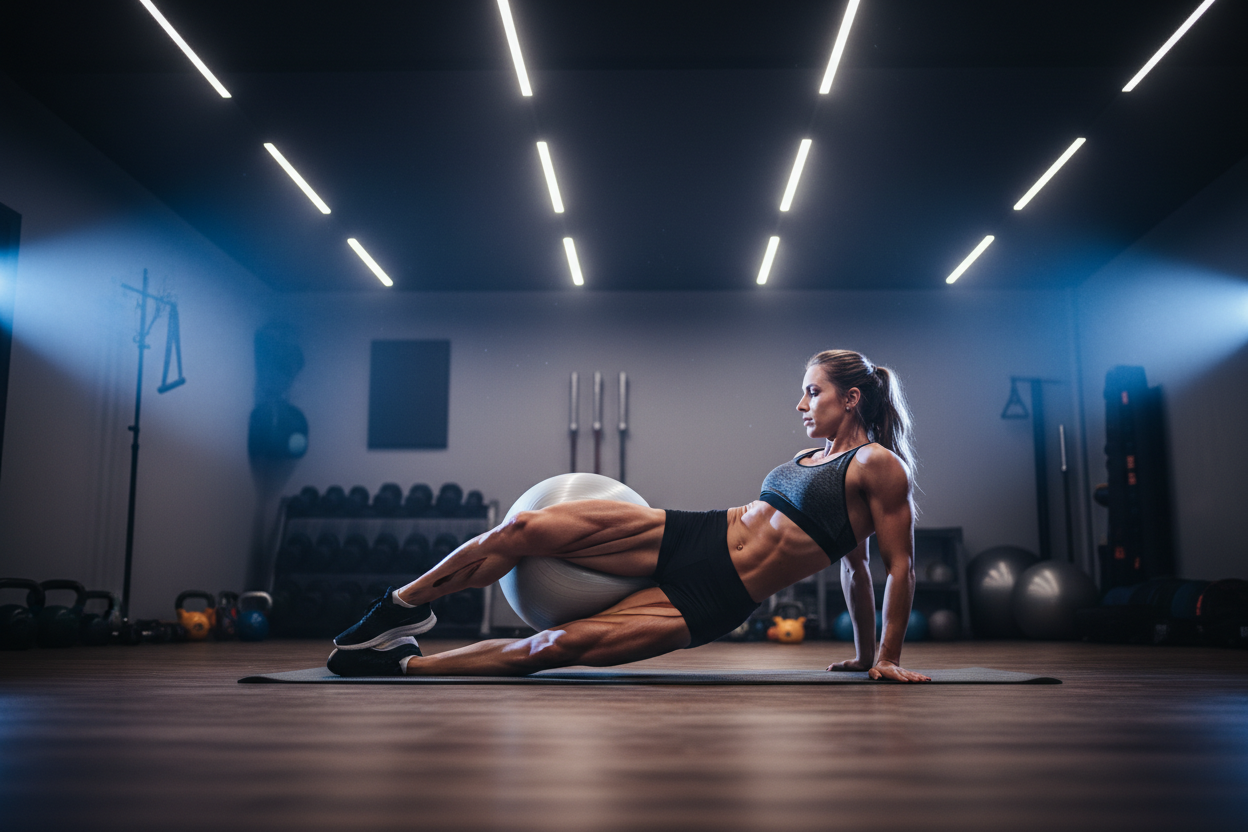
How to do it: Lie on your side. Cross your top leg over the bottom leg, planting the foot on the floor. Keep the bottom leg straight and lift it toward the ceiling. Pause at the top for two seconds, then lower slowly.
4. The Isometric Pillow Squeeze
Don't laugh at the simplicity. Isometric holds are fantastic for tendon health. This is one of the easiest home adductor exercises to integrate into a daily routine.
How to do it: Lie on your back with knees bent. Place a firm pillow, yoga block, or medicine ball between your knees. Squeeze as hard as you can for 10 seconds. Relax. Repeat for 5 rounds.
Common Mistakes with Bodyweight Adductor Exercises
Even with at home adductor exercises, form breakdown is common. The biggest error is using momentum. When doing leg lifts or lunges, swinging the leg bypasses the muscle belly and puts stress on the hip joint.
Another issue is ignoring the "eccentric" (lowering) phase. During the sliding lunge, if you just drop down without controlling the slide, you miss half the growth potential. Control the descent to maximize fiber recruitment.
My Training Log: Real Talk
I want to be transparent about my personal experience with hip adductor workout routines, specifically the Copenhagen Plank. The first time I tried these, I thought, "It's just a side plank, how hard can it be?"
I was humbled immediately. I set up using a dining room chair. Within 15 seconds, the adductor on my top leg wasn't just burning; it was vibrating. But the real "gotcha" moment wasn't the muscle failure—it was the pressure on my inner ankle bone.
If you are doing these at home, do not rest your bare ankle on a hard surface. It feels like you are grinding the bone directly against wood. I had to grab a thick couch cushion to place under my foot. Also, the day after that first session, I felt a weird soreness—not deep in the muscle, but right up near the groin attachment point. It felt sketchy, like I was on the verge of a pull. That taught me a valuable lesson: regression is key. I switched to the bent-knee variation for three weeks before I earned the right to do the full straight-leg version.
Conclusion
Building strong legs isn't just about quads and hamstrings. Integrating a dedicated hip adductor at home session will fill the gaps in your lower body strength, improve your main lifts, and keep your knees healthy. Start with the Copenhagen plank and lateral lunges, stay consistent, and you will feel the difference in your stability within weeks.
Frequently Asked Questions
Can I build mass with adductor at home exercises?
Yes. While heavy weights are great for max strength, bodyweight adductor exercises like the Copenhagen plank provide immense tension. By increasing the time under tension or the leverage (moving the bench further down your leg), you can stimulate significant hypertrophy.
How often should I perform these exercises?
The adductors are relatively small muscles that recover quickly, but they can be prone to soreness. Aim for 2 to 3 times per week. You can add 1 or 2 exercises to the end of your regular lower body sessions.
Do I need equipment for effective home adductor exercises?
No. You can perform a comprehensive routine using just your body weight, a smooth floor (for sliding lunges), and a chair or couch. Resistance bands can be added later for progression, but they are not mandatory for starting.


