The Truth About Building Big Legs: A Hamstring Hypertrophy Guide
Walking into most commercial gyms, you will see row after row of people hammering away at leg extensions and leg presses. The result is often a physique that looks impressive from the front but disappears entirely when viewed from the side. The hamstrings are the biceps of the lower body, yet they rarely get the attention they deserve. If you want legs that fill out your jeans and provide a stable base for heavy lifting, you have to stop treating your posterior chain as an afterthought. Building thick, dense hamstrings requires a specific approach that differs significantly from how you train your quads.
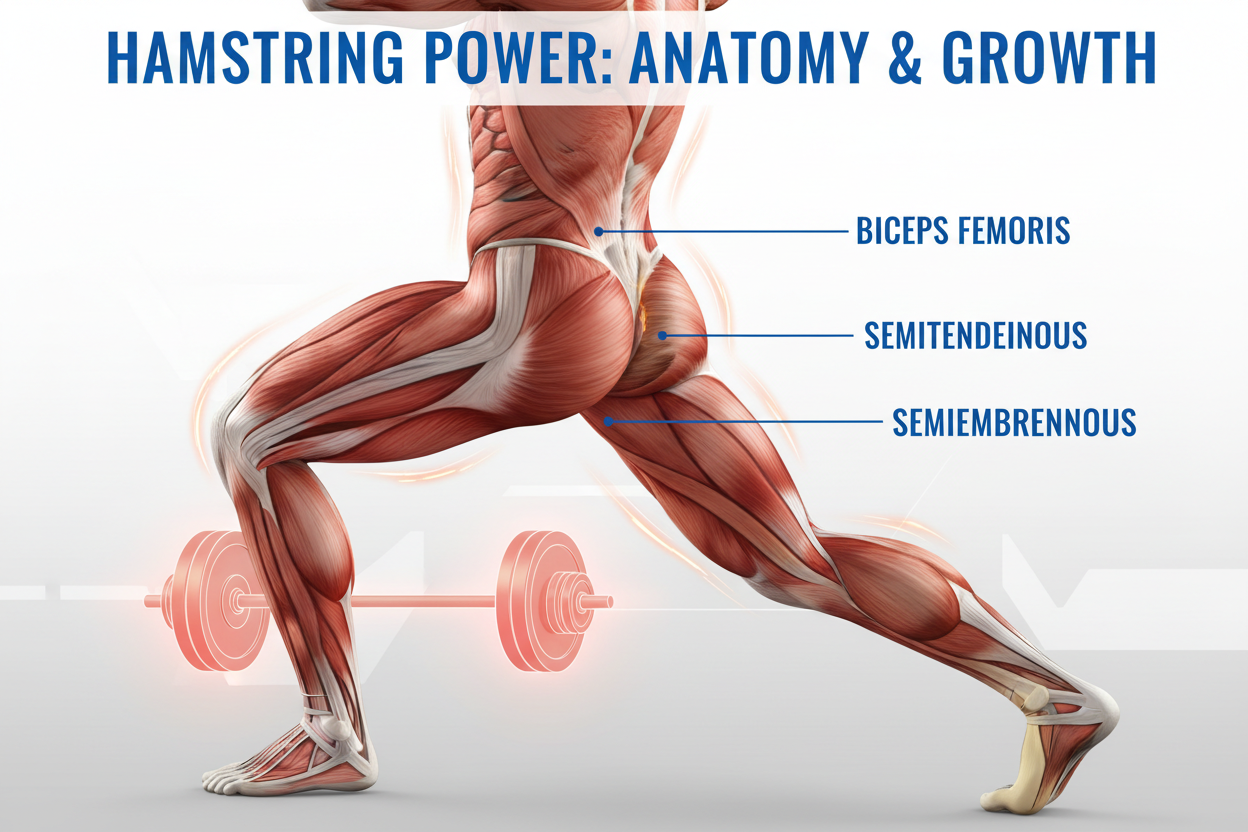
Understanding the Anatomy of Growth
To effectively target these muscles, you need to understand what they actually do. The hamstring group crosses two joints: the hip and the knee. This means they are responsible for extending the hips (thrusting forward) and flexing the knee (bringing your heel to your glute). Many lifters make the mistake of only training one of these functions, usually by throwing in a few sets of lying leg curls at the end of a workout.
Complete development requires hitting both movement patterns with high intensity. The best hamstring exercises for mass will always fall into two categories: hip hinges and knee flexion movements. Neglecting either one leaves potential growth on the table and creates structural imbalances that can lead to injury.
My Battle with Weak Hamstrings
I learned this lesson the hard way a few years back. I was obsessed with squatting heavy, and my quads were growing, but my deadlift had plateaued hard. Worse, I started developing nagging knee pain that wouldn't go away. I realized my hamstrings were virtually non-existent compared to my quads. I had to swallow my pride, drop the weight on my squats, and dedicate entire sessions to my posterior chain. I started prioritizing Romanian Deadlifts and strict, controlled curls. Within six months, not only did my legs look completely different, but my knee pain vanished, and my conventional deadlift shot up by 50 pounds. It wasn't magic; it was just balance.
The Hip Hinge: The Foundation of Mass
If you want size, you need to move heavy loads through a full range of motion. The Romanian Deadlift (RDL) is arguably the king of posterior chain movements. Unlike a conventional deadlift where the quads help break the floor, the RDL keeps the tension almost exclusively on the hamstrings and glutes.
The key here is the "hinge." You aren't just bending over; you are pushing your hips back as if trying to close a car door with your glutes. Keep a slight bend in your knees, but don't turn it into a squat. Lower the bar only as far as your flexibility allows while maintaining a flat back. You should feel a deep, painful stretch in the belly of the muscle. This stretch under load is a primary driver of hypertrophy.
Stiff-Legged Deadlifts vs. RDLs
People often confuse these. In a stiff-legged deadlift, the bar starts from the floor every rep, and your legs are straighter. This removes the stretch reflex and forces a dead-stop contraction. For pure mass, the RDL is generally superior because the constant tension and the focus on the eccentric (lowering) portion of the lift create more muscle damage, which signals the body to repair and grow.
Knee Flexion: Isolating the Muscle
While heavy hinges build the density, knee flexion exercises build the "hang" of the hamstring. This is where the seated leg curl shines. Biomechanics research suggests that the seated leg curl is actually superior to the lying leg curl for hypertrophy. Sitting flexes your hips, which puts the hamstrings in a stretched position before you even start the movement. Training a muscle at long muscle lengths is highly correlated with greater growth.
When performing these, forget about moving the whole stack. Lock your body into the machine. Drive your hips down into the pad and dorsiflex your ankles (pull your toes toward your shins). Perform the rep with a controlled tempo—explode down, pause for a second, and take three full seconds to let the weight up. If you are bouncing the weight, you are training your ego, not your legs.
The Nordic Curl
For those lacking equipment or wanting an athletic carryover, the Nordic hamstring curl is brutal but effective. You kneel on a pad with your ankles secured and lower your torso toward the ground as slowly as possible using only your hamstrings. Most people cannot do a full concentric rep (pulling themselves back up) without using their hands, and that is fine. Focus entirely on resisting gravity on the way down. This eccentric overload creates massive tension.
Constructing the Workout
You cannot just throw these exercises together randomly. The best hamstring workout for mass needs to manage fatigue while ensuring high stimulus. Since the hamstrings are fast-twitch dominant, they respond well to lower reps on heavy compounds and moderate reps on isolation movements.
A highly effective session structure looks like this:
- A. Seated Leg Curls: 3 sets of 12-15 reps. Start here to pre-exhaust the hamstrings and warm up the knees. Focus on the squeeze.
- B. Romanian Deadlifts (Barbell or Dumbbell): 4 sets of 6-10 reps. Go heavy. Focus on the stretch and keeping a neutral spine. Rest periods should be longer here, around 2-3 minutes.
- C. Glute-Ham Raise or Nordic Curls: 3 sets to failure (focusing on the lowering phase).
- D. Walking Lunges (Long Stride): 2 sets of 20 steps. Taking a long stride biases the hamstrings and glutes over the quads.
Volume and Frequency
Hamstrings are notorious for getting sore, especially if you emphasize the stretch in the RDL. If you are new to prioritizing them, start with lower volume. Training them twice a week is usually the sweet spot for hypertrophy. You might do a heavy hip-hinge focus on your "Leg Day A" and a machine-curl focus on "Leg Day B." This ensures you are hitting both functions of the muscle without crippling yourself for the rest of the week.
Consistency is the final variable. You won't see changes in two weeks. The posterior chain is stubborn. But if you commit to the stretch, control the eccentric, and progressively overload your lifts, your legs will transform from simple pillars into complex, powerful anatomy.
Frequently Asked Questions
Should I train hamstrings before or after quads?
If your hamstrings are a weak point, train them first. Prioritizing them when your energy levels are highest ensures you can lift heavier loads with better focus. If you wait until after heavy squats, your RDL performance will suffer due to fatigue.
Why do I feel RDLs in my lower back instead of my legs?
This usually happens because you are bending at the waist rather than hinging at the hips, or the weight is too far from your body. Keep the bar shaving your legs throughout the movement and focus on pushing your butt back toward the wall behind you, rather than leaning forward.
Can I build mass with just bodyweight exercises?
It is difficult but possible with high intensity. Nordic curls are the gold standard for bodyweight hamstring training and provide enough resistance to stimulate significant growth. However, adding external load via deadlift variations is generally faster for maximum hypertrophy.