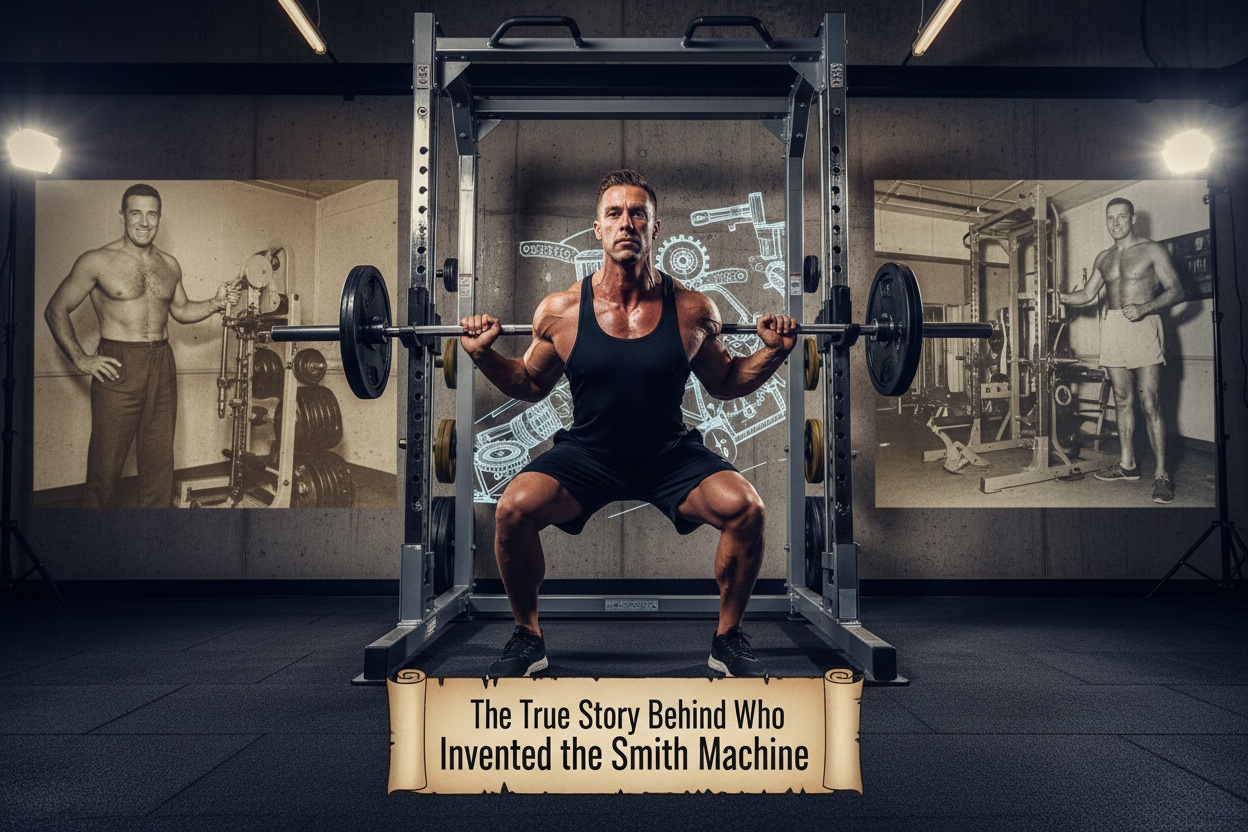
The True Story Behind Who Invented the Smith Machine
Walk into any commercial gym from Los Angeles to London, and you will see it. It stands tall, usually occupied, and often the subject of intense debate among lifters. But few stop to ask who invented the smith machine or how it ended up in nearly every fitness facility on the planet.
The history isn't as straightforward as a single patent. It involves the father of modern fitness, a gym executive with an eye for business, and a makeshift garage prototype. If you think a guy named Smith woke up one day with the idea, you only have half the story.
Key Takeaways: The Origin Story
- The Concept Creator: Jack LaLanne is credited with creating the original sliding rack mechanism in the 1950s.
- The Namesake: Rudy Smith, a gym executive, saw LaLanne's prototype and commercialized it.
- The Engineer: Paul Martin was hired by Smith to improve the design for mass production.
- The Purpose: Originally designed to allow lifters to squat and press heavy weights without a spotter.
The Godfather of Fitness: Jack LaLanne's Prototype
Before we talk about Smith, we have to talk about Jack LaLanne. Often called the "Godfather of Fitness," LaLanne was a pioneer who invented much of the equipment we take for granted today, including the leg extension machine and pulley systems.
In the early 1950s, LaLanne wasn't satisfied with the safety of free weight squatting alone. He wanted a way to push his limits without the risk of getting pinned under a heavy barbell if he failed a rep.
LaLanne rigged up a sliding apparatus in his gym. It was a primitive setup—essentially a barbell attached to a sliding mechanism that moved vertically within a rack. This allowed for a self-spotting mechanism. However, LaLanne was more interested in training than manufacturing. He rarely patented his inventions, preferring to simply use them to get stronger.
Enter Rudy Smith: The Man Who Commercialized It
So, why is it called a smith machine if LaLanne built the first one? This is where business meets innovation.
Rudy Smith was an executive at Vic Tanny's, a famous chain of gyms during the golden era of bodybuilding. While visiting LaLanne's gym, Smith noticed the sliding rack apparatus. He immediately recognized the commercial potential. In a busy gym environment, liability is a major concern. A machine that allowed members to squat safely without needing a staff member to spot them was a goldmine.
Smith took the concept to Paul Martin, a talented engineer. Together, they refined LaLanne's rough prototype. They improved the gliding mechanism and added the distinct hook-and-catch system that allows you to lock the weight at any height with a simple twist of the wrist.
Because Rudy Smith was the one who commissioned the final design, arranged for its manufacturing, and installed it in Vic Tanny's gyms across the country, it became known colloquially—and eventually officially—as the "Smith Machine."
The Evolution of the Design
The machine you use today is slightly different from the 1950s version. The original machines moved in a strictly vertical plane. While efficient, this doesn't perfectly mimic the natural arc of a human body during a press or squat.
Vertical vs. Angled Rails
Modern iterations often feature a slight angle (usually 7 to 12 degrees). This change was made to better accommodate the natural path of the bar during a bench press or squat, reducing shear force on the joints. However, purists still argue that the fixed path—whether vertical or angled—removes the need for stabilizer muscles, which is the primary criticism of the machine today.
Counterbalance Systems
Another addition by later engineers was the counterbalance system. If you look at the top of a high-end Smith machine, you will see pulleys and weights hidden in the frame. These counterweights reduce the starting weight of the bar (which can weigh 45-50 lbs on its own) to practically zero, making the machine accessible for rehabilitation and beginner lifters.
My Training Log: Real Talk
I've spent years under both free barbells and guided rails, and I want to share my personal experience with who invented the smith machine—or rather, the machine they left us with. History is great, but how it feels is what matters.
The first thing you notice on an older or poorly maintained Smith machine is the "drag." There is a specific, gritty vibration that travels down the bar and into your palms if the guide rods haven't been greased recently. It's a sensation you don't get with free weights. It feels like the machine is fighting you on the eccentric (lowering) phase.
Also, the "wrist flick" is a learned skill. I remember doing heavy shrugs on a Smith machine in a gym in Ohio. I was near failure, my grip was frying, and I tried to rack the weight. I didn't rotate my wrists back far enough. The hook slammed against the catch—CLACK-CLACK-CLACK—skipping three slots before finally locking in. That sound is unmistakable. It’s the sound of almost losing it.
While I prefer free weights for main compounds, I credit the Smith machine for my calf development. Standing on a block and using that fixed rail allows for a stretch at the bottom that feels safer than balancing a free barbell on my traps. It has its place, regardless of what the internet purists say.
Conclusion
The Smith machine is a hybrid of Jack LaLanne's ingenuity and Rudy Smith's business acumen. It solved a specific problem: how to lift heavy safely without a partner. While it shouldn't replace every free weight exercise in your program, understanding its history helps you appreciate it as a tool for hypertrophy and safety, rather than just a rack that takes up space.
Frequently Asked Questions
Did Jack LaLanne invent the Smith Machine?
Yes, Jack LaLanne invented the original concept and prototype of the sliding rack mechanism in the 1950s to allow for safer solo squatting. However, he did not patent or mass-produce it.
Why isn't it called the LaLanne Machine?
It is not called the LaLanne machine because Rudy Smith was the executive who recognized its commercial potential, refined the design with engineer Paul Martin, and distributed it to gyms nationwide.
When was the Smith Machine invented?
The original concept was developed by Jack LaLanne in the early 1950s. The commercial version developed by Rudy Smith began appearing in Vic Tanny's gyms shortly thereafter, becoming a staple by the late 1950s.