The Secret to a Faster, Safer Workout Isn't the Weights—It's How You Store Them
Walk into any high-performance training facility, and you will notice something immediately: the floor is clear. The energy in the room feels different when you aren't navigating a minefield of cast iron and rubber. While most lifters obsess over the specific brand of plates or the knurling on a bar, the unsung hero of workout efficiency is actually organization. Specifically, the ability to grab a pre-loaded bar, perform a set, and return it instantly to its designated spot defines the rhythm of a serious session. This flow is impossible without the right infrastructure supporting your movement.
Efficiency in the gym is not just about saving time; it is about maintaining intensity. When you are in the middle of a metabolic conditioning circuit or a high-volume hypertrophy block, your heart rate is the metric that matters. Stopping to load plates onto an Olympic bar for a set of curls, then unloading them to change the weight for skull crushers, kills your momentum. This is why pre-loaded bars are a staple in commercial settings, and why a sturdy fixed barbell rack is often the centerpiece of the free weight area. It transforms a collection of metal into a functional system that allows you to train without logistical pauses.
The Real Impact on Training Intensity
There is a distinct psychological shift that happens when you have immediate access to a full run of weights. Consider the mechanics of a drop set. You might start bicep curls at 80 pounds, rep to failure, and immediately need to drop to 60, then 40. If you have to stop and change plates, the physiological stress on the muscle dissipates. The metabolic accumulation—the "pump"—fades.
Having a vertical or horizontal storage solution allows you to move down the rack seamlessly. You simply rack the heavy bar and unrack the lighter one in a single motion. This accessibility turns a standard workout into a high-intensity session. The equipment facilitates the technique. Without a proper fixed weight barbell rack holding a sequence of straight or EZ-curl bars, these advanced intensity techniques become clumsy and far less effective.
I learned this lesson the hard way during my early years of lifting in a garage gym that lacked proper storage. I was attempting a complex superset involving upright rows and overhead extensions. Because I didn't have a dedicated place to set the bars, I was placing them on the floor between sets. By the third round, fatigue set in, my foot caught the edge of a curling bar I had carelessly rolled aside, and I nearly twisted my ankle while holding a 40-pound weight. It was a wake-up call. The clutter wasn't just annoying; it was a genuine hazard that compromised my safety and broke my focus. Investing in proper storage wasn't just about tidiness; it was about respecting the training environment.
Protecting Your Investment and Yourself
Beyond the flow of the workout, there is the matter of equipment longevity. Fixed barbells are expensive. whether they are urethane-coated, rubber-encased, or classic steel, they represent a significant financial outlay. Leaving them on the ground exposes them to moisture, dirt, and unnecessary impact. A bar left on the floor is a bar that gets stepped on, kicked, or rolled over by heavy benches.
A quality fixed barbell rack protects the equipment by keeping it elevated and spaced. The contact points on these racks usually feature protective lining—often a heavy-duty plastic or rubber composite—that prevents metal-on-metal contact. This preserves the knurling on the handles and keeps the coating on the weights intact. If you have ever picked up a bar with rusted knurling or chipped rubber, you know how unappealing it is to use. Proper storage extends the lifespan of these tools by years.
Identifying the Right Storage Configuration
Not all storage solutions serve the same purpose. The layout of your training space dictates what kind of rack you need. In tighter spaces, such as home gyms or smaller personal training studios, an A-frame design is often superior. It utilizes vertical space, stacking the bars in a compact footprint. However, you need to be mindful of stability; removing heavy bars from the top while the bottom is empty can sometimes make cheaper units top-heavy.
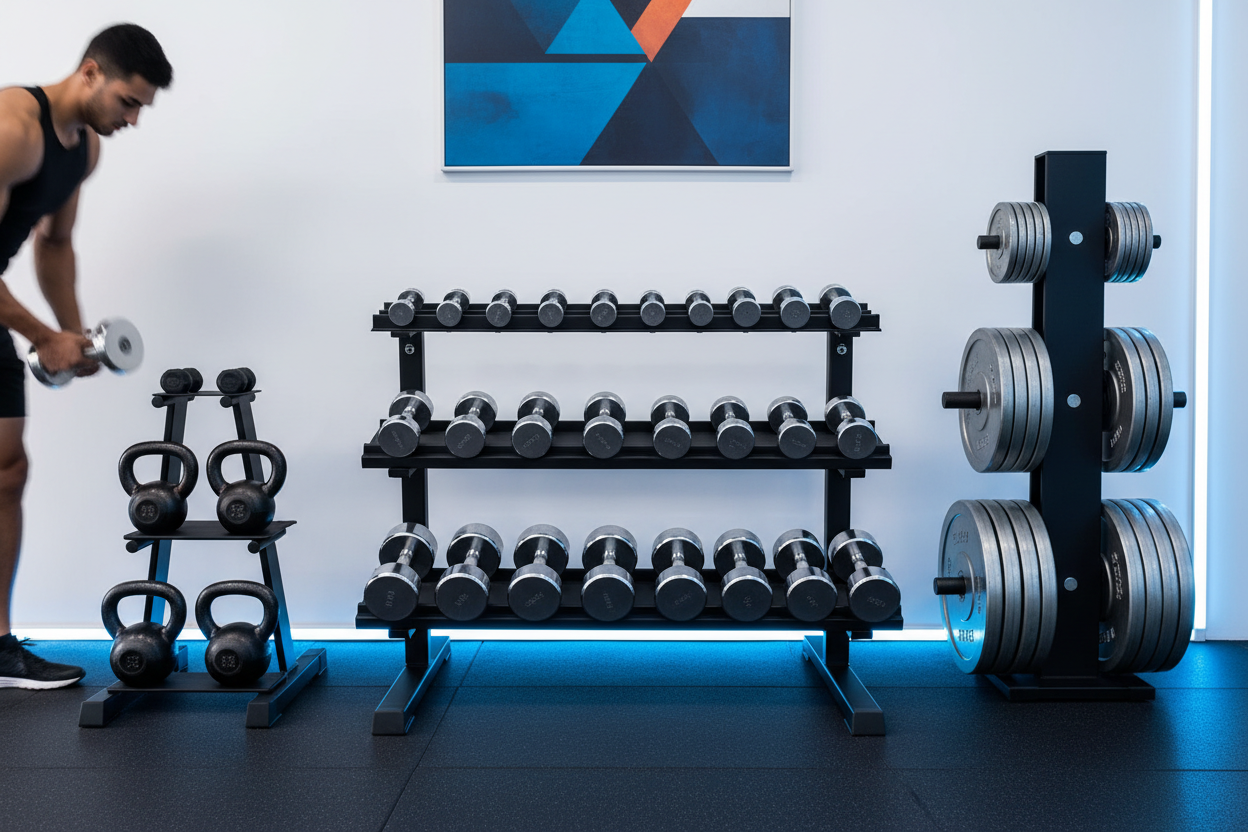
For larger facilities with a full run of weights (usually 20 lbs up to 110 lbs), a horizontal, double-sided fixed weight barbell rack is the standard. These allow for easier access because you don't have to reach over other bars to get to the one you want. They also tend to be more stable due to a wider base. When selecting a rack, look for heavy-gauge steel tubing and welded joints. Bolt-together units are fine for light home use, but for heavy fixed bars, a fully welded frame offers the rigidity needed to handle hundreds of pounds of static load without wobbling.
The Safety Factor in Shared Spaces
If you run a commercial facility or even a garage gym where friends train, liability and safety are constant concerns. Trip hazards are the most common cause of gym injuries that aren't related to the actual lifting of weights. A stray barbell is round; it rolls. If a floor is slightly uneven, a bar placed on the ground can easily migrate into a walkway.
Dedicated storage creates a culture of discipline. When there is a specific slot for the 60lb bar, users are psychologically more inclined to put it back. It signals that the space is professional and cared for. Conversely, if the gym owner doesn't provide a fixed barbell rack, it implicitly tells members that leaving weights on the floor is acceptable behavior. This leads to a chaotic environment where focus is lost, and the risk of injury skyrockets.
Ultimately, the quality of a workout is determined by the absence of friction. You shouldn't have to fight your environment to get a good session in. The iron should be heavy, the effort should be high, but the logistics should be invisible. By prioritizing organization and proper equipment housing, you clear the path for the only thing that actually matters: progressive overload and consistent effort.
Frequently Asked Questions
What is the difference between a fixed barbell and an Olympic barbell?
An Olympic barbell is a standard bar (usually 45 lbs) with rotating sleeves that allows you to add or remove weight plates manually. A fixed barbell has the weights permanently attached to the bar, meaning you cannot adjust the weight, but you can switch between different bars rapidly without loading or unloading.
Do I need a specific rack for curling bars versus straight bars?
Generally, no. Most standard racks are designed to accommodate the inner shaft length of both straight bars and EZ-curl bars. However, you should measure the distance between the weight heads on your shortest bar to ensure the rack's uprights aren't too wide to support it.
How much space do I need for a commercial-style barbell rack?
A standard horizontal rack holding 10 bars typically requires a footprint of about 3 feet by 4 feet, but you must account for clearance. You need at least 2 feet of open space on the side where you access the weights so you can safely remove a bar without hitting a wall or other equipment.