The Pulley Height Mistake Ruining Your Cable Shoulder Fly
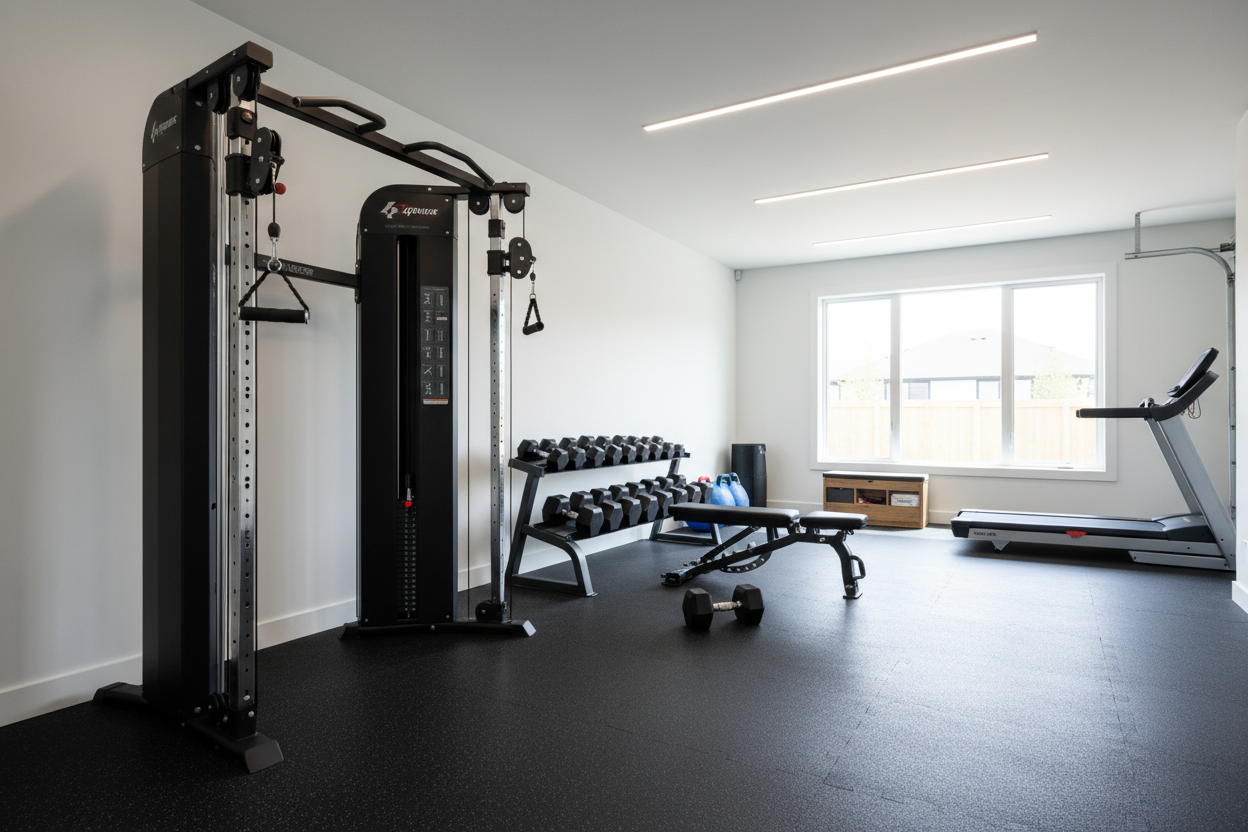
I remember dragging my old adjustable bench into the middle of my garage, trying to mimic a seated lateral raise with a pair of rusty 20s. The tension was non-existent at the bottom and then suddenly slammed my joints at the top. When I finally upgraded to a functional trainer, I thought I had solved the problem, but I was still performing the cable shoulder fly with the same flawed logic.
- Stop setting the pulley at the floor peg; it kills the tension curve.
- Align the pulley with your wrist or knee height for maximum delt engagement.
- Use cuffs instead of handles to eliminate grip fatigue.
- Aim for high-volume sets in the 12-20 rep range.
Why I Stopped Treating Cables Like Dumbbells
Most home gym owners treat their cable machine like a fancy, expensive dumbbell stand. They drop the pulley to the lowest possible peg because that is where a dumbbell starts its journey. It is a waste of a machine that likely cost you four figures. When the cable starts at the floor, there is almost zero tension on the side deltoid at the beginning of the movement. You are essentially just swinging the weight until it hits the mid-point of the arc.
I spent months doing this, wondering why my shoulders felt more worked during my warm-up presses than my isolation work. The cable should be an upgrade, not a mirror. If you wanted the resistance to drop off at the bottom, you would have stayed with the dumbbells.
The Biomechanics of a Real Cable Shoulder Fly
Your side delts are mechanically weakest at the very beginning and the very end of the range of motion. Pulleys are the best machine for shoulders because they can provide tension where gravity fails, but only if the angle of pull is correct. For a shoulder fly cable movement to work, the cable needs to be pulling across your body, not just straight up from the floor.
By adjusting the starting position, you change the 'moment arm.' You want the heaviest part of the lift to align with the strongest part of your muscle's range. If the pulley is at the floor, the cable is almost parallel to your arm at the start, which provides zero effective resistance to the deltoid. We need that cable perpendicular to the arm as soon as possible.
The Wrist-Height Rule That Changes Everything
Here is the fix I use in my own training: Raise the pulley to roughly the height of your wrist when your arm is hanging at your side, or about knee height. This simple tweak ensures that when you grab the handle, the cable is already at a significant angle to your arm. As soon as you move your hand even three inches away from your thigh, your delts are under fire.
This makes the cable fly for shoulders significantly harder. You will likely have to drop the weight on the stack by 10 or 15 pounds. Don't let your ego get in the way. The goal isn't to move the stack; it is to make the side deltoid scream. At this height, the tension remains constant from the first inch to the last.
D-Handles vs. Cuffs: Taking Grip Out of the Equation
Standard D-handles are the default, but they aren't the best. Your forearms and grip will almost always give out before your shoulders do, especially on high-rep sets. I switched to using ankle cuffs wrapped around my wrists. It is a total shift in how the movement feels. By removing the hand from the equation, you can focus entirely on driving your elbows out to the walls.
When I am doing heavy unilateral work, I make sure I am grounded. I prefer standing on a large exercise mat for home gym setups rather than slick concrete. If your feet are sliding or you are struggling for stability, you cannot generate maximum force. A solid base allows you to lean slightly away from the machine, further increasing the range of motion for the cable fly shoulders.
Programming the Cable Fly Shoulders Routine
This is an isolation movement, not a power lift. I typically slot these at the end of an upper-body session or right after my heavy overhead pressing. Since the side delts can handle a lot of volume and recover quickly, I aim for 3 to 4 sets of 12 to 20 reps. The pump is intense, and the injury risk is low compared to heavy upright rows.
I often pair these with a cable shoulder pull to ensure the rear delts get equal love. Keeping the rest periods short—around 45 to 60 seconds—keeps the intensity high without needing to load every plate on the machine. My side delts have grown more in the last six months of using this 'wrist-height' method than they did in three years of floor-peg raises.
How high should I raise my hand?
Stop when your hand is level with your shoulder. Going any higher shifts the tension from the deltoid to the upper traps, which defeats the purpose of the isolation.
Should I lean away from the machine?
A slight lean (about 10-15 degrees) can help increase the stretch at the bottom, but don't overdo it. If you're leaning so far you're falling over, you're losing the stability needed to grow.
Can I do this with a resistance band?
You can, but bands have an ascending resistance—they get harder at the top and have almost no tension at the bottom. A cable machine is superior because the weight is constant throughout the entire arc.