The Perfect Starting Dumbbell Weight Is Lighter Than You Think
I remember standing in a big-box sporting goods store a decade ago, staring at a rack of iron and feeling like a total chump for even looking at the 15-pounders. I wanted to walk out with the 50s because that is what 'real' lifters use. But choosing the right dumbbell weight isn't about looking cool in the checkout line; it's about not tearing a rotator cuff three weeks into your new routine. I've seen too many guys blow their budget on heavy iron they can't actually move with anything resembling good form.
- Start with a weight you can overhead press 10-12 times with zero momentum.
- Your legs are 2-3x stronger than your arms; one single pair of weights rarely covers both.
- Adjustable dumbbells save massive floor space but fixed hex bells are virtually indestructible.
- Avoid 'beginner sets' that top out at 10 lbs—you'll outgrow those in a week of consistent training.
The Ego Trap of Buying Your First Set
We have all been there. You see a 'good starting dumbbell weight' guide online and think you are the exception to the rule. You buy a pair of 45s, try to curl them, and end up using more body swing than a playground. Buying too heavy too fast is the quickest way to turn your home gym into a graveyard of expensive, dusty paperweights. When you are asking what weight dumbbells should i use, the answer is usually 5 pounds lighter than your ego wants to admit.
The goal is progressive overload, not immediate max-out. If you buy a normal dumbbell weight like a 25-lb pair and can only do three ugly reps, you aren't building muscle—you're just practicing how to get injured. You need a starting weight for dumbbells that allows for a full range of motion so your joints actually adapt to the load.
The Overhead Press Test for Your Starting Point
Here is the foolproof, real-world test to find your baseline weight for dumbbells. Go to a store, grab a pair, and try to press them over your head while standing. If you can do 12 reps without arching your back like a bridge or shimmying your hips, that is your 'medium' weight. This will be your workhorse for chest presses, rows, and overhead work. I actually I Built an Exercises for Shoulders Dumbbell Routine Using One Weight recently that proves you don't need a massive rack to get results if the weight is right.
For most men, a good starting dumbbell weight for upper body movements falls between 15 and 25 lbs. If you are looking for the best dumbbell weight for beginners who have never lifted a thing, 15 lbs is the sweet spot. It is heavy enough to feel like work but light enough to keep your form tight during lateral raises and rear delt flies.
Why Your Legs Demand a Completely Different Setup
Your quads and glutes are massive muscle groups. The 20-lb dumbbell weight for beginners male lifters use for biceps will feel like a feather when you are doing goblet squats or lunges. To get a real leg workout, you need a way to stabilize and likely a heavier load. I usually pair my heavier sets with a Gxmmat Adjustable Weight Bench for Bulgarian split squats. Without a bench, you are just doing awkward standing lunges that don't hit the target depth.
If you are wondering how heavy dumbbells do i need for legs, aim for something 15-20 lbs heavier than your upper body weight. If you press 20s, you should be squatting at least a single 40 or 50-lb bell. This is where the 'one size fits all' approach to buying dumbbell weight sizes usually fails.
Adjustable vs. Fixed: What Should You Actually Buy?
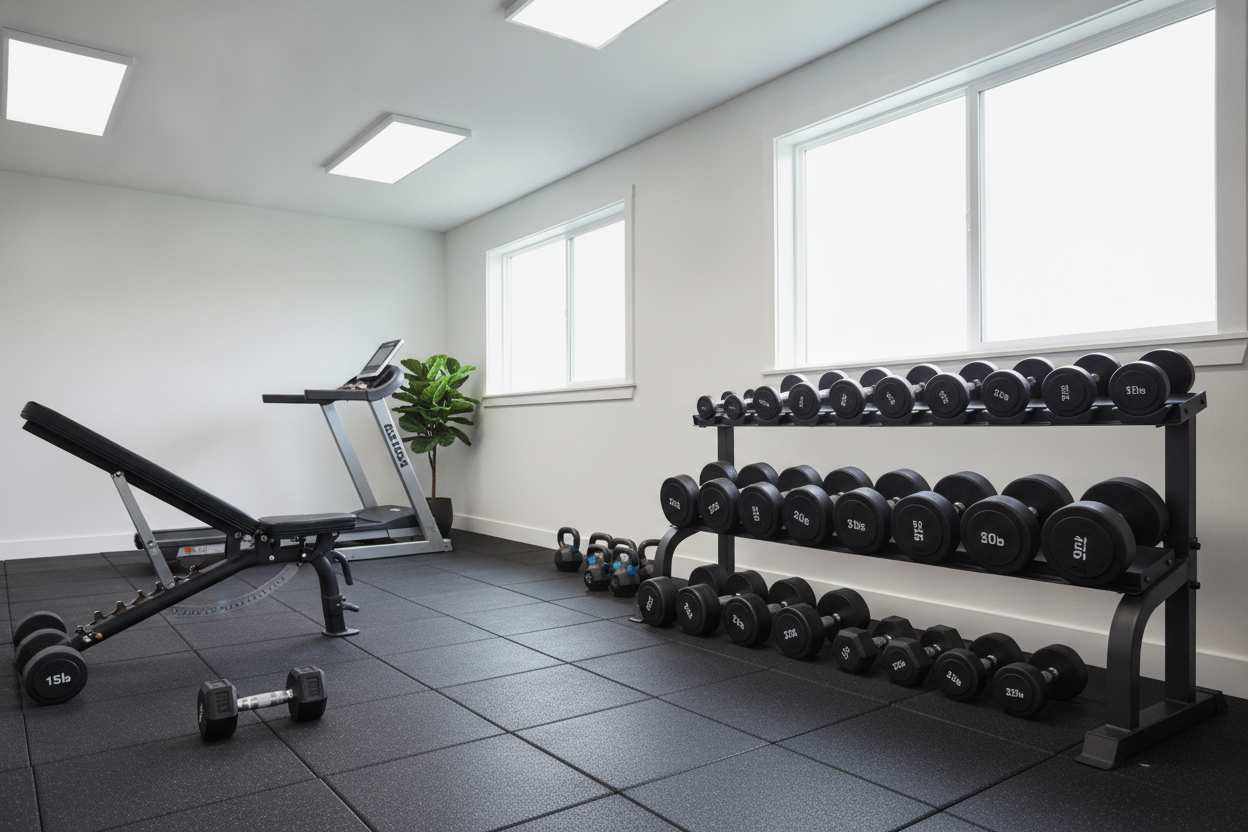
If you have the cash and the 100-square-foot wall space, a full rack of rubber hex dumbbells is the dream. They don't rattle, and you can drop them without the fear of internal plastic gears snapping. But for most of us, a pair of adjustables is the smarter play. You are looking at about $300-$400 for a decent pair that replaces 15+ sets of weights. When you calculate how much dumbbell weight costs per pound, adjustables win every time.
Fixed weights are better if you do a lot of 'drop sets' where you need to switch weights instantly. But if you're just starting, the best dumbbell weight to build muscle is the one that gives you room to grow. A set of adjustables that goes up to 50 or 52.5 lbs will keep you busy for at least two years of solid training.
What About Female Lifters Sharing the Gym?
Don't buy into the 'pink' marketing. Physics does not care about gender. While the average dumbbell weight for a man might start a bit higher, the mechanics of what size hand weights to use remain the same. Avoid the tiny 2-lb neoprene weights unless you are doing physical therapy. Check out this guide on Exactly What Size Weight Should a Woman Use (No Pink Dumbbells) to avoid the 'toning' weight trap that keeps people from seeing real strength gains.
The Final Verdict: Buy Only What You've Earned
Don't buy a 5-100 lb set today. Buy a pair of 15s and a pair of 30s. Or buy one solid set of adjustables. You have to earn the 50s. Once you can hit 15 reps of a goblet squat with perfect depth using your 'heavy' pair, then you go back to the store. That is the best weight for dumbbells—the one that challenges you today but leaves you room to be better tomorrow.
What size dumbbells should I start with?
Most men should start with 15-20 lb weights for upper body and 30-35 lbs for lower body. Women typically find 8-12 lbs a great starting point for presses and rows.
How heavy should dumbbells be for building muscle?
Heavy enough that the last 2 reps of a 10-rep set are a struggle, but not so heavy your form breaks. This is usually 60-80% of your maximum effort.
How many dumbbells do I need?
At minimum, you need two pairs: one light/medium for shoulders and arms, and one heavy for chest and legs. Alternatively, one pair of adjustable dumbbells covers all bases.