The Only Bodyweight Exercises Equipment Worth Buying
I remember the exact moment I realized the fitness industry was gaslighting me. I was standing in a big-box sporting goods store, staring at a $400 'bodyweight gym machine' that looked like a rejected Transformer. It was six feet tall, wobbled when I touched it, and took up more floor space than my actual car. The irony was thick: I was looking for bodyweight exercises equipment to simplify my life, yet here I was considering a massive piece of hardware to help me move my own mass.
- Gymnastics rings offer more versatility than any $1,000 machine.
- Avoid 'Power Towers'—they are space-wasters with low weight capacities.
- A wall-mounted pull-up bar is a non-negotiable foundation.
- High-density flooring is essential for joint health during floor work.
Why the Fitness Industry Wants to Complicate Calisthenics
The 'bodyweight gym' market is a goldmine for companies because they know people want the results of gymnastics and calisthenics without the steep learning curve. They try to sell you a 'body weight training equipment' solution that promises to make the hard stuff easy. In reality, they are just selling you expensive levers and pulleys that strip away the stabilization benefits of true bodyweight training.
If a piece of bodyweight equipment has a seat, a weight stack, or a 'patented folding mechanism,' run the other way. Real bodyweight training is about you versus gravity. The gear should only be there to give you a place to hang, push, or pull. My garage is proof that you don't need a mortgage-sized investment to get elite-level strength. You just need gear that won't break when you're mid-muscle-up.
The Core Four: Gear That Actually Earns Its Keep
When I evaluate equipment for bodyweight training, I have three rules: it must be bulletproof, it must fit in a corner, and it must serve at least five different exercises. Most 'bodyweight fitness equipment' fails at least two of these. To build a world-class physique using nothing but your own skin and bone, you only need four specific tools. Anything else is just distracting you from the work.
Gymnastics Rings: The Undisputed King
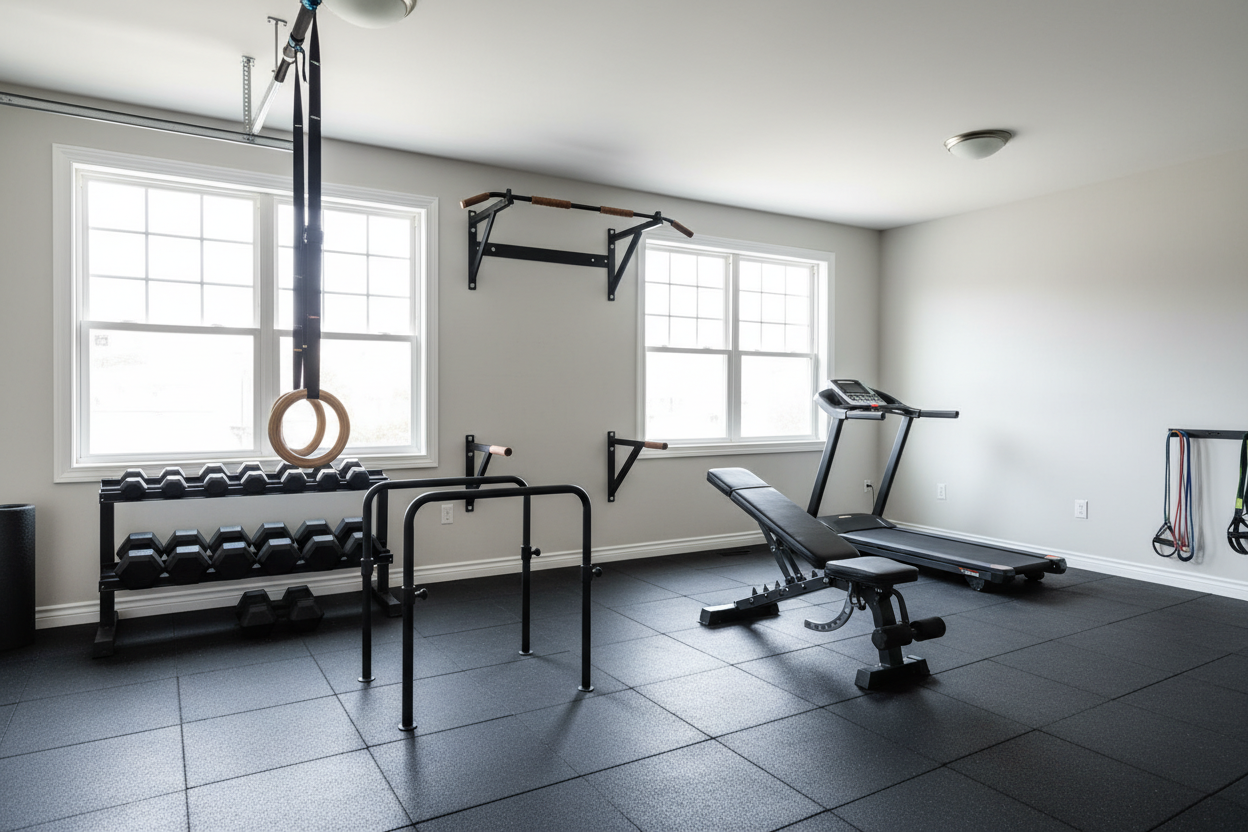
If I could only keep one piece of gear in my entire gym, it would be a pair of wooden gymnastics rings. They are the ultimate body weight training equipment because they are inherently unstable. When you do a dip on a fixed bar, the bar stays still. When you do a dip on rings, your shoulders, core, and stabilizers have to fight to keep the rings from flying outward. That instability is where the magic happens.
Go for wood, not plastic. Plastic rings get slick the second your palms sweat, whereas wood absorbs moisture and provides a tactile grip that feels secure. I look for 1.25-inch rings (the FIG standard) with heavy-duty 1.5-inch straps. You can hang them from a tree branch, a ceiling joist, or a pull-up bar. They scale perfectly—beginners can do inclined rows, while advanced trainees can work toward the iron cross. All for about forty bucks.
A Pull-Up Bar That Won't Destroy Your Doorframe
We've all seen those cheap tension-based doorframe bars. I've used them, and I've also ended up on my tailbone when the rubber pads slipped. If you're serious about bodyweight training, you need a bar that is bolted to something solid. A wall-mounted or ceiling-mounted bar with a 30-inch offset from the wall gives you enough room to kick for kipping pull-ups or tuck for front levers.
Look for a bar with a 1.25-inch diameter and a powder-coated finish. You want a bit of texture so you aren't sliding around, but not so much knurling that it shreds your calluses during high-rep sets. A solid bar should have a weight capacity of at least 400 lbs. If the manufacturer doesn't list a weight capacity, they don't trust their own welds, and neither should you.
Proper Flooring (Because Concrete Hurts)
Doing handstand push-ups or L-sits on bare concrete is a recipe for wrist impingement and bruised knees. A thin yoga mat isn't going to cut it when you start working on explosive movements or high-volume floor work. You need a high-density surface that offers enough cushion to protect your joints but enough firmness that your hands don't sink in during a balance move.
I personally use a large 6x8ft exercise mat in my setup. It covers enough area that I can transition from burpees to mobility work without stepping onto the cold garage floor. It’s thick enough to damp the sound of my landing, which my neighbors appreciate, and it stays put during lateral movements. If you're training barefoot, this is the single best investment for your long-term joint health.
Parallettes Instead of Gimmicky Push-Up Boards
Those color-coded push-up boards you see on social media are plastic junk. They limit your hand positioning and break under heavy load. Instead, get a pair of steel or wooden parallettes. Parallettes allow you to keep your wrists in a neutral position, which is a lifesaver if you have history of carpal tunnel or general wrist pain.
More importantly, they raise you off the ground, allowing for a deeper range of motion on push-ups and providing the clearance needed for L-sits and tuck sits. I prefer the low-profile steel versions that sit about 6 inches off the ground. They are impossible to tip over and can be tossed into a gym bag if you're training at the park. They turn a standard floor workout into a legitimate strength session.
The 'Bodyweight Machines' You Should Never Buy
Let's talk about the 'Power Tower.' Every big-box store sells a version of this wobbly, vertical frame with a pull-up bar and dip station. Most of them have a 250-lb weight limit, which sounds like a lot until you realize that dynamic movement (like a pull-up) exerts way more force than your static weight. I've seen these things tip over during basic leg raises.
If you have enough floor space for a power tower, you have enough space for a squat rack. A rack is infinitely more useful and safer. If you're going to dedicate a 4x4 foot section of your house to a 'bodyweight workout machine,' you’re better off reading a comprehensive weight training equipment guide and buying a half-rack that can actually grow with you. Don't waste money on a weightless workout machine that limits your ceiling height and wobbles every time you try to exert force.
Building Your Bodyweight Home Gym on a Budget
You can build an elite-level setup for less than the cost of a two-month gym membership. Start with the rings and a solid place to hang them. That alone covers 80% of your needs. From there, add the flooring and parallettes. You don't need digital displays, resistance bands with 'smart' sensors, or any of the other fluff that populates the 'bodyweight exercise machine' category.
I’ve made the mistake of buying the 'all-in-one' kits before. They usually come with flimsy straps and plastic handles that feel like they’ll snap. Buy your pieces individually and prioritize heavy-duty materials like steel and hardwood. You can often find current home gym equipment deals that bundle these essentials, but always check the specs first. If it looks like it belongs in a late-night infomercial, it probably doesn't belong in your gym.
My Personal Gear Fail
Five years ago, I bought a 'no-screw' doorway pull-up bar because I didn't want to drill into my rental wall. I was doing a set of weighted chin-ups with a 25-lb plate hanging between my legs. On the third rep, the plastic leverage point snapped. I fell straight down, landed on the plate, and spent three weeks limping. It was a $30 bar that cost me a month of training. Now, I only use wall-mounted bars. If you can't bolt it down, don't hang your body from it.
FAQ
Is wooden or plastic better for gymnastics rings?
Wood is superior. It offers a much better grip when your hands are sweaty and feels more 'natural' for long sessions. Plastic is only better if you plan on leaving them outside in the rain.
Do I really need parallettes?
You don't *need* them, but if you want to master the L-sit or do deep push-ups without killing your wrists, they are the best tool for the job. They are much more effective than those rotating push-up handles.
Can I do a full bodyweight workout with just a pull-up bar?
You can do a lot, but you'll struggle with 'push' movements and core stability. Combining a bar with rings gives you a complete upper-body gym that fits in a backpack.