The L Over Exercise: Build a Bulletproof Core at Home
I still remember training a client in her cramped 400-square-foot apartment during the height of the 2020 lockdowns. She had exactly a 6x4 foot patch of floor space between her couch and coffee table, zero equipment, and a goal to build serious core strength. We couldn't rely on cable machines or heavy dumbbells for rotational work. That is when I introduced her to the l over exercise.
It is a brutal, highly effective bodyweight movement that forces your core to stabilize and rotate under the leverage of your own legs. If you want to develop thick, powerful obliques and a midsection that can actually transfer force, you do not need a massive home gym setup.
Quick Takeaways
- Zero Equipment Needed: Requires only the space of a standard yoga mat (roughly 68 by 24 inches).
- Rotational Power: Targets the internal and external obliques far better than standard crunches.
- Scalable: Easily modified by bending the knees or adding 2 to 5-pound ankle weights.
- Spine Health: Builds anti-rotational and rotational control, protecting the lower back during heavy lifts.
What Exactly is the L Over Exercise?
You might know this movement by its more common gym-bro name: lying windshield wipers. I prefer calling it the L-over because it accurately describes your body's geometry during the setup. You lie flat on your back, extend your legs straight up to the ceiling to form a 90-degree 'L' shape, and slowly lower them over to one side.
Unlike standard sit-ups that only work in the sagittal plane (moving forward and backward), this exercise forces your core to work in the transverse plane. Your abdominal muscles have to hit the brakes as your legs drop to the floor, then aggressively contract to pull them back to the starting position.
As a trainer who specializes in garage gyms and living room setups, I rely heavily on movements that maximize leverage rather than external load. It is a cornerstone of making minimalist exercise work at home. You use the weight of your own legs—which typically account for about 35 to 40 percent of your total body weight—as the primary resistance.
Biomechanics: Muscles Targeted by L-Overs
To understand why this movement is so punishing, you have to look at the anatomy. When you drop your legs to the right, your left obliques are doing the heavy lifting to keep your spine from twisting out of control.
The primary drivers are your internal and external obliques. These muscles run diagonally across your torso and are responsible for rotating your trunk and resisting unwanted rotation. During the eccentric (lowering) phase, they stretch under load, which is exactly how you build dense, visible muscle tissue.
Your transverse abdominis (TVA) acts as a built-in weight belt. This deep core muscle has to stay braced the entire time to keep your pelvis stable. If your TVA disengages, your lower back will immediately arch off the floor, transferring the load straight to your lumbar spine.
Finally, the rectus abdominis (your six-pack muscles) and hip flexors work isometrically. They fire constantly just to hold your legs up in that strict 90-degree L-shape. It is a full-spectrum core contraction that standard machines simply cannot replicate.
Step-by-Step: How to Perform the L Over Exercise
Execution is everything. If you just wildly swing your legs side to side, you are using momentum, not muscle. Here is exactly how I cue my clients through the movement.
First, lie flat on your back on a comfortable surface. A standard half-inch high-density foam mat works perfectly. Extend your arms straight out to your sides so your body forms a 'T'. Press your palms firmly into the floor; these are your anchors.
Next, squeeze your legs together and raise them straight up toward the ceiling. Your hips should be at exactly 90 degrees, forming that distinct L-shape. Brace your core as if someone is about to drop a 10-pound medicine ball on your stomach.
Now, slowly lower both legs down to the right side. Keep them glued together. The goal is to take a full three seconds to lower them. Go as far as you can while keeping your left shoulder blade pinned to the floor. If that shoulder pops up, you have gone too far.
Pause for one second at the bottom of the range of motion. Then, forcefully exhale and use your left obliques to pull your legs back to the center. Stop completely at the top to kill any momentum before lowering your legs to the left side.
3 Common Form Mistakes (And How to Fix Them)
I have watched hundreds of people attempt this movement, and almost everyone makes the same three errors on their first try.
1. Lifting the Opposite Shoulder: This is the most common cheat. When you drop your legs to the right, your left shoulder wants to lift off the floor to give you more range of motion. This completely disengages the obliques. Fix it by driving your palms into the floor and actively pinning your shoulder blades down. Range of motion does not matter if the tension is gone.
2. Rushing the Eccentric: Gravity wants to pull your legs down fast. If you let your legs free-fall, you miss out on the eccentric muscle damage that causes actual growth. Force yourself to count 'one-one-thousand, two-one-thousand, three-one-thousand' on the way down.
3. Overarching the Lower Back: As your legs come back to the center, your lower back might arch, creating a gap between your spine and the mat. This puts dangerous sheer force on your lumbar vertebrae. Fix this by actively tucking your pelvis and pressing your lower back flat into the mat before you even start the set.
Scaling the L-Overs Exercise for Any Fitness Level
The beauty of the l-overs exercise is how easily you can manipulate the leverage to match your current strength level.
If keeping your legs completely straight is too intense, or if you lack the hamstring flexibility, shorten the lever. Bend your knees to 90 degrees (often called bent-knee windshield wipers). This drastically reduces the torque on your core while still training the exact same rotational movement pattern. Once you can hit 15 reps per side with bent knees, straighten them out.
If you are advanced and straight legs feel too easy, you have two options. First, strap on a pair of adjustable ankle weights. Even a mere 2.5 pounds per leg feels incredibly heavy at the end of that long lever. I highly recommend using soft neoprene ankle weights to avoid scraping your legs.
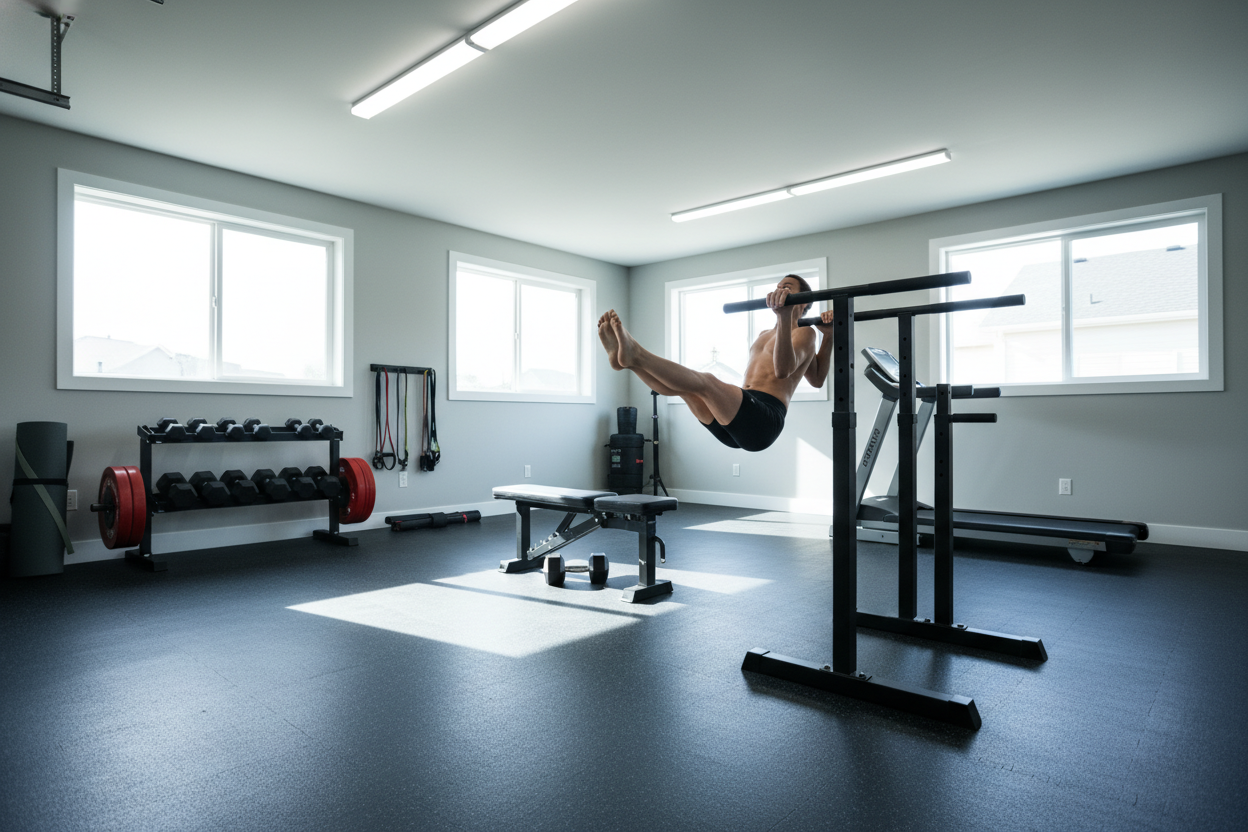
Your second option is to move the movement to a hanging pull-up bar. Hanging L-overs require massive grip strength and lat engagement, making it an elite upper-body and core hybrid movement.
Programming: Adding L-Overs to Your Home Routine
Because this is a high-tension movement, you do not want to throw it in at the very end of a brutal leg day when your core is already fried. I prefer programming these near the start of a dedicated core session or directly after upper body work.
For most of my home gym clients, I program 3 sets of 8 to 12 reps per side, moving at a strict 3-1-1-0 tempo (3 seconds down, 1 second pause, 1 second up, zero rest at the top). Rest 60 to 90 seconds between sets. Do this twice a week.
If you want a complete abdominal protocol, try pairing this movement with the routine detailed in the hard core exercise NYT answers guide. You will hit the rectus abdominis with heavy flexion exercises, and use L-overs to handle the rotational and oblique demands.
Trainer's Notes: My Experience with L-Overs
Over the last eight years of outfitting garage gyms and training clients in living rooms, I have programmed thousands of reps of this movement. I personally run through a 4-set gauntlet of straight-leg L-overs every Thursday on a standard 8mm thick yoga mat.
I will be honest about one downside: this exercise requires a baseline level of hamstring mobility. If you have incredibly tight hamstrings, you simply will not be able to hold your legs perfectly straight at 90 degrees. You will end up with a slight bend in the knee anyway. Do not stress about it. Work on your hamstring flexibility over time, but do not let it stop you from doing the bent-knee variation right now to build that foundational oblique strength.
Frequently Asked Questions
How often should I do L-overs?
Treat your core like any other muscle group. Two to three times a week is optimal. Doing them every single day does not give your oblique tissues enough time to repair and grow.
Can L-overs cause lower back pain?
They should not, provided your form is correct. If you experience lower back pain, it usually means your transverse abdominis has disengaged and your lower back is arching. Regress to the bent-knee version until you can keep your back flat against the floor.
Should I wear shoes during this exercise?
I actually prefer my clients do these barefoot or in socks. Heavy cross-training shoes add unnecessary weight to the end of the lever, which can throw off your form if you aren't ready for the extra load.