The Hidden Key to Shoulder Health: External Rotators Explained
If you have ever felt a sharp pinch while bench pressing or a dull ache after a long day of sitting, you are likely dealing with an imbalance in your shoulder mechanics. Most lifters obsess over internal rotation—think pecs and lats—but completely neglect the backend of the joint. I’m talking about the external rotators of the shoulder.
These muscles are the unsung heroes of upper body stability. Without them, your arm bone (humerus) wouldn't stay centered in the socket, leading to impingement and performance plateaus. Let’s break down exactly what these muscles are, why they fail, and how to bulletproof them.
Quick Summary: The Essentials
For those looking for a fast answer on anatomy and function, here is what you need to know about shoulder rotation muscles:
- Primary Movers: The Infraspinatus and Teres Minor are the main muscles that externally rotate the shoulder.
- Secondary Helpers: The Posterior Deltoid assists, particularly when the arm is abducted (raised to the side).
- Function: These muscles rotate the arm outward and, more importantly, decelerate the arm during throwing motions and stabilize the joint during pressing.
- Common Weakness: Weak external rotators lead to forward rounded shoulders and rotator cuff impingement.
What Muscles Externally Rotate the Shoulder?
Understanding the anatomy helps you visualize the movement. When we ask what muscles do external rotation of the shoulder, we are primarily looking at the posterior aspect of the rotator cuff.
1. Infraspinatus
This is the workhorse. Sitting on the back of your shoulder blade (scapula), the infraspinatus is responsible for the majority of external rotation force when your arm is at your side. If you cannot rotate your arm outward against resistance, this muscle is usually the weak link.
2. Teres Minor
Think of the Teres Minor as the Infraspinatus’s little brother. It sits just below it. While it assists in rotation, its crucial role is stabilization. It helps keep the head of the humerus depressed (pulled down) so it doesn't jam up into the acromion bone when you lift your arm overhead.
3. Posterior Deltoid
While not part of the rotator cuff, the rear delt is a major player. It is one of the primary muscles involved in shoulder external rotation when the arm is raised at 90 degrees (like the top of a face pull). Developing this muscle adds armor to the back of the joint.
Why You Need to Train External Rotation
Many athletes treat shoulder external rotation muscles worked in the gym as an afterthought—usually a few lazy band pulls during a warm-up. This is a mistake. Here is the science on why they matter.
Joint Centration
Your pecs and lats are powerful internal rotators. If they are tight and strong, and your external rotators of arm are weak, your shoulder gets pulled forward. This misalignment reduces space in the joint capsule. Strong external rotators pull the ball back into the center of the socket, allowing for pain-free pressing.
Deceleration Power
If you throw a baseball or swing a racket, your internal rotators generate the speed. However, the external rotation muscle group acts as the brakes. Without strong brakes, the momentum can tear the joint apart. Most non-contact shoulder injuries occur because the external rotators weren't strong enough to stop the arm.
How to Effectively Train These Muscles
Stop doing heavy rotations with poor form. These are small stabilizer muscles; they respond to higher reps and perfect tension, not ego lifting. Here are the most effective movements.
The Face Pull (Done Correctly)
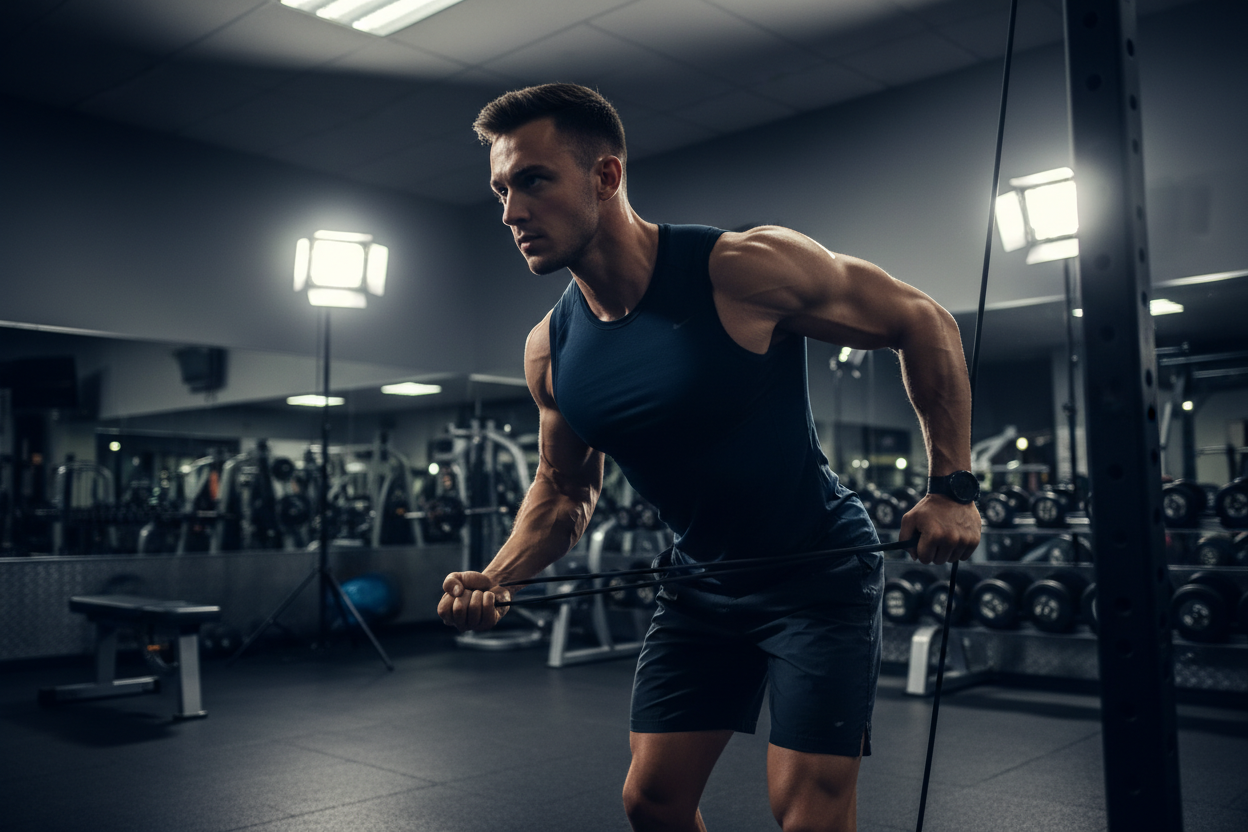
Most people butcher this. Do not pull the rope to your chin. Pull it to your eyes or forehead. As you pull back, actively externally rotate shoulder mechanics by trying to beat your hands back behind your ears. This hits the posterior delt and the rotator cuff simultaneously.
Side-Lying Dumbbell Wiper
Lie on your side with a small towel roll tucked under your armpit. With your elbow bent at 90 degrees, rotate a light dumbbell toward the ceiling. The towel roll is key—it prevents you from cheating by using your deltoids. This isolates the muscles that externally rotate the shoulder better than almost any standing variation.
My Personal Experience with External Rotators
I learned about these muscles the hard way—through a stubborn bench press plateau that turned into a nagging injury. For years, I thought shoulder pain was just the "cost of doing business" in powerlifting. I could bench 315 lbs, but I couldn't brush the back of my hair without wincing.
I started incorporating heavy, slow eccentrics for my external rotators. The specific detail I remember most vividly is the sensation of the "Side-Lying Wiper." I started with a 5lb pink dumbbell, and my ego took a massive hit. The burn wasn't in the big meaty part of the shoulder; it felt like a hot, cramping sensation deep underneath the shoulder blade, right near the armpit.
It felt unstable, shaky, and weak. But after three weeks of doing that grit-work every single session, the "click" in my right shoulder during bench press warm-ups disappeared. The bar path felt smoother, not because I was stronger, but because the stabilizers were finally doing their job.
Conclusion
Shoulder health isn't about luck; it's about balance. If you spend all your time pressing and curling, you are feeding the imbalance. Dedicate time to the external rotators muscles. Strengthening the Infraspinatus and Teres Minor won't just keep you out of the doctor's office; it will provide the stable base you need to press heavier weights safely.
Frequently Asked Questions
What acts as an antagonist to the external rotators?
The antagonists are the internal rotators. The primary muscles are the Subscapularis (part of the rotator cuff), the Pectoralis Major, the Latissimus Dorsi, and the Teres Major. These powerful muscles rotate the arm inward.
Can tight external rotators cause pain?
Yes, though it is less common than tight internal rotators. If the shoulder er muscles are excessively tight, they can restrict internal rotation range of motion, making it difficult to reach behind your back (like tucking in a shirt) and altering overall joint mechanics.
How often should I train shoulder external rotation?
Because these are postural and endurance-based muscles, you can train them frequently. Aim for 2 to 3 times per week at the end of your upper body workouts. Use light weight and high repetitions (15-20 reps) to focus on the muscles for shoulder external rotation without compensating.