The Hidden Flaw in Most Weight Training Routines for Beginners
I remember standing in my garage three years ago, staring at a printout of a 'beginner' program that had 14 different exercises for a single Monday session. I spent more time checking my phone to see how to perform a 'prone incline spider curl' than I did actually moving heavy objects. It was a mess, and it’s exactly how most weight training routines for beginners are built today.
- Focus on four main movement patterns: push, pull, squat, and hinge.
- Ignore the 'muscle confusion' marketing; consistency beats variety every time.
- Master your body weight before chasing heavy plate milestones.
- Invest in a few high-quality versatile pieces rather than a room full of single-use machines.
The Ugly Truth About Modern Starter Programs
The fitness industry doesn't make money when you realize that five basic movements can carry you through the first two years of your training. They make money when you subscribe to an app that gives you a 'fresh' workout every day. These lifting workouts for beginners are often packed with fluff to make the subscription feel valuable.
When you see a program with 12 different accessory movements, it’s not because you need them. It’s because the creator is trying to keep you entertained so you don't cancel your membership. Real progress is boring. It’s doing the same movements better, week after week, until you’re significantly stronger than you were last month.
Why You Should Ignore the Fancy Contraptions
I see people flocking to commercial gyms because they think they need the row of chrome-plated towers. The reality is that relying on weight lifting machines early on prevents you from learning core stabilization. A machine balances the weight for you; a barbell or dumbbell forces your body to find that balance.
If you can't stabilize your own torso during a press, you aren't building functional strength. You're just getting good at sitting in a chair and pushing. For a beginner, the mechanical learning phase is the most important part. You need to feel the weight shift and learn how to correct it in real-time.
Building Your Baseline: The Core Movements
You don't need a PhD in kinesiology to build a routine. You just need to hit the big four: push something away from you, pull something toward you, sit down and stand up (squat), and bend at the waist (hinge). If your program does those four things, you're 90% of the way there.
I recommend a three-day-a-week full-body split. It gives you enough frequency to learn the movements without the soul-crushing volume that leads to burnout. Keep the sets between 2 and 3, and the reps between 8 and 12. Don't overthink the 'optimal' range yet.
Mastering the Push and Pull
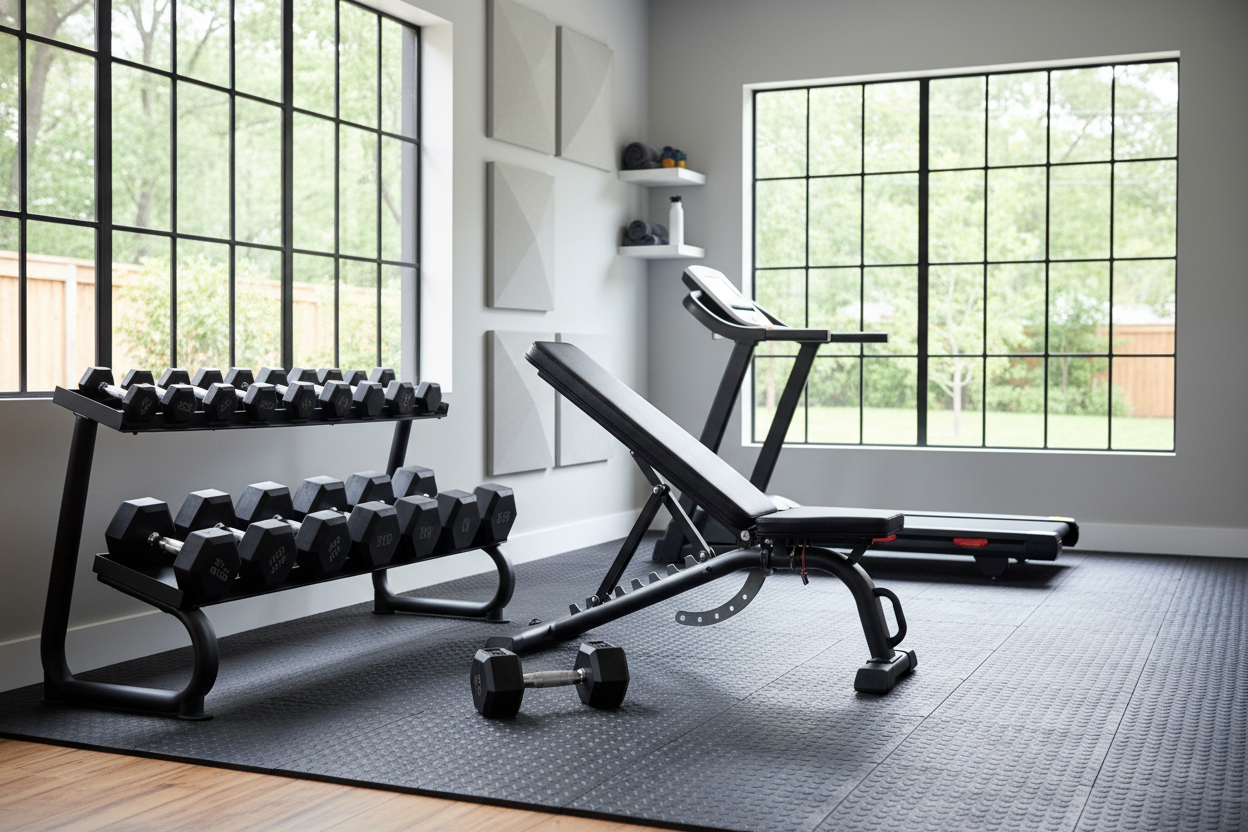
For pushing, you want a mix of horizontal and vertical movements. An adjustable weight bench is the primary tool needed to execute proper pressing angles at home. It allows you to move from a flat chest press to an incline press, which targets the upper chest and shoulders more effectively.
For pulling, find a way to do rows and chin-ups (or assisted variations). Pulling is the most neglected part of beginner routines, yet it's the most vital for shoulder health and posture. If you're pushing twice as much as you're pulling, your shoulders will eventually let you know they're unhappy.
Leg Day Doesn't Have to Destroy You
The biggest mistake novices make is trying to emulate a pro bodybuilder's leg day. If you can't walk for six days after your workout, you won't want to come back for week two. Start with goblet squats and Romanian deadlifts. Focus on the 'hinge'—pushing your hips back like you're trying to close a car door with your butt.
The Hardware: Equipping Your First Routine
You don't need a 3,000-square-foot facility. I started with a pair of 25-lb dumbbells and a flat bench. Before you drop thousands, spend some time choosing the best strength and weight training equipment for your goals to ensure you aren't buying stuff that will just gather dust.
The biggest waste of money is the 'as-seen-on-TV' multi-gym. They have terrible resale value and limited ROM (range of motion). I’m a huge advocate for buying gear before your weight training program is fully mapped out being a recipe for disaster. Buy the program (or write it), then buy the tools required to execute it.
My Personal Gear Mistake
Early on, I bought a cheap 'standard' barbell set from a local big-box store. The bar was thin, the weights were sand-filled plastic, and it felt like it was going to snap with 100 lbs on it. I ended up giving it away for free two months later. If I had just bought a decent Olympic bar and a few iron plates from the start, I would have saved myself $150 and a lot of frustration.
FAQ
How long should a beginner workout last?
If you're focused, you can get everything done in 45 to 60 minutes. Anything longer and you're likely doing too much 'filler' work or spending too much time on your phone.
Do I need to do cardio too?
Cardio is great for your heart, but don't let it interfere with your lifting. A 20-minute walk on off days is plenty for a beginner focusing on strength.
What if I don't have a rack for squats?
Use dumbbells or kettlebells. A heavy goblet squat is more than enough to build a solid foundation of leg strength before you ever need to put a bar on your back.