The Density Workout for Home Gym Owners: Beating Light Weights
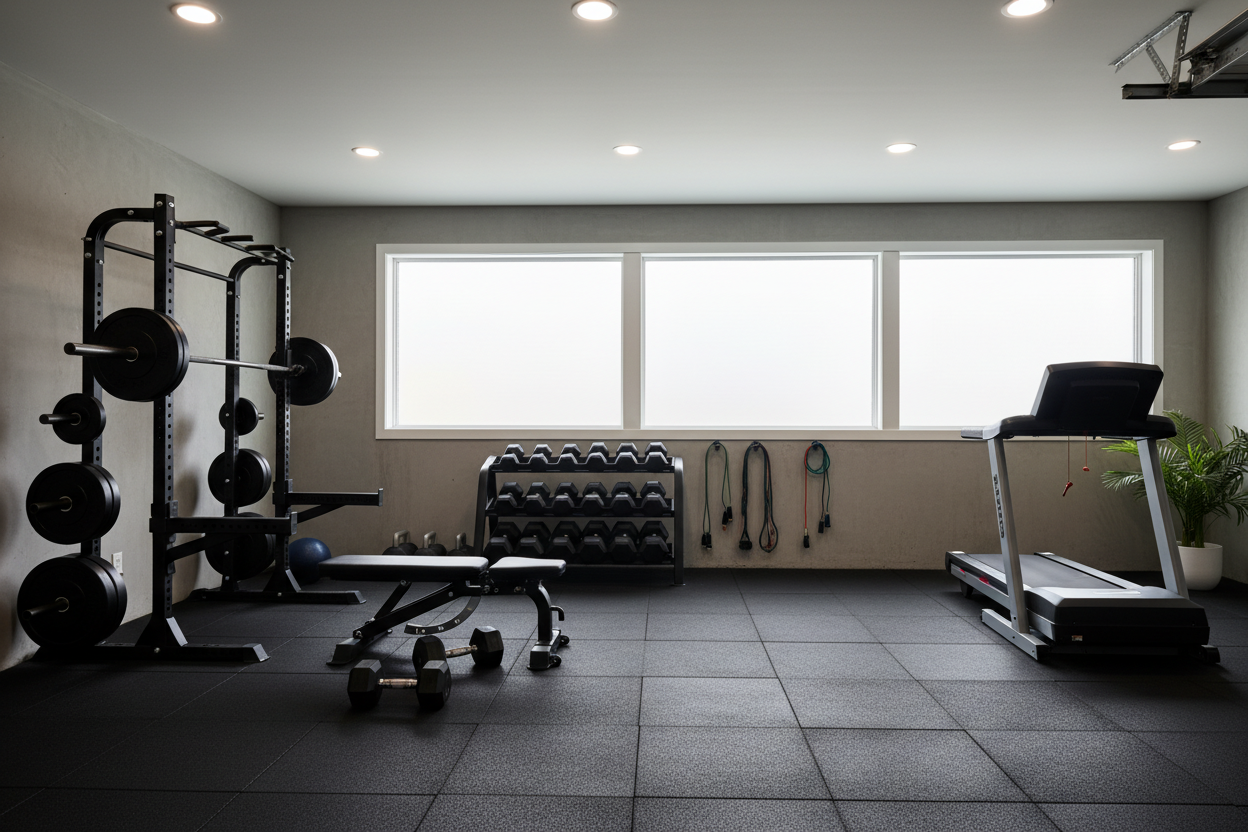
Picture this: you have a pair of 50-pound dumbbells, a flat bench, and a 10x10 foot space in your garage. For the first few months, you made great progress. But now, you can bench press those 50s for 20 reps easily. Buying a heavier set of adjustable dumbbells or a full barbell setup costs a small fortune and eats up floor space. I see this exact scenario with my clients all the time. If you need a serious workout for home gym setups that forces muscle growth without buying heavier plates, you need to change the math. Instead of increasing the weight, we are going to decrease the time.
Quick Takeaways
- Density training builds muscle by compressing more workout volume into less time.
- It bypasses the need for heavy barbell plates, making it perfect for minimal setups.
- EMOM (Every Minute on the Minute) intervals force strict rest periods and perfect form.
- AMRAP (As Many Rounds As Possible) circuits drive both cardiovascular fitness and hypertrophy.
- You track progress by counting total reps completed in a time block, not weight lifted.
Why Light Weights Stall Your Home Training Progress
Most traditional programs rely on progressive overload through weight. You do 3 sets of 10 reps with 40 pounds this week, and 45 pounds next week. But what happens when your adjustable dumbbells max out at 52.5 pounds? You hit a wall.
I have tested dozens of garage and spare bedroom setups for clients. The most common plateau happens around the six-month mark. Trainees start doing sets of 25 or 30 reps just to feel a burn. This turns a strength session into a marathon endurance event. High-rep sets are fine, but eventually, the cardiovascular fatigue sets in before the targeted muscle actually reaches failure.
When you cannot add more iron to the bar, you have to manipulate the clock. Shifting your focus from the load on the bar to the time on the stopwatch completely changes the stimulus. You force your muscles to perform the same amount of work with less recovery, creating the metabolic stress required for hypertrophy. This approach saves you from spending thousands of dollars on heavier iron plates that you barely have room to store.
What is Density Training?
In simple terms, workout density is the total volume of work you complete divided by the time it takes to complete it. If you lift 5,000 total pounds in 45 minutes today, and lift that same 5,000 pounds in 35 minutes next week, your workout density has increased. You forced your body to adapt to a higher demand in a shorter window.
This is the ultimate strategy for maximizing a minimalist equipment setup. You do not need a 300-pound Olympic weight set to trigger muscle growth. By compressing your rest periods, a pair of 35-pound dumbbells will feel like 70-pounders by the end of a 15-minute block. The cumulative fatigue recruits deeper muscle fibers that normally only activate under heavy, maximal loads.
When I program for clients with limited gear, density training is my secret weapon. It creates massive mechanical tension and metabolic stress—two of the primary drivers of muscle hypertrophy. Plus, it solves the problem of long, drawn-out sessions. You get in, you suffer through a highly concentrated block of work, and you get out. You are trading heavy weight for high intensity.
Structuring Home Gym Workout Routines for Density
To make this work, you have to throw out the traditional '3 sets of 10 with 90 seconds of rest' mentality. Effective home gym workout routines built for density rely on structured time intervals. You dictate the pace using a timer, not how you feel.
First, you need to organize your space. Because density training requires rapid transitions between exercises, you cannot waste time tripping over stray dumbbells or sliding around on a hardwood floor. Establishing a dedicated training zone with a large exercise mat for home gym use is a foundational step. It gives you the grip to safely perform fast-paced movements and the cushioning to drop weights quickly when the timer beeps.
Once your space is prepped, pick two to four exercises that target opposing muscle groups. Think push-ups and dumbbell rows, or goblet squats and Romanian deadlifts. Grouping non-competing muscles allows one muscle to recover while the other works, keeping your heart rate elevated and maximizing the volume you can achieve in your time limit.
The EMOM Protocol (Every Minute on the Minute)
The EMOM format is brilliant for building strength and dialing in your form under fatigue. Set a timer to beep every 60 seconds. At the top of the minute, perform a specific number of reps of an exercise. Whatever time is left in that minute is your rest.
For example, if you program 10 dumbbell thrusters, and it takes you 20 seconds to complete them, you get 40 seconds of rest before the next minute starts. As the rounds progress, you will naturally slow down. Those 10 reps might take 35 seconds, leaving you with only 25 seconds of rest. The creeping fatigue forces your muscles to adapt.
You can run EMOMs with whatever gear you have available. If you are wondering which pieces of gear work best for these fast-paced circuits, sticking to the top home workout equipment like kettlebells, adjustable dumbbells, and suspension trainers will give you the most versatility. The forced rest periods prevent you from getting lazy, guaranteeing a highly dense training block.
The AMRAP Protocol (As Many Rounds As Possible)
While EMOMs dictate your rest, AMRAPs put you entirely in the driver's seat. You set a timer for a specific window—usually 15 to 20 minutes—and complete a circuit of exercises as many times as you can before the clock runs out.
I love programming AMRAPs for cardiovascular conditioning and muscle hypertrophy simultaneously. A classic setup might be 10 push-ups, 15 kettlebell swings, and 20 walking lunges. You move continuously, resting only when absolutely necessary to maintain safe form.
The beauty of the AMRAP is its built-in progression. If you complete 5 rounds this week, your goal is to hit 5.5 or 6 rounds next week. You are doing more work in the exact same amount of time, which forces your muscles to adapt without requiring a single extra pound of resistance. It completely eliminates the excuse of not having heavy enough weights.
Building a Workout Routine With Home Gym Equipment
Let us put this theory into practice. Here is a tangible, 4-day sample workout routine with home gym equipment that applies these density principles to push, pull, and leg days.
Day 1: Upper Body Push (AMRAP)
Set a timer for 20 minutes. Complete 12 dumbbell floor presses, 15 overhead triceps extensions, and 20 release push-ups. Keep cycling through until the timer sounds. If you own heavier stationary gear, this is where you can incorporate the best weight training machines into your circuit, perhaps swapping the floor press for a functional trainer chest press.
Day 2: Lower Body (EMOM)
Set a timer for 16 minutes. Minute 1: 15 Goblet Squats. Minute 2: 15 Dumbbell Romanian Deadlifts. Minute 3: 12 Alternating Reverse Lunges per leg. Minute 4: Rest. Repeat this block 4 times.
Day 3: Upper Body Pull (AMRAP)
Set your timer for 20 minutes. Perform 10 pull-ups (or inverted rows), 15 dumbbell bent-over rows, and 20 alternating dumbbell bicep curls.
Day 4: Full Body Density Finisher
Pick two exercises, like burpees and kettlebell swings. Do an EMOM for 10 minutes, alternating between 12 burpees on the even minutes and 20 swings on the odd minutes.
My Personal Experience: When I first tested this 4-day split in my own garage using only a 50-pound kettlebell and some resistance bands, I was humbled. The pump was incredible. However, I will share one honest downside: cardiovascular fatigue can sometimes mask muscle failure. During AMRAPs, my lungs often gave out before my chest or back did. You have to actively fight to keep your lifting pace steady so the targeted muscles do the actual work.
Protecting Your Joints During High-Volume Sets
Density training is inherently fast-paced. When you are rushing to finish your reps before the minute is up, you will inevitably drop weights faster and land harder on your feet. Joint protection becomes critical when you are doing hundreds of reps in a 20-minute window.
Shock absorption and traction are your best friends here. Performing explosive AMRAP movements like jump squats or fast-paced lunges on bare concrete or thin puzzle mats is a recipe for knee and ankle pain. I always recommend upgrading your surface solution to something substantial, like a 6x8ft exercise mat, to properly cushion your joints.
A high-quality, dense mat absorbs the impact of rapid directional changes and prevents the sweat pooling that causes slips. It also deadens the noise of dumbbells hitting the floor, which is a major bonus if you train in an upstairs apartment or while the kids are sleeping.
Tracking Your Density Progress Over Time
The biggest mistake I see clients make with density training is failing to log their numbers. Because you are not adding weight, you might feel like you are not progressing. You must track your total reps completed within the time limit.
Keep a simple notebook near your setup. If you did 85 total push-ups in your 15-minute AMRAP today, your goal next week is 86. That single extra rep means your density increased. Over a 12-week macrocycle, those extra reps compound into serious strength and muscle gains, proving you do not need heavy plates to build an impressive physique at home.
Frequently Asked Questions
Can I build muscle with just 20-pound dumbbells using density training?
Yes. By drastically reducing your rest periods using EMOMs or AMRAPs, 20-pound dumbbells can provide enough metabolic stress to trigger hypertrophy, even if they feel too light during normal sets.
How many days a week should I do density workouts?
Because density training is highly taxing on your central nervous system and cardiovascular system, 3 to 4 days a week is the sweet spot for most home trainees. Allow for adequate recovery between sessions.
Is density training safe for beginners?
It can be, provided you prioritize form over speed. Beginners should start with longer time limits and fewer reps per minute to ensure their technique does not break down as fatigue sets in.