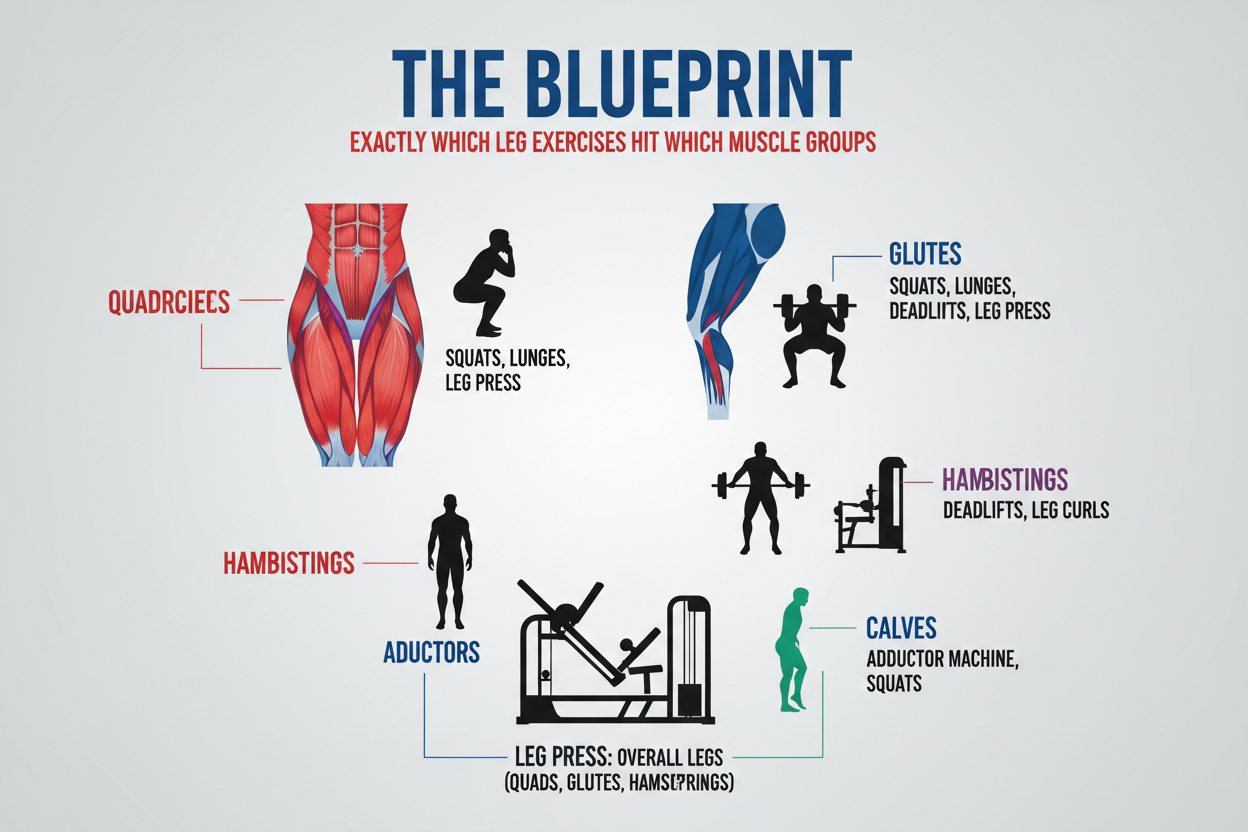
The Blueprint: Exactly Which Leg Exercises Hit Which Muscle Groups
Most people walk into the gym on leg day with a simple plan: squat until it hurts. While the squat is undeniably the king of lower body movements, relying on it exclusively leaves a lot of potential growth on the table. To build a truly balanced, aesthetic, and functional lower body, you need to understand the anatomy. You need to know exactly which movements stimulate specific fibers so you aren't just tired, but productive.
Leg training is not just about moving weight from point A to point B. It is about tension distribution. If you want sweeping quads, hanging hamstrings, and glutes that actually function, you have to dissect your training. This guide breaks down the lower body architecture and maps out the most effective movements for each area.
The Quadriceps: The Front of the Thigh
The quadriceps are a four-headed beast responsible for knee extension. They are the show muscles of the front leg, giving the thigh its sweep and size. When people think of leg muscle group exercises, they usually picture movements that torch the quads. Because these muscles are dominant in almost all standing movements, they are easy to hit but hard to isolate perfectly without the right intent.
To target the quads effectively, you need exercises that require a high degree of knee flexion. The further your knee travels over your toe (safely), the more the quad has to work to extend the leg back to straight.
Top Quadriceps Exercises
- High-Bar Back Squat: Placing the bar higher on the traps allows for a more upright torso, forcing the knees forward and placing the load squarely on the quads.
- Front Squat: By shifting the weight to the front of the shoulders, you eliminate most hip drive, isolating the anterior chain.
- Leg Extensions: This is the only movement that isolates the rectus femoris (the middle quad muscle) fully because it works the muscle in a shortened position without hip involvement.
- Bulgarian Split Squats: While these hit the glutes, keeping your torso upright turns this into a quadriceps incinerator.
The Hamstrings: The Posterior Chain
Neglecting the back of the leg is the most common mistake in gym culture. The hamstrings have two main functions: bending the knee (knee flexion) and extending the hips (moving your leg backward). Many lifters have overpowering quads and weak hamstrings, which is a recipe for knee injuries and poor posture. Understanding the link between leg muscle groups and exercises for the posterior chain is vital for structural integrity.
You cannot train hamstrings with just one movement pattern. You need to hinge at the hips to stretch them, and curl at the knee to contract them.
Top Hamstring Exercises
- Romanian Deadlifts (RDLs): This is a hip-hinge movement. It works the hamstrings by stretching them under load. Keep a slight bend in the knee and push your hips back until you feel a deep stretch.
- Seated or Lying Leg Curls: These target the knee flexion function. The seated variation is often superior for hypertrophy because it trains the hamstring in a lengthened position at the hip.
- Nordic Hamstring Curls: An advanced bodyweight movement that eccentrically overloads the muscle, providing bulletproof protection against tears.
The Glutes: The Powerhouse
The glutes are the largest muscle group in the body. While they assist in squats and deadlifts, they often require direct work to reach their full potential. Leg workouts muscle groups often overlap, meaning your quads or hamstrings might take over a movement intended for your glutes if your form isn't locked in. This is often called "glute amnesia," where the butt muscles forget how to fire.
To wake them up, you need heavy hip extension and abduction (moving the leg away from the body).
Top Glute Exercises
- Hip Thrusts: The undisputed champion of glute isolation. It allows for maximum contraction at the top of the movement without the lower back fatigue associated with squats.
- Glute Bridges: Similar to thrusts but performed from the floor, often better for high-repetition pump work.
- Cable Kickbacks: These allow you to train the gluteus maximus through a full range of motion with constant tension.
My Experience with Muscle Imbalance
I learned the hard way why categorizing leg exercises by muscle group matters. For the first few years of my training, I was obsessed with heavy back squats. My numbers went up, and my quads grew, but I developed nagging patellar tendonitis. My knees ached constantly. I eventually saw a physical therapist who pointed out that my hamstrings were virtually non-existent compared to my quads. My body was braking a Ferrari with bicycle brakes. I had to completely overhaul my routine, splitting my leg days to prioritize posterior chain movements like RDLs and heavy curls. Within three months, the knee pain vanished, and my squat numbers actually increased because I had a stable base to push from. It shifted my perspective from just "lifting heavy" to "lifting smart."
Calves and Adductors: The Details
Leg workouts and what they target must include the stabilizers and lower leg muscles. The adductors (inner thigh) contribute significantly to squat strength and leg size, while the calves are essential for ankle stability and aesthetics.
- Standing Calf Raises: Targets the gastrocnemius (the upper, heart-shaped muscle). Keep the knees straight.
- Seated Calf Raises: Targets the soleus (the muscle underneath). This adds width to the lower leg.
- Copenhagen Planks: An incredible isometric exercise for the adductors that improves groin health and squat stability.
Structuring Your Routine
Now that you know the parts, how do you assemble the car? You shouldn't try to do every single exercise listed above in one session. That leads to junk volume. Instead, you can organize your leg workouts by muscle group focus.
A popular method is to have two leg days. Leg Day A focuses on the anterior chain (Quads/Adductors/Calves), while Leg Day B focuses on the posterior chain (Hamstrings/Glutes). This allows you to attack each area with high intensity and recover fully before hitting it again.
Alternatively, if you prefer full-body sessions, select one compound movement for the quads (like a squat), one hinge for the hamstrings (like an RDL), and one isolation movement for whichever area is lagging. This ensures you cover all bases without spending three hours in the gym.
Ultimately, the best physique comes from intention. Don't just go through the motions. Analyze your leg workouts and what they target, feel the specific muscle contract, and adjust your foot placement or torso angle until the tension is exactly where it needs to be. Anatomy is the map; effort is the vehicle.
Frequently Asked Questions
How often should I train my legs for maximum growth?
For most lifters, training legs twice a week is the sweet spot. This frequency allows for sufficient volume to stimulate growth while providing enough rest days for the central nervous system and muscle fibers to recover.
Can I build big legs with just bodyweight exercises?
Yes, but it requires higher volume and advanced variations. You will need to utilize unilateral movements like pistol squats, shrimp squats, and Nordic curls to generate enough mechanical tension to force adaptation without external weights.
Why do I feel squats in my lower back instead of my legs?
This usually indicates a weak core or poor hip mobility, causing you to lean forward excessively. Try switching to Front Squats or Goblet Squats, which force a more upright torso and shift the load back onto the quadriceps.