The Big Leg Workout Strategy Most Lifters Ignore
You have likely tried high reps until your lungs burned. You might have loaded the bar until it bent across your back. Yet, despite the sweat and the effort, the tape measure around your thighs hasn't budged. This is the frustration of the "hardgainer," but the issue usually isn't genetics—it's execution.
Building massive quads and hamstrings requires more than just showing up. It requires a fundamental shift in how you approach your big leg workout. It’s about mechanical tension, not just fatigue. If you are tired of spinning your wheels, you need to stop exercising and start training for hypertrophy specifically.
Key Takeaways for Mass
- Volume vs. Intensity: Heavy weight is vital, but volume (sets x reps) drives hypertrophy. Aim for 10-20 hard sets per muscle group weekly.
- Full Range of Motion (ROM): Partial reps yield partial results. Deep squats recruit more muscle fibers than heavy quarter-squats.
- Compound Priority: Base your workout on multi-joint movements like squats and leg presses before isolation work.
- Time Under Tension: Control the eccentric (lowering) phase to maximize muscle fiber damage and growth signaling.
The Anatomy of a Mass-Building Leg Session
To construct a workout for big legs, you must understand what makes muscles grow. It is not just pain; it is the management of tension. Many lifters confuse being out of breath with stimulating growth.
While metabolic stress (the pump) matters, mechanical tension (heavy load through a full range of motion) is the primary driver. Here is how to structure your session.
1. The Primary Compound Lift
Every leg workout for big legs should start with a heavy compound movement. This is where you move the most weight while your nervous system is fresh.
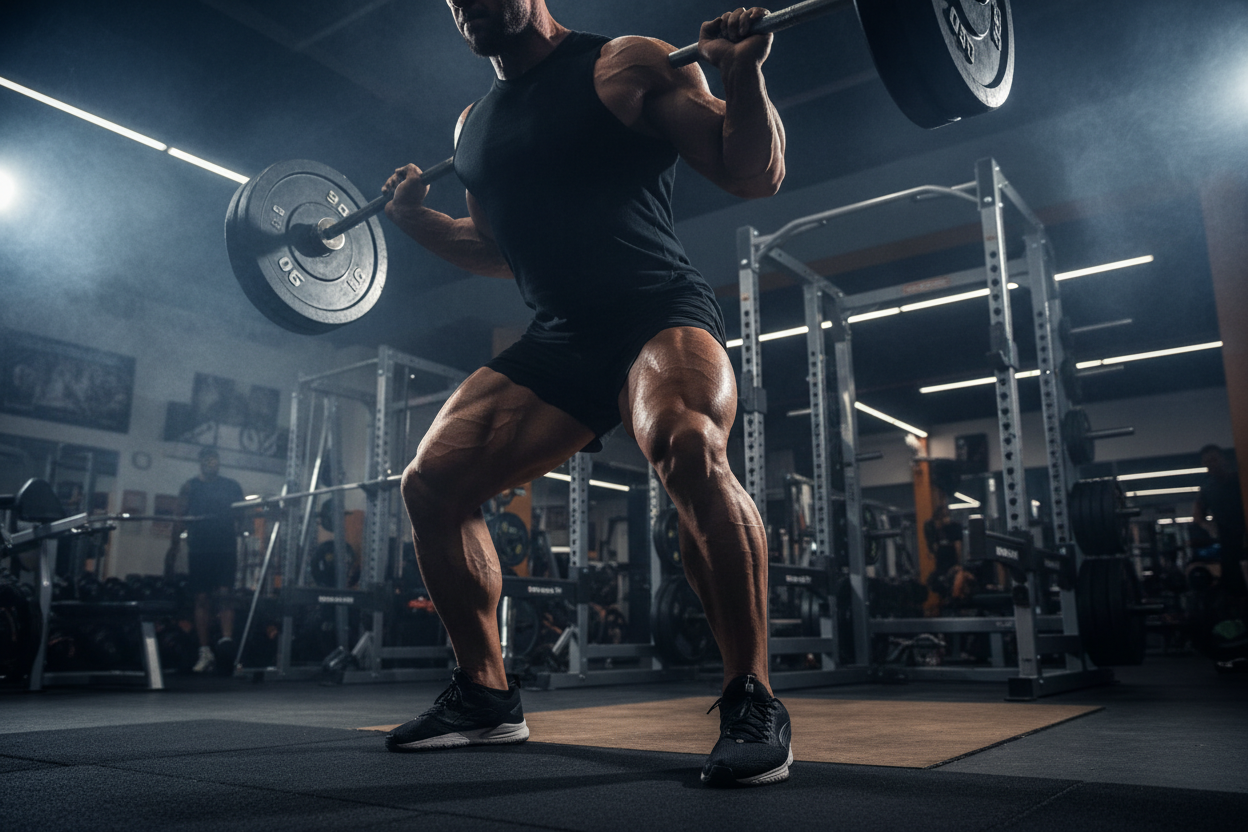
The Back Squat is the gold standard here. However, for pure size, high-bar squats often beat low-bar squats because they force greater knee flexion, placing more tension on the quadriceps. If back issues prevent squatting, a Hack Squat is a superior alternative for isolation without the spinal load.
2. Unilateral Movements for Symmetry
If you want to know the best exercises for bigger legs, look at what most people skip. Unilateral (single-leg) training is non-negotiable.
Bulgarian Split Squats or Walking Lunges address imbalances. If your left leg is weaker than your right, your bilateral squat will suffer, and your growth will plateau. These exercises to grow legs force each limb to carry its own load, ensuring that your dominant side doesn't steal the gains.
3. The Hamstring Factor
Big legs aren't just quads. Neglecting hamstrings leaves your legs looking two-dimensional from the side. The Romanian Deadlift (RDL) is essential here.
Unlike a leg curl which works the knee flexion, the RDL works the hip hinge. This creates that thick, dense look on the back of the thigh. When looking for exercises to get bigger legs, ensure you have one hip-hinge movement and one knee-flexion movement (like a seated leg curl).
Common Mistakes Sabotaging Your Growth
Ego Lifting Over Tension
We have all seen it: the guy loading 10 plates on the leg press and moving the sled two inches. This is not a bigger legs exercise; it is an ego stroke. To stimulate growth, you must control the weight. If you cannot pause at the bottom, the weight is too heavy.
Ignoring the Eccentric
The lowering phase of a lift causes the most micro-tears in the muscle fiber. If you drop into the hole of a squat without control, you are missing 50% of the growth potential. Slow down. A 3-second descent can turn a light weight into a mass builder.
My Training Log: Real Talk
I want to be honest about what a truly effective leg day feels like. It isn't the "glamorous" pump you see on Instagram. I remember specifically when I finally cracked the code on my quad growth. I stopped focusing on the max number on the bar and focused on the pain of the stretch.
There is a specific, gritty feeling when you are doing high-rep Hack Squats properly. It’s not just burning; it’s a wave of nausea that hits around rep 12 when you know you have to get to 15. I recall sitting on the machine after a set, staring at the safety latch, watching my sweat drip onto the metal platform, and genuinely debating if I could stand up.
The real indicator of a good session wasn't the soreness the next day—it was the "waddle" immediately after. It was the fact that pushing the clutch in my car on the drive home made my leg shake uncontrollably. If you leave the gym walking briskly, you probably didn't push hard enough to force an adaptation.
Conclusion
Achieving massive lower body development is a marathon, not a sprint. By utilizing these leg workouts for bigger legs and adhering to strict form, you will force your body to adapt. Drop the ego, increase the range of motion, and embrace the discomfort. The size will follow.
Frequently Asked Questions
How often should I do a big leg workout?
For most natural lifters, training legs twice a week is optimal. This frequency allows you to split the volume, perhaps focusing on quad-dominant exercises for bigger legs on one day and hamstring/glute-dominant movements on the other, ensuring recovery and maximum intensity.
Can I get big legs with just bodyweight?
To a degree, yes, but eventually, you will need external resistance. To continue seeing results with a legs grow exercise routine without weights, you must drastically increase volume or leverage difficult variations like pistol squats. However, iron is best for maximum mass.
Why are my legs getting stronger but not bigger?
This is usually a volume issue. You might be training in very low rep ranges (1-5) which builds strength (neurological efficiency) rather than hypertrophy. To switch to a workout for big legs, aim for the 8-15 rep range and focus on time under tension rather than just moving the weight from A to B.