The 1 Month Gym Workout Plan to Gain Muscle for Guys With No Time
I’ve spent too many nights at 11:00 PM in my garage, shivering under a space heater and staring at a barbell, trying to figure out how to fit a pro-bodybuilder split into a dad-life reality. Most of us don't have the luxury of a two-hour midday session followed by a nap and a protein shake. We have jobs, kids, and a lawn that won't mow itself. Finding a 1 month gym workout plan to gain muscle that actually respects your schedule is like finding a matching pair of 2.5-lb plates in a commercial gym—nearly impossible.
Quick Takeaways
- Focus on 4 high-intensity sessions per week to allow for recovery.
- Limit every workout to exactly 45 minutes to maximize hormonal response and focus.
- Prioritize compound movements (squats, presses, rows) over isolation fluff.
- Use supersets to condense volume without extending gym time.
- Ensure your floor space is optimized to minimize transition time between lifts.
Why Most 30-Day Muscle Sprints Are Built for Unemployed Guys
If you pick up any mainstream fitness magazine, the '30-day transformation' usually demands six days a week in the gym. For a natural lifter with a mortgage and a stress-heavy career, that is a recipe for a systemic meltdown. Your central nervous system (CNS) isn't a bottomless pit of recovery. When you layer heavy deadlifts on top of a 50-hour work week, your cortisol levels spike, and muscle protein synthesis takes a backseat to survival.
These high-volume plans are often designed for 22-year-olds whose biggest stressor is a dead phone battery. For the rest of us, we need a plan that triggers hypertrophy without leaving us too exhausted to play with our kids in the evening. This 30-day sprint isn't about doing more; it's about doing the right things with a level of intensity that makes every minute count. We’re going to trade mindless reps for mechanical tension.
The Breakdown: A One Month Workout Plan to Gain Muscle
To see real growth in four weeks, we are utilizing a 4-day Upper/Lower split. This ensures every muscle group is hit twice a week, which is the sweet spot for hypertrophy. This one month workout plan to gain muscle relies on 'Heavy-Light' periodization. Mondays and Tuesdays are for heavy, low-rep compound movements to build strength and density. Thursdays and Fridays focus on the 8-12 rep range to drive blood flow and metabolic stress.
We use supersets for all accessory work. For example, after your heavy bench press, you’ll jump immediately into weighted pull-ups. This doesn’t just save time; it keeps your heart rate elevated and improves work capacity. You aren't just building a physique that looks good in a t-shirt; you're building a body that can actually handle work. If you find yourself resting for three minutes between sets of lateral raises, you're doing it wrong.
The 45-Minute Rule for Hypertrophy
Parkinson’s Law states that work expands to fill the time available for its completion. If you give yourself two hours to lift, you’ll spend 30 minutes scrolling Instagram. When I shrank my workout plan for muscle gain to a hard 45-minute cap, my intensity skyrocketed. I stopped worrying about 'junk volume'—those extra sets of cable crossovers that don't actually build tissue—and focused entirely on the lifts that move the needle.
Setting a timer on your watch or phone creates a sense of urgency. It forces you to stay focused on the bar. If you haven't finished your last set of curls by the 45-minute mark, you leave. This discipline teaches you to stop wasting time and start training with the intent required to actually force your muscles to adapt and grow.
Stop Wasting Time: Why Your Gym Floor Setup Matters
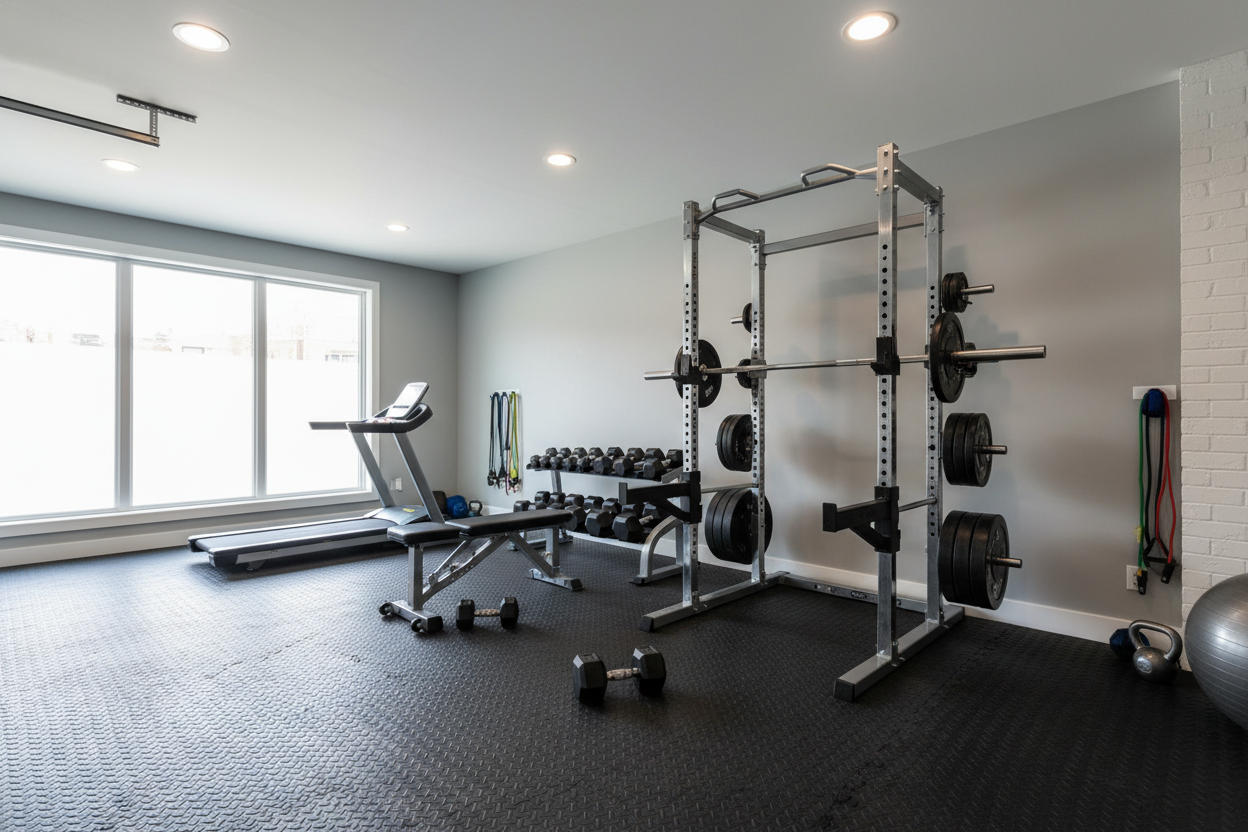
Efficiency in a home gym isn't just about the program; it's about the geography of your gear. If you have to move a mountain of bikes just to get to your squat rack, you’ve already lost the mental battle. I’ve found that having a dedicated, stable area is the difference between a 40-minute session and an hour-long ordeal. I use a large 6x8ft exercise mat so I can transition from floor presses to rows without having to drag equipment across a concrete floor or worry about slipping.
A good floor setup allows you to keep your dumbbells, kettlebells, and bench in one tight radius. In a 30-day sprint, every second spent 'setting up' is a second stolen from your recovery or your family. Think of your gym floor like a professional kitchen—everything should be within arm's reach so the 'chef' can focus on the work, not the logistics.
Surviving the Inevitable Week 3 Wall
Around day 20, the novelty of the new program wears off and the 'Week 3 Wall' hits. This is where your joints start to feel a bit 'creaky' and the thought of another heavy set of squats makes you want to stay on the couch. This is systemic fatigue, and it’s a sign that the intensity is working. To get through this, you need to be aggressive with your recovery. Aim for an extra 300 calories a day—mostly from clean carbs—to fuel the sessions.
Mentally, this is the most important part of the month. You’ll need to push through the 3-week plateau by focusing on small wins, like adding 2.5 lbs to the bar or hitting one extra rep. Sleep is your best friend here. If you're getting less than seven hours, you aren't building muscle; you're just tearing yourself down. Protect your sleep like it’s part of the workout itself.
Day 31: What Happens When the Month Is Over?
You’ve finished the sprint. Your shirts are tighter in the shoulders, and your strength has likely ticked up. But you can't run a high-intensity sprint forever without snapping. Day 31 should be the start of a 'deload' week—reduce your weights by 30% and just move. This allows your connective tissue to catch up with your muscle growth and prevents the kind of nagging injuries that sideline garage gym lifters for months.
After your deload, it’s time to choose your next path. You can jump back into another hypertrophy block or transition into a dedicated strength phase. To see what fits your long-term goals, browse our workout hub for routines that match your equipment and available time. The goal is consistency over years, not just intensity for 30 days.
My Personal Experience: The 'Dad Tax' Lesson
A few years ago, I tried to follow a high-volume 'Arnold-style' split while balancing a newborn and a promotion. I lasted exactly 14 days before I nearly fell asleep at my desk during a budget meeting. I was irritable, my lifts were regressing, and I hated the gym. I realized I was paying the 'Dad Tax'—my recovery capacity was lower than I wanted to admit. When I switched to a 4-day, 45-minute focused plan, I actually started seeing gains again. The lesson? More is not better. Better is better.
FAQ
Can I build muscle in just one month?
Yes, you can certainly add visible muscle and significant strength in 30 days, especially if you are returning to training or have been inconsistent. You won't look like a pro bodybuilder, but you will see a noticeable change in how your clothes fit and your overall power.
Do I need a full power rack for this plan?
While a rack is ideal for heavy squats and presses, you can adapt this plan for dumbbells and a bench. The key is maintaining the intensity and the 45-minute time limit, regardless of the tools you are using.
Should I do cardio during this 30-day muscle plan?
Keep cardio to a minimum—think 20-minute walks on your off days. You want your body's resources focused entirely on repairing muscle tissue, not recovering from a 5-mile run. Save the heavy conditioning for your next phase.