Stuck in a Chair? Here’s How to Wake Up Your Glutes Without Standing Up
We spend an alarming amount of our lives glued to a seat. Whether you are driving a truck, coding at a computer, or sitting through endless Zoom meetings, your posterior chain is likely suffering. The phenomenon is often called "glute amnesia," where your muscles essentially forget how to fire because they are constantly lengthened and compressed. The good news is that you don't need a gym membership or even standing room to wake them up. You can effectively exercise glutes while sitting right where you are.
Many people assume that unless you are squatting heavy weights, you aren't working your backside. That is a misconception. While you won't build massive hypertrophy from a swivel chair, you can maintain muscle connection, improve blood flow, and prevent the dreaded "pancake butt" syndrome. Integrating seated glute exercises into your day is less about building a bodybuilder physique and more about muscle activation and spinal health. Let’s look at how you can turn your seat into a workout station.
The Invisible Squeeze: Your First Line of Defense
The absolute simplest way to combat inactivity is the isometric squeeze. This is the bread and butter of glute exercises while sitting at desk jobs because it is completely invisible to your coworkers. You don't need special equipment, and you can do it while on a phone call.
To perform this, plant your feet flat on the floor, shoulder-width apart. Squeeze your buttocks together as hard as you can. Imagine you are trying to crack a walnut between your cheeks. Hold this tension for 10 to 15 seconds, then release. Repeat this 10 to 15 times. This creates a mind-muscle connection. If you are wondering how to activate glutes while sitting, this is the foundational movement. It sends a signal to the nerves that these muscles are still needed.
The Seated Leg Lift
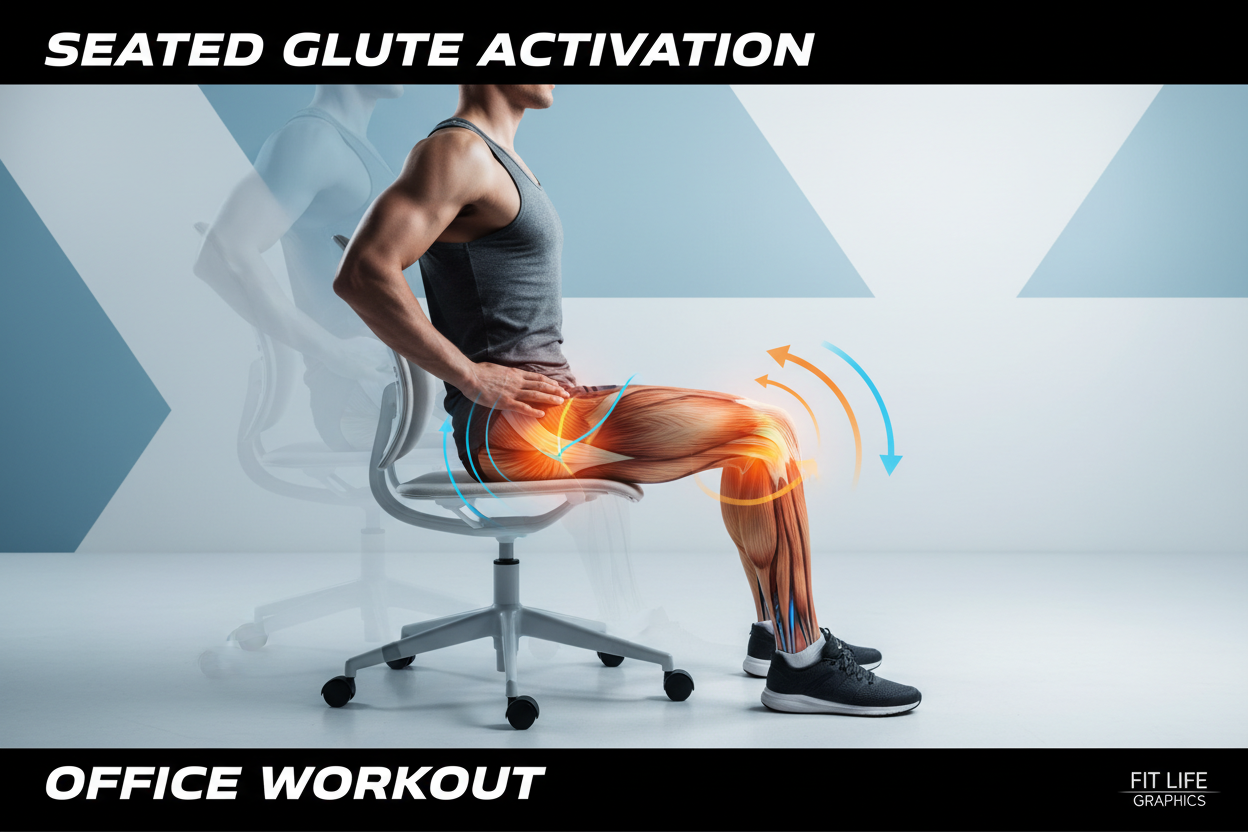
Once you have mastered the squeeze, you can move on to dynamic movement. Glute exercises sitting down can also engage your hamstrings and lower back. The seated leg lift is deceptive; it looks easy, but if done with intention, it burns.
Sit on the edge of your chair with your spine tall. Do not lean against the backrest. Straighten one leg out in front of you. Keeping the leg straight, lift it a few inches off the floor, but here is the trick: focus on tightening the glute of the working leg. You might feel your quad working, but try to drive the movement from the hip. Pulse the leg up and down for 20 repetitions before switching sides. This is one of the more effective chair exercises for buttocks because it forces stabilization from the core and hips.
The Hover Squat
If you have a bit of privacy or don't mind a few stares, the hover is the king of chair glute exercises. It bridges the gap between sitting and standing.
Scoot to the edge of your seat. Place your feet firmly on the ground. Lean your torso forward slightly (hinging at the hips, not rounding the back) and lift your bum just one inch off the seat. Hold this hover position. You are technically doing glute exercises while sitting down, or at least while almost sitting down. Hold for 5 seconds, then lower back down. Do this 10 times. This mimics the hardest part of a squat without the full range of motion, keeping constant tension on the muscles.
My Battle with "Office Chair Back"
I learned the hard way why these movements matter. A few years ago, I took a job that required about nine hours of desk time a day. Within six months, my lower back was constantly throbbing. I assumed I had a back injury. When I finally saw a physical therapist, she didn't treat my back; she poked my glutes and told me they were "asleep." My lower back was doing all the work that my hips should have been supporting.
She assigned me buttocks exercises while sitting to do every hour. I felt ridiculous at first, clenching my muscles during conference calls. But within three weeks, the back pain vanished. It wasn't that I had built massive muscle; it was that I had taught my glutes to support my pelvis again. That experience taught me that sitting glute exercises aren't just for fitness enthusiasts; they are for anyone who wants to walk upright without pain.
Modifications for Mobility and Seniors
Not everyone can perform high-intensity movements, and stability is often a major concern as we age. Seated glute exercises for seniors are excellent for maintaining pelvic stability, which directly correlates to balance and fall prevention. The safety of the chair removes the fear of falling while allowing the senior to work on strength.
For this demographic, or anyone with limited mobility, the "Clam Shell" is a great variation of chair exercises for glutes. Sit with your knees together and feet flat. Keep your feet touching, but open your knees outward as far as comfortable, engaging the outer glutes (gluteus medius). If you have a resistance band, wrap it around your thighs just above the knees for added difficulty. This targets the hips in a way that forward-backward movements miss.
The Desk Drawer Press
This is a stealthy move for those needing glute exercises at desk environments where movement is restricted. If you have a heavy desk with a solid side panel (or even the leg of the desk), you can use it for isometric abduction.
Sit close to the desk. Position your leg so the outside of your knee or thigh rests against the desk leg or drawers. Push your leg outward into the desk as hard as you can, as if you are trying to push the desk away. The desk won't move, but your outer glute will fire intensely. Hold for 10 seconds. This is a variation of sitting glute exercises that targets the gluteus medius, which is crucial for hip stability.
Frequency and Routine
You might be wondering how often you should do these. Unlike heavy deadlifts which require days of recovery, chair exercises for buttocks can and should be done daily, perhaps even hourly. The goal is frequency, not exhaustion.
Try "triggering" your workout. Every time you hit send on an email, do five glute squeezes. Every time you take a sip of water, do a 10-second hold. By weaving these seated glute exercises into your natural workflow, you ensure that your muscles never go fully dormant during the workday.
Why This Matters Beyond Vanity
Aesthetics are fine, but the function is vital. Your glutes are the engine of your body. When they are weak or inactive, your hamstrings, lower back, and even your knees have to compensate. This leads to a cascade of joint issues. By taking the time to perform chair glute exercises, you are protecting your kinetic chain.
Remember, the best exercise is the one you actually do. You don't need to wait until 5:00 PM to hit the gym. You can start right now. Plant your feet, check your posture, and squeeze. Your back will thank you later.
Frequently Asked Questions
Can seated glute exercises actually build muscle mass?
Generally, seated exercises are better for muscle activation, endurance, and preventing atrophy rather than building significant mass. To build substantial size, you typically need heavy resistance and full range of motion, but seated moves are excellent for shaping and maintaining tone.
How long does it take to see results from chair exercises?
If you are consistent, you will likely feel a difference in hip stability and reduced back pain within two to three weeks. Visibile changes take longer, usually requiring a combination of these exercises, proper nutrition, and overall activity.
Are these exercises safe for people with lower back pain?
Yes, in most cases, these exercises help alleviate back pain by strengthening the support system for the spine. However, always maintain good posture (don't slouch) while performing them, and consult a medical professional if you have a specific injury.