
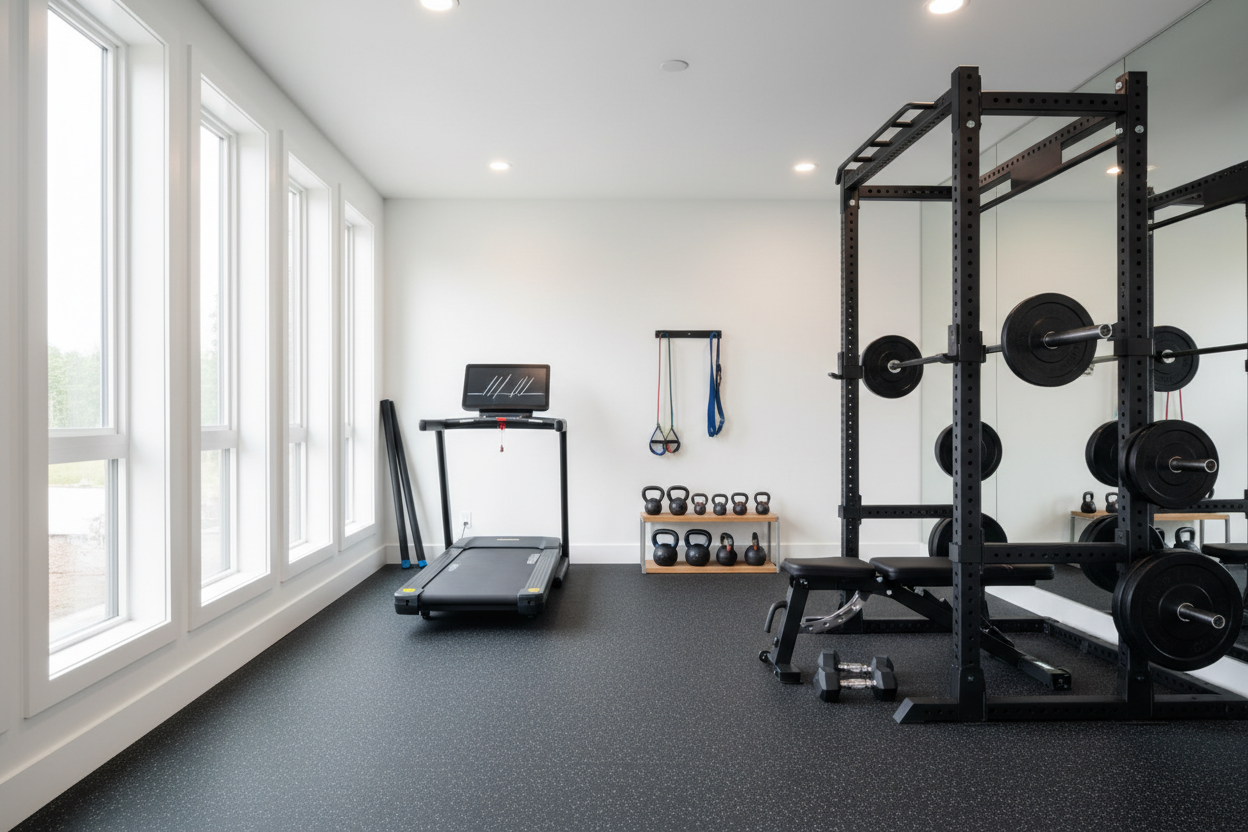
Structuring a 5-Day At Home Workout Routine to Avoid Burnout
I remember a client who decided to transform his spare bedroom into a makeshift gym during a massive snowstorm. He was highly motivated and immediately jumped into a grueling daily regimen consisting of heavy kettlebell swings, hundreds of push-ups, and plyometric jumps. By day eight, his shoulders were screaming, his lower back was completely stiff, and his motivation had tanked. He hadn't built a sustainable plan; he had built a one-way ticket to central nervous system burnout.
If you want to train almost every day without running yourself into the ground, you need a structured 5-day at home workout routine. It is entirely possible to train frequently in your living room or garage, but you have to actively manage your fatigue. The secret isn't just working harder; it is alternating the intensity of your sessions so your muscles and joints can actually recover while you keep moving.
Quick Takeaways
- High-frequency training requires alternating heavy compound days with low-impact isolation days.
- Your CNS needs at least one mid-week active recovery day to prevent burnout.
- Proper flooring and joint protection are critical when increasing your weekly training volume.
- Progressive overload should be tracked over a multi-week cycle rather than session to session.
The Problem With Most High-Frequency Home Programs
When people transition to working out at home, they often overcompensate for the lack of heavy gym machines by dramatically increasing their rep counts and impact. Instead of doing three sets of heavy bench presses, they do hundreds of burpees and explosive jump squats.
This approach heavily taxes the central nervous system (CNS). Your CNS is the command center that fires your muscle fibers. When you demand max power from it five days in a row, it fatigues. You might feel this as a sudden drop in grip strength, persistent brain fog, or a feeling of lead in your legs.
Furthermore, high-impact daily training wreaks havoc on your joints, especially if you are training on a hard surface like concrete or thin carpet. Tendons take longer to recover than muscle tissue. If you hammer your patellar tendons with daily jump lunges, inflammation will eventually force you to stop. Proper load management means understanding that not every day can be a maximum-effort day. You need a split that respects your physiology.
The Fatigue-Managed Split Explained
To fix the burnout issue, I use what I call the Fatigue-Managed Split. This methodology is the foundation of any sustainable 5 day home workout plan. The core concept is simple: you alternate high-CNS demand days with low-impact, localized isolation days.
Instead of doing full-body high-intensity intervals every single afternoon, we partition the stress. We load the spine and push heavy weights early in the week when you are fresh. Then, we back off the heavy, systemic stress and focus on localized muscle pumps—like biceps, triceps, and shoulders—later in the week.
This approach allows for global recovery while you train locally. Your lower back and knees get a break while your arms and upper back do the work. By managing the fatigue wave, you can train five days a week, stimulate muscle growth consistently, and still feel energized enough to tackle a demanding work project. It turns a grueling chore into a repeatable, daily habit.
Setting Up Your Training Environment
Your physical space dictates your exercise selection more than you might realize. If you are crammed between a coffee table and a sofa on slippery hardwood floors, your ability to safely perform a heavy goblet squat or a lateral lunge is severely compromised.
For a high-frequency split, your foundation is everything. I always advise my clients to establish a dedicated 6x6 or 6x8 foot training zone. Investing in a high-density 6x8ft exercise mat provides the necessary grip for heavy lifts and the shock absorption required for safely performing compound movements and plyometrics at home.
Mentally, stepping onto a dedicated surface also triggers a psychological shift. You aren't just in your living room anymore; you are in the gym. Setting up a large exercise mat for home gym use protects your subflooring from dropped dumbbells and saves your knees during floor-based core work. Once your flooring is sorted, you can safely execute the demanding movements required early in the week.
Day-by-Day Breakdown of the Routine
Let us look at exactly how to structure the days. This 5 day home workout routine is designed to test your limits when you are fresh, enforce recovery when you need it, and finish the week with high-volume metabolic work. Here is the daily blueprint.
Day 1 & 2: Heavy Compound Focus
Day 1 is your Heavy Push day. We are focusing on the chest, shoulders, and quads. Think heavy dumbbell floor presses working in the 6-8 rep range, Bulgarian split squats with 30-pound dumbbells, and strict overhead presses. The goal here is mechanical tension. You want to lift heavy enough that the last two reps of every set are a struggle.
Day 2 is your Heavy Pull day. This targets the back, hamstrings, and glutes. Movements include heavy dumbbell Romanian deadlifts, bent-over rows, and pull-ups if you have a doorframe bar. Because you are fresh from the weekend, your CNS can handle the heavy loads and the stabilization required to keep your spine neutral during these compound lifts. Keep rest periods longer here—around 90 to 120 seconds between sets—to ensure you are moving maximum weight.
Day 3: Active Recovery & Core Stabilization
By Day 3, your CNS is likely dragging, and your muscles are holding onto some inflammation. This is where most programs fail by pushing another heavy day. Instead, Day 3 is for active recovery and core stabilization.
We drop the heavy weights entirely. The focus shifts to 30 to 40 minutes of mobility work, deep stretching, and core exercises like dead bugs, bird-dogs, and forearm planks. This low-impact movement increases blood flow to your recovering muscles, helping clear out metabolic waste without adding new stress to your joints or nervous system. You maintain the habit of training daily, but you give your body the break it desperately needs.
Day 4 & 5: Metabolic Conditioning & Isolation
Day 4 ramps the intensity back up but shifts the focus to metabolic conditioning and upper body isolation. We want high volume with low joint stress. Think 15 to 20 reps of bicep curls, triceps kickbacks, and lateral raises. Because these are single-joint movements, they do not tax the CNS heavily.
Day 5 closes out your 5-day workout routine at home with a lower-body and conditioning focus. Instead of heavy squats, we use bodyweight walking lunges, glute bridges, and light kettlebell swings. You can incorporate short, 15-minute AMRAP (As Many Rounds As Possible) circuits to spike your heart rate and empty the tank before taking two full days off for the weekend.
Scaling to a 5-Week Workout Plan At Home
A routine is only as good as its progression. Doing the exact same weights and reps for months will stall your progress. To turn this into a true 5-week workout plan at home, you need to apply progressive overload.
In Week 1, establish your baseline weights. By Week 3, you should be aiming to add an extra rep to your heavy sets or decrease your rest times by 15 seconds on your metabolic days. By Week 5, you should be pushing slightly heavier dumbbells on your compound lifts. Adding strategic equipment to enhance your at home workout—like resistance bands to add accommodating resistance to your push-ups, or a heavier set of adjustable dumbbells—gives you the runway to scale this program effectively. Week 5 becomes a planned overreaching week, followed by a lighter deload in Week 6.
Time Management for Busy Schedules
One of the main reasons clients skip days on a high-frequency split is a lack of time. If your workouts take 90 minutes, you will inevitably skip them when work gets busy.
Keep these sessions tight. Days 1 and 2 should take exactly 45 minutes if you strictly time your rest periods. Days 4 and 5 can easily be completed in 35 minutes by utilizing supersets—pairing a bicep curl immediately with a triceps extension. If you are struggling to fit this in, you might need to condense your volume. I often point busy clients toward a structured 45 minute workout routine for beginners to help them master the art of the time-capped workout before they attempt a 5-day split.
My Experience Testing Home Gym Setups
Over the past five years, I have tested dozens of home workout configurations. When I first tried running a 5-day split at home, I used cheap, interlocking foam tiles on my garage floor. That was a huge mistake. During heavy split squats, the tiles would pull apart, and they offered zero stability for heavy lifting. I eventually upgraded to a dense, single-piece mat and a pair of 5-52.5 lb adjustable dumbbells. The dumbbells were fantastic for space-saving, though the one honest downside is that the locking mechanisms can be slightly bulky during certain movements like goblet squats. However, having the right flooring and adjustable weight made managing fatigue and progressing through the weeks infinitely smoother.
Frequently Asked Questions
Can I build muscle with just dumbbells at home?
Absolutely. Muscle tissue responds to mechanical tension, not the specific shape of the weight. As long as you are taking your sets close to failure and progressively overloading over time, adjustable dumbbells provide plenty of stimulus for hypertrophy.
What if I miss a day in the 5-day split?
Do not panic and do not try to cram two workouts into one. Simply pick up where you left off the next day. The beauty of a fatigue-managed split is its flexibility; shifting the schedule by one day will not ruin your progress.
Is it okay to do cardio on my active recovery day?
Light cardio is perfectly fine. A brisk 30-minute walk or a gentle cycle keeps blood flowing without taxing your central nervous system. Avoid high-intensity interval sprints, as they will defeat the purpose of the recovery day.


