Stop Wasting Your Leg Day: The Burnout Routine Your Glutes Are Missing
You have just crushed your heavy squats, deadlifts, and hip thrusts. Your legs feel heavy, but you are left wondering if you really squeezed every last drop of effort out of the target muscle. This is exactly where a finisher comes into play. A glute finisher is a short, high-intensity circuit performed at the very end of your lower body workout designed to completely exhaust the muscle fibers, maximize metabolic stress, and drive blood into the area for a massive pump. Instead of focusing on heavy loads, you focus on high repetitions and minimal rest to trigger hypertrophy through metabolic accumulation.
Many lifters make the mistake of thinking heavy compound lifts are the only requirement for growth. While mechanical tension from heavy lifting is the primary driver of muscle growth, metabolic stress—that burning sensation you feel when lactic acid builds up—is a powerful secondary mechanism. By skipping this final step, you might be leaving potential gains on the gym floor.
My Realization About Training Intensity
For years, I stuck rigidly to the classic 5x5 strength programs. My squat numbers were going up, and my deadlift was respectable, yet my physique didn't reflect the work I was putting in. My quads were growing, but my glutes seemed to stay exactly the same. I realized I was suffering from a lack of mind-muscle connection; my quads and lower back were taking over the heavy movements, and my glutes were just along for the ride.
I decided to experiment by adding five minutes of isolation work at the end of my leg day, using nothing but a mini-band and my body weight. The first time I tried a high-rep burnout circuit, I physically couldn't walk up the stairs to leave the gym. The soreness the next day was in a completely different area than usual. That was the moment I understood that heavy weight moves the load, but high-rep tension targets the specific muscle.
The Mechanics of a Good Finisher
Effective finishers are not about random movement. They require a strategic shift in mindset. During your main workout, you are likely resting two to three minutes between sets to recover ATP for strength. During a finisher, you want to do the opposite. You want to deny the muscle full recovery.
The goal is to keep the muscle under constant tension. This creates an occlusion effect, trapping blood in the muscle and causing cellular swelling. This swelling signals the body to repair and strengthen the tissue. To achieve this, you should aim for higher rep ranges, typically between 20 and 30 reps per set, or work for timed intervals (e.g., 45 seconds of work, 15 seconds of rest).
Top Glute Finisher Exercises to Try
There are dozens of movements you could do, but some offer a better stimulus-to-fatigue ratio than others. The most effective glute finisher exercises usually involve abduction (moving the leg away from the body) or hip extension, often using bands or light weights to maintain constant tension.
1. The Banded Frog Pump
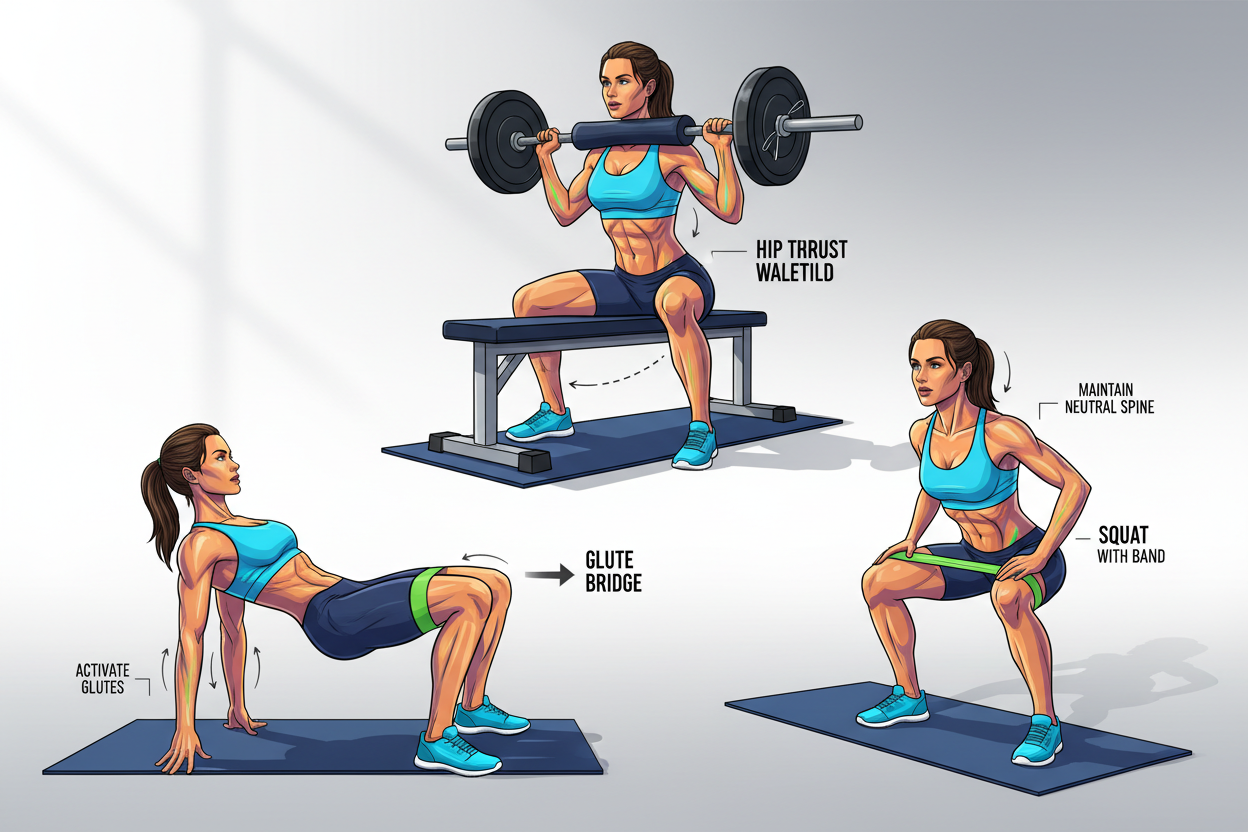
This is arguably one of the best isolation movements because it takes the hamstrings and lower back out of the equation almost entirely. Lie on your back with the soles of your feet touching, knees flared out like a frog. Place a dumbbell on your lap or use a resistance band above your knees. Bridge your hips up while squeezing your glutes hard at the top. Because the range of motion is short, you can perform high reps quickly. Aim for sets of 30 to 50 reps.
2. Seated Band Abductions
Sit on the edge of a bench with a heavy resistance band looped around your knees. Place your feet slightly wider than shoulder-width apart. Hinge forward slightly at the hips to target the upper glutes, then drive your knees outward against the band. Do 20 reps leaning forward, 20 reps sitting upright, and 20 reps leaning back. This "20-20-20" method is brutal and effective.
3. Single-Leg Hip Thrusts
You don't need a barbell for these to be effective at the end of a workout. Use your body weight or a light dumbbell. Rest your upper back on a bench, lift one foot off the ground, and drive through the heel of the planted foot. The unilateral nature of this movement ensures you aren't compensating with a stronger side. Since your glutes are already pre-fatigued from your main workout, even body weight will feel heavy.
4. Lateral Band Walks
Place a mini-band around your ankles (harder) or above your knees (easier). Drop into a quarter squat position—this is crucial, do not stand straight up. Step laterally, ensuring you are leading with your heel rather than your toe to prevent hip flexor dominance. Keep tension on the band the entire time; never let your feet come all the way together.
Structuring the Best Glute Finishers
Knowing the exercises is only half the battle. You need to combine them into a sequence that flows well and minimizes transition time. The best glute finishers are usually structured as supersets or giant sets. Here are two routine options depending on your equipment access.
Option A: The "Glute Pump" Giant Set
Perform these three exercises back-to-back with zero rest between them. Rest for 60 seconds only after completing all three. Repeat for 2 or 3 rounds.
- Banded Glute Bridges: 25 reps
- Banded Butterfly Abductions (lying on back): 20 reps
- Frog Pumps: 30 reps
Option B: The Standing Burnout
This is perfect if all the benches are taken and you only have a small corner of the gym. Perform 3 rounds with 45 seconds of rest between rounds.
- Lateral Band Walks: 15 steps to the left, 15 steps to the right
- Monster Walks (walking forward/backward with wide stance): 10 steps forward, 10 steps back
- Standing Glute Kickbacks (band around ankles): 15 reps per leg
Common Pitfalls to Avoid
Even with the right exercises, poor execution can ruin the effect. The most common error is using momentum. When you get tired, the natural tendency is to swing the weight or the leg. This shifts the tension to the lower back. If you cannot complete a rep with strict form, drop the weight or switch to a lighter band. You are chasing the burn, not a personal record.
Another issue is resting too long. If you stop for two minutes to check your phone in the middle of a finisher, you lose the metabolic accumulation you worked for. The burning sensation is the goal. Embrace the discomfort for those few minutes, knowing that it signals the end of the workout is near.
Final Thoughts on Frequency
You do not need to do a finisher after every single workout. Doing so can eventually lead to recovery issues, especially if you are lifting very heavy during your compound movements. Utilizing them once or twice a week is the sweet spot for most people. Listen to your body. If your glutes are still sore by the time your next leg day rolls around, you might be overdoing the volume. Adjust accordingly, keep the intensity high, and watch your progress accelerate.
Frequently Asked Questions
Can I do glute finishers at home without weights?
Yes, absolutely. High-repetition bodyweight movements are highly effective for metabolic stress. Exercises like single-leg glute bridges, frog pumps, and donkey kicks can provide an intense workout without any equipment if you keep the rest periods short and the rep counts high.
Should I do a finisher if I am a beginner?
Beginners can use finishers, but they should proceed with caution. Since a novice lifter will fatigue faster, it is better to start with just one round of a finisher circuit to test recovery capacity. Focus on mastering the form of the main lifts first, treating the finisher as a supplementary tool rather than the main event.
Do glute finishers help with fat loss?
While spot reduction (losing fat in one specific area) is a myth, finishers increase the overall caloric burn of a workout due to their high intensity. They contribute to the "afterburn" effect (EPOC), helping you burn more calories in the hours following your gym session, which supports overall fat loss.