Stop Waiting for the Leg Press: How to Build Massive Legs With Free Weights
There is a common misconception circulating in fitness culture that you need a gym filled with hydraulic presses, cable systems, and massive sleds to build impressive lower body strength. This couldn't be further from the truth. In reality, relying heavily on machinery can sometimes limit your athletic potential by stabilizing the weight for you, robbing your smaller stabilizer muscles of the work they need to grow. If you want to develop functional power, balance, and size, you need to strip your training back to the basics.
The most effective approach involves manipulating gravity, leverage, and free weights. Good leg workouts without machines force your body to move through natural ranges of motion, engaging your core and central nervous system in ways a seated extension simply cannot. By focusing on compound movements and unilateral training, you trigger a higher hormonal response and burn more calories, all while building legs that look as strong as they perform.
Why Free Weights Often Beat Machines
Machines lock you into a fixed path of motion. While this is helpful for isolating a specific muscle head or working around an injury, it creates a two-dimensional strength profile. Life and sport happen in three dimensions. When you perform a squat with a dumbbell or a lunge with your body weight, your body must constantly micro-adjust to keep you upright.
This process recruits a massive amount of muscle fiber that often lies dormant during machine exercises. Your adductors, abductors, and deep hip rotators have to fire in synchronization with your quads and hamstrings. This is why a 200-pound barbell squat feels significantly heavier and more taxing than a 400-pound leg press. You are lifting the weight, balancing your body, and coordinating a complex kinetic chain all at once.
My Realization on the Road
I learned this lesson the hard way a few years ago. I was traveling for work and stuck in a small town with a hotel gym that had nothing but a rack of dumbbells going up to 50 pounds and a dusty adjustable bench. I was used to loading up plates on the hack squat and thought I was in for a wasted week of training. I decided to try a high-volume leg day without machines, focusing purely on tempo and single-leg movements.
I started with Bulgarian split squats, slowing the descent to a four-second count. By the third set, my legs were shaking uncontrollably. I followed that with walking lunges and stiff-legged deadlifts. The next morning, I woke up with a level of soreness I hadn't felt in years. I realized that I had been letting the machines do the stabilizing work for me. That trip completely changed how I program leg training, proving that intensity is about how you apply tension, not just how much metal you move.
The Unilateral Advantage
If you remove machines from the equation, your best friends become single-leg (unilateral) exercises. Most people have significant strength imbalances between their left and right sides. A barbell squat might hide this, as your dominant leg compensates, but a single-leg squat exposes it immediately.
The Bulgarian Split Squat is arguably the king of these movements. By elevating your rear foot on a bench or chair, you place the entire load on the front leg. This stretches the hip flexors of the rear leg while demanding immense drive from the front glute and quad. If you don't have heavy weights, you don't need them here. Even holding moderate dumbbells can feel crushing if you maintain constant tension without locking out at the top.
Mastering the Hinge Pattern
Quads often get all the attention, but the posterior chain—your hamstrings, glutes, and lower back—is the engine of your lower body. Without a lying leg curl machine, you need to master the hip hinge. The Romanian Deadlift (RDL) with dumbbells or a kettlebell is essential.
The key here is pushing your hips back as if you are trying to close a car door with your glutes. Keep a slight bend in the knees but do not turn it into a squat. You should feel a deep stretch in the hamstrings as the weights lower. The beauty of the dumbbell RDL is that you can position the weights at your sides rather than in front of your shins, which keeps the center of gravity closer to your body and reduces shear force on the lower spine. This allows for heavy loading with a lower risk of injury compared to a conventional barbell deadlift.
Squat Variations for Home or Free-Weight Gyms
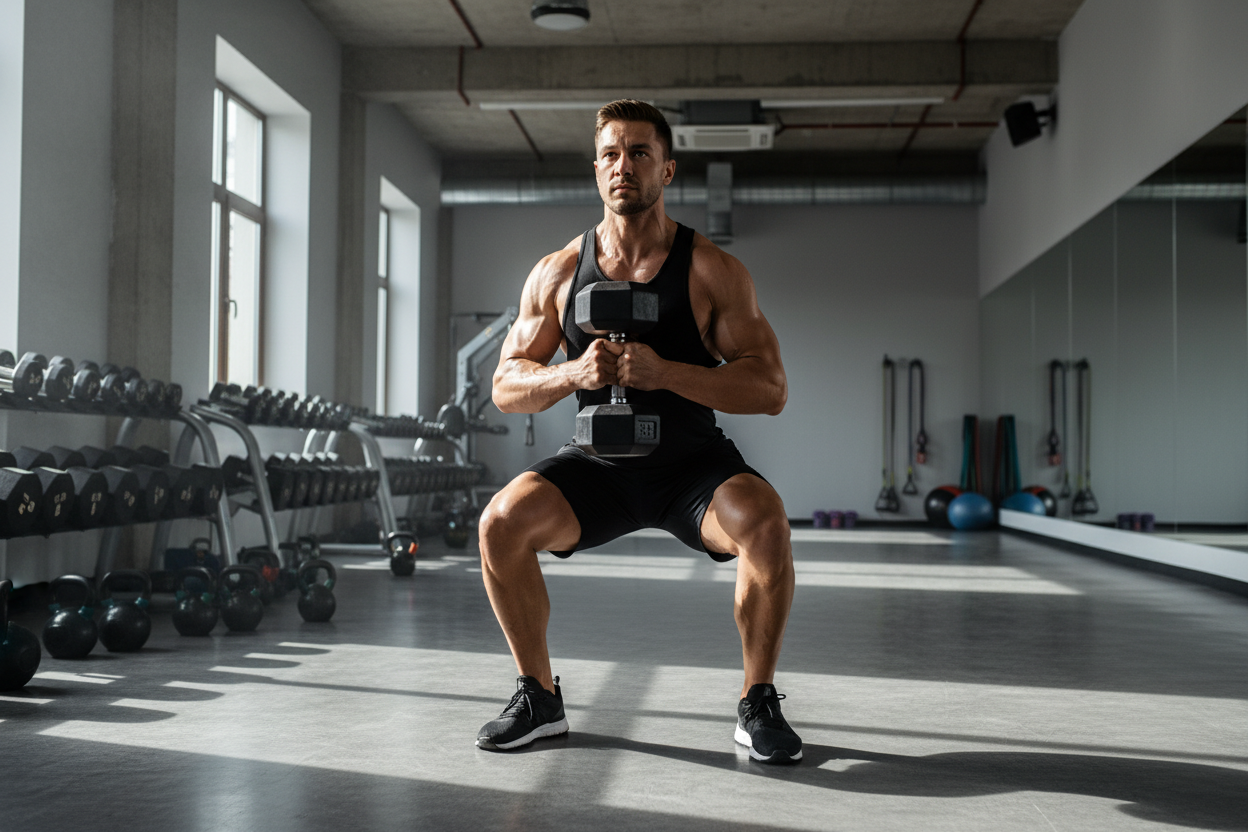
You do not need a squat rack to squat effectively. The Goblet Squat is one of the most underrated exercises for leg development. By holding a weight against your chest, you naturally shift your center of gravity backward. This forces you to keep your torso upright and allows you to sink deeper into the squat than you likely could with a bar on your back.
For those looking to add intensity, try the "1.5 rep" method. Go all the way down, come up halfway, go back down, and then return to the top. That counts as one rep. This increases the time under tension for the quadriceps and eliminates momentum. It turns a light weight into a heavy challenge very quickly.
The Finisher: Walking Lunges
To cap off a good leg workout without machines, walking lunges serve as the ultimate metabolic finisher. This movement requires dynamic stability. Every step forces you to decelerate your body weight and then explosively push forward into the next rep.
Aim for distance or high reps rather than heavy weight here. Doing 50 steps of walking lunges at the end of a session flushes the muscles with blood and depletes the remaining glycogen stores. It builds mental toughness just as much as physical strength. If you have limited space, reverse lunges are a viable alternative, though they tend to be slightly less demanding on balance.
Structuring Your Session
When putting this together, prioritize your compound movements first when your energy is highest. Start with a Goblet Squat or a heavy Dumbbell Squat. Move into your unilateral work like the Split Squat, then hit the posterior chain with RDLs. Finish with high-rep lunges or calf raises holding a weight. Rest times should be kept strictly between 60 to 90 seconds to maintain metabolic stress.
Consistency with these free-weight movements builds a type of dense, functional muscle that machines rarely produce. You become more athletic, your joints become more resilient, and you ensure that you can get a world-class workout regardless of the equipment available to you.
Frequently Asked Questions
Can I actually build mass without heavy machines?
Yes, muscle growth is driven by mechanical tension and metabolic stress, not just the specific tool used. By utilizing progressive overload—adding reps, decreasing rest time, or slowing down the tempo—you can stimulate significant hypertrophy using dumbbells and body weight alone.
How do I protect my knees during free-weight lunges and squats?
Focus on keeping your front heel planted firmly on the ground and ensure your knee tracks in line with your toes, not collapsing inward. If you experience pain, try reducing the range of motion slightly or switching to reverse lunges, which generally place less shear force on the knee joint than forward walking lunges.
How often should I do this type of leg workout?
Because free-weight leg training is more taxing on the central nervous system and stabilizer muscles than machine work, twice a week is usually the sweet spot for most lifters. This allows for adequate recovery time (48 to 72 hours) between sessions to maximize repair and growth.