Stop Using the Standing Shoulder Press Machine Like This
You’ve likely walked past it in the gym—that imposing piece of leverage equipment that looks a bit like a medieval torture device. It’s the standing shoulder press machine, often referred to as a Viking Press or Jammer Press. Most lifters skip it in favor of dumbbells or the seated military press because they simply don't know how to set it up.
That is a mistake. By ignoring this machine, you are missing out on one of the few movements that bridges the gap between raw strength and functional stability. The problem isn't the equipment; it's that most people treat it like a seated machine, just without the chair. If you aren't bracing correctly, you're just compressing your spine.
Key Takeaways: Mastering the Machine
- Core Integration: Unlike seated variations, standing forces your abs and glutes to stabilize the load, protecting your lumbar spine.
- Neutral Grip Advantage: Most standing press machines utilize a neutral (palms facing in) grip, which reduces impingement risk in the rotator cuff.
- Fixed Path Stability: It allows you to overload the muscles safely without the balance requirements of a barbell, making it ideal for hypertrophy.
- No Leg Drive: Unless training for explosive power (push press), keep the knees soft but static to isolate the deltoids.
Why Stand When You Can Sit?
The default setting for most gym-goers is to sit down for shoulder work. While seated presses are great for pure isolation, they take the rest of your body out of the equation. The standing press machine changes the dynamic entirely.
When you stand, you create a kinetic chain that starts at your feet and ends at your hands. Your glutes must fire to keep your pelvis neutral. Your abs must brace to prevent your ribs from flaring. This essentially turns a shoulder exercise into a full-body stability drill.
From a hypertrophy standpoint, this machine allows you to grind out reps safely. If your stabilizers fail on a barbell overhead press, you risk dropping the weight on your head. On a machine, you can safely push to failure.
Proper Setup and Execution
Getting the most out of a standing press machine requires more than just grabbing the handles and pushing.
1. The Stance
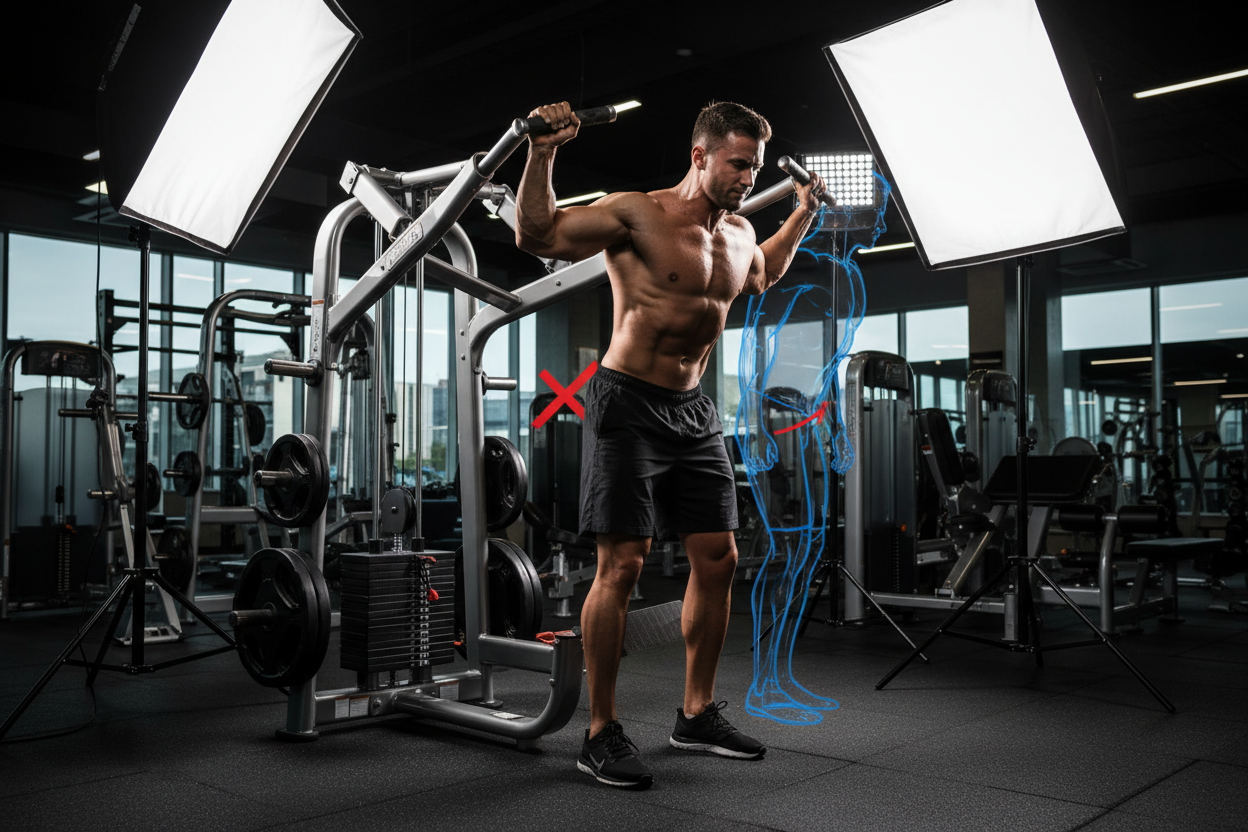
Don't stand with your feet together. Adopt a shoulder-width stance. Some lifters prefer a staggered stance (one foot forward, one back) for better balance. This reduces the urge to lean back excessively as the weight gets heavy.
2. The Grip and Elbows
Grab the handles firmly. Keep your wrists straight, not bent backward. Your elbows should be slightly in front of your torso, not flared out to the sides. This positioning aligns with the natural scapular plane, saving your shoulders from unnecessary grind.
3. The Press
Drive the handles upward explosively but with control. As you press, think about pushing your head slightly "through the window" created by your arms at the top. Do not shrug your shoulders up to your ears; keep your lats engaged to depress the scapula.
The "Viking" Variation and Mechanics
Many gyms feature a specific type of standing machine called a Viking Press. The pivot point is usually in front of you or below you, creating an arc of motion rather than a straight vertical line.
This arc matches the natural rotation of the shoulder joint better than a Smith machine. Because the weight is on a lever, the resistance curve changes throughout the lift. It’s often heaviest at the bottom and slightly lighter at the top, which aligns perfectly with your muscle's strength curve.
Common Mistakes That Kill Progress
I see these errors constantly, and they are usually the culprit behind lower back pain.
Hyperextending the Lower Back
If you lean back to turn the press into a standing incline chest press, the weight is too heavy. This puts massive shear force on your lumbar spine. Squeeze your glutes hard. If your glutes are tight, your lower back cannot hyperextend.
Using Momentum
This isn't a push press. Bouncing at the knees to get the weight moving robs your deltoids of tension. Keep your lower body rigid. The only thing moving should be your arms.
My Training Log: Real Talk
I remember the first time I used a plate-loaded Viking press at a warehouse gym. It looked rugged, just raw steel and knurling.
The first thing I noticed wasn't the pump—it was the grip width. The handles were fixed, and they were slightly wider than my shoulders. When I unracked it, the metal felt cold and unforgiving, no rubber grips to hide behind. I remember the specific "clank-thud" sound the machine made when I bottomed out on the first rep because I hadn't set the stop-pins correctly for my height. It jolted my wrists instantly.
But the biggest realization came on the third set. My core was on fire. I wasn't doing crunches, but because the weight was leveraged forward, my abs were fighting to keep me upright. With dumbbells, I usually fail because of balance; with this machine, I failed because my delts were genuinely toast. That burning grit in the front delts—without the nagging pain in my rotator cuff—is exactly why I keep this in my rotation.
Conclusion
The standing shoulder press machine is an underutilized tool that offers the safety of a machine with the functional demands of free weights. It protects your joints while hammering your deltoids. Stop walking past it. Adjust the height, brace your core, and press with intent.
Frequently Asked Questions
What muscles does the standing shoulder press machine work?
It primarily targets the anterior (front) and medial (side) deltoids. However, because you are standing, it heavily recruits the triceps, upper chest (clavicular head), and the entire core musculature for stabilization.
Is the standing press machine safer for the back than a barbell press?
Generally, yes. The machine provides a fixed path of motion, which reduces the likelihood of the weight drifting backward and forcing your spine into hyperextension. However, you must still brace your core to ensure safety.
Can I use this machine if I have shoulder pain?
Many lifters with shoulder issues find the standing press machine more comfortable than barbells. The neutral grip (palms facing each other) often available on these machines opens up the shoulder joint space, reducing the risk of impingement during the press.