Stop Tripping Over Your Weights: The Ultimate Guide to Barbell Storage
There is a specific sound that haunts every home gym owner: the deafening clang of a steel bar rolling off a bench and hitting the concrete floor. If you have been lifting for any amount of time, you know that acquiring equipment is the fun part, but figuring out where to put it all is the headache. Most people start with a single bar and a few plates, leaning them casually in a corner. Fast forward a year, and you have specialty bars, curl bars, and a trap bar cluttering your footprint. This isn't just an organizational failure; it is a safety hazard and a quick way to damage expensive gear.
Proper storage is the backbone of a functional training space. While we obsess over the tensile strength of a barbell or the calibration of plates, the humble barbell rack often gets overlooked until it is absolutely necessary. Organizing your lifting zone does more than clear up floor space; it protects the knurling on your bars and prevents the bearings from accumulating dust and grime from the ground. Whether you are outfitting a garage gym or managing a commercial facility, how you store your steel dictates the flow and safety of your workouts.
Why Your Bar Storage Method Matters
I learned the importance of proper storage the hard way. A few years ago, I was training in a cramped garage setup with zero organization. I had a standard Olympic bar and a safety squat bar leaning against a drywall corner. During a heavy deadlift session, I set the weights down with a bit too much vibration, and the safety squat bar slid sideways, taking a chunk out of the wall and landing inches from my ankle. That near-miss was the wake-up call I needed. I realized that leaning heavy steel against a wall isn't storage; it's an accident waiting to happen. Investing in a sturdy rack for barbell organization immediately changed the vibe of the room from "chaotic storage unit" to "dedicated training facility."
Beyond personal safety, leaving bars on the ground or leaning them vertically without support puts uneven pressure on the sleeves. Over time, this can damage the bushings or bearings, affecting the spin of the bar. If you have spent good money on a precision piece of equipment, tossing it on the floor is counterintuitive.
Choosing Between Vertical and Horizontal Storage
The two main categories for storage are vertical stands and horizontal gun racks. Your choice largely depends on your available space and the type of bars you own. A vertical gym barbell stand is often the go-to for tight spaces. These typically feature 5 to 9 tubes that hold the bars upright by their sleeves. They have a tiny footprint, usually less than two square feet, making them ideal for garage gyms where floor space is at a premium.
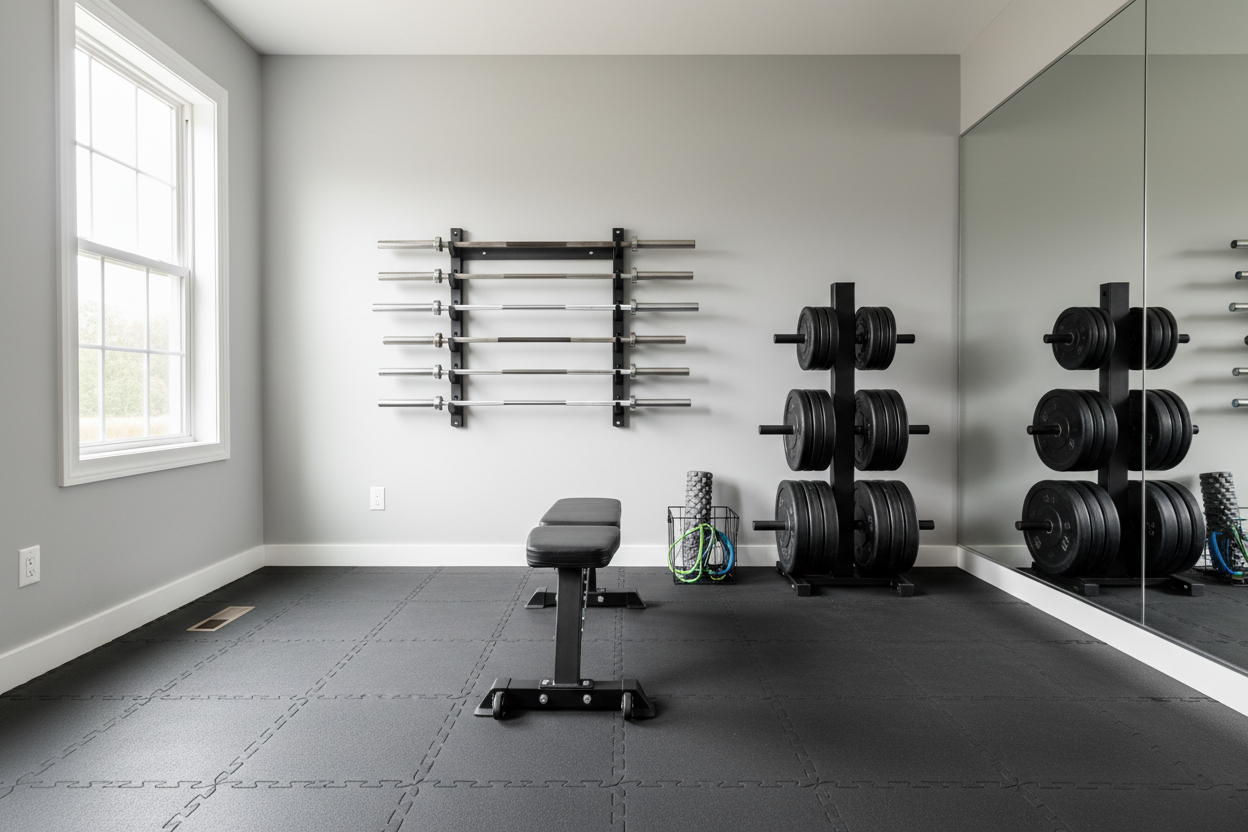
However, vertical storage has limitations. If you have a low ceiling, you might struggle to pull a 7-foot bar out of the holder without hitting the roof. Additionally, some specialty bars with unique sleeve designs don't fit well in standard tubes. In contrast, horizontal racks mount to the wall. This is often the preferred gym barbell rack style for displaying collections. It keeps the bars off the floor entirely and allows you to easily identify the bar you want. The downside is that they require wall space and proper installation into studs to handle the load.
The Commercial vs. Home Setup
In a commercial setting, durability and volume are the main concerns. A busy barbell rack gym setup needs to withstand constant abuse. Members aren't always gentle when they re-rack weights. Commercial racks are generally built with heavier gauge steel and feature protective liners—usually UHMW plastic—to prevent metal-on-metal contact. If you are building a high-traffic area, you cannot skimp on these materials.
For home users, the options are more flexible. You might see terms like barbell carrier used in product descriptions. While sometimes used interchangeably with storage racks, a carrier can also refer to portable devices designed to help you move heavy bars and plates from one area to another. For stationary storage, sticking to a dedicated wall mount or floor stand is usually the best bet.
Key Features to Look For
When you are ready to buy, look closely at the contact points. The best barbells rack designs feature plastic or rubber lining where the bar rests. Metal-on-metal contact dulls the knurling—the grip pattern on the shaft—which is crucial for your lift. If you have a black zinc or cerakote finish on your bar, a bare metal rack will scratch that finish off within weeks.
Spacing is another critical factor. If you buy a horizontal rack, ensure the hooks are spaced widely enough to accommodate the shaft length of your bars but narrow enough to fit shorter specialty bars like curl bars. Some generic racks have fixed spacing that works for standard Olympic bars but fails when you try to rack barbell variations that are shorter or oddly shaped.
Stability is non-negotiable. If you opt for a floor-standing unit, check the base width. A narrow base becomes top-heavy once you load it up. You want a barbell and rack combination that feels like it is bolted to the earth, even if it is free-standing. For wall-mounted units, hardware is key. Never use drywall anchors for holding barbells. You must lag bolt these into wooden studs or use concrete anchors if mounting into masonry.
Organizing for Workflow
Placement is just as important as the equipment itself. Place your rack near your lifting platform or power rack. You don't want to carry a 45lb bar across the room every time you switch exercises. In a well-designed barbell rack gym environment, the flow of traffic is considered; the storage is accessible but not in the way of active lifting zones.
If you have a mix of equipment, consider a hybrid storage system. Some power racks come with add-on attachments that allow you to store bars vertically attached to the uprights of the cage. This is a "zero footprint" solution that utilizes the structure you already have. It is essentially a single-bar gym barbell rack attached directly to your squat stand.
Maintenance of Your Storage
Once you have your storage set up, keep it clean. Dust settles into the tubes of vertical stands, which can eventually gum up your bar sleeves. A quick vacuum out of the holders every few months helps. For horizontal racks, check the tightness of the wall bolts periodically. Wood expands and contracts with seasons, and the heavy load can loosen fasteners over time. Ensuring your barbells rack securely ensures your safety.
Ultimately, the goal is to create a space that invites you to train. When you aren't tripping over equipment, and you know exactly where everything is, your mental focus shifts entirely to the workout. A quality rack isn't the sexiest purchase you will make for your gym, but it is undoubtedly one of the most important for longevity and safety.
Frequently Asked Questions
Does storing a barbell vertically damage it?
Generally, no. Storing a barbell vertically in a proper stand will not bend the bar or damage the bearings, provided the weight is resting on the sleeve and not the shaft. However, cheaper bars with loose bushings might leak small amounts of oil over time if stored upright, but for high-quality equipment, it is perfectly safe.
How much space do I need for a horizontal wall rack?
You need a wall width of roughly 8 to 9 feet to comfortably store full-length Olympic bars horizontally. While the rack brackets themselves are usually spaced about 4 to 5 feet apart to catch the shaft, you need clearance on both sides to maneuver the bar in and out without hitting adjacent walls or equipment.
Can I mount a barbell rack into drywall?
Absolutely not. A standard barbell weighs 45lbs (20kg), and a fully loaded rack can easily exceed 200lbs. Drywall anchors cannot support this dynamic load. You must mount horizontal racks directly into wooden wall studs or concrete using heavy-duty lag bolts to prevent the rack from ripping off the wall.