Stop Splitting: The Real Full Body Lean Muscle Workout
You’re standing in your garage, staring at a rack that cost more than your first car and a pile of iron that’s slowly oxidizing in the humidity. You have 45 minutes before the rest of the house wakes up and starts demanding breakfast. Why on earth are you spending twenty of those minutes doing three variations of bicep curls? Bodybuilding splits are a luxury for people who don’t have real jobs or who have 'assistance' in the recovery department.
If you want to actually look like you lift while maintaining the ability to move like a human being, you need a full body lean muscle workout that prioritizes movement over mirrors. I’ve spent years chasing the 'pump' only to realize I was just getting tired, not stronger. Switching to a movement-based approach changed everything.
Quick Takeaways
- Ditch the 'Chest Day' mentality; your body works as a unit, not a collection of parts.
- Focus on the 5 pillars: Push, Pull, Squat, Hinge, and Carry.
- Three full-body sessions per week beat five mediocre split sessions every time.
- Stability is king—if your feet are sliding on bare concrete, your gains are leaking.
Why Your 'Chest Day' is Wasting Garage Gym Time
Most of us grew up reading magazines that told us Monday is for chest, Tuesday is for back, and Friday is for legs. That works if you’re a professional bodybuilder with four hours to kill and a chemical edge. For the rest of us training in a 10x10 space, it’s a recipe for plateaus and weird imbalances. When you isolate muscles, you miss out on the systemic fatigue that actually triggers growth.
In a home gym, every minute counts. If you’re only hitting your chest once a week, you’re waiting 168 hours between growth signals. That’s inefficient. By adopting a full body workout for muscle and strength, you hit those muscle groups three times a week. You aren't doing 12 sets of chest in one go; you’re doing 4 sets, three times. The total volume is the same, but the frequency keeps protein synthesis spiked all week long.
Plus, let’s be honest: isolated 'arm days' in a garage feel a bit silly when you could be getting bigger arms as a byproduct of heavy weighted pull-ups and rows. I’ve found that my physique actually filled out more once I stopped obsessing over my peaks and started obsessing over my press numbers. You don't need a pec deck; you need a heavy barbell and a plan that doesn't waste your morning.
The 5 Pillars of a Full Body Workout for Lean Muscle Mass
To build a physique that isn't just for show, you have to cover the fundamental human movements. I categorize everything into five buckets: Push, Pull, Squat, Hinge, and Carry. If your program hits these five, you literally cannot have a weak link. It’s impossible to have a small chest if you have a massive overhead press and bench. It’s impossible to have chicken legs if you’re squatting and hinging heavy twice a week.
The Push and Pull are obvious, but people mess them up by only working in one plane. You need vertical pushes (overhead press) and horizontal pushes (bench press). Same for pulls—lat pulldowns are great, but heavy barbell rows are what put meat on your frame. This balanced approach is the secret to a full body workout for lean muscle mass that doesn't leave you with rounded shoulders or a 'beach muscle' only look.
Then there’s the Hinge and the Squat. These are the engines of your body. A hinge (think deadlifts or RDLs) targets the posterior chain—the stuff you can't see in the mirror but everyone else notices. The squat builds the foundation. Finally, the Carry. This is the most underrated movement in the book. Pick up the heaviest kettlebells or dumbbells you own and walk until your grip fails. It builds traps, forearms, and a core that feels like a brick wall.
Swapping Muscle Groups for Movement Categories
If you’re struggling to let go of the old terminology, here’s a quick translation. Instead of 'Back Day,' think Vertical Pull (pull-ups) and Horizontal Pull (rows). Instead of 'Leg Day,' split it into Squat patterns (quad dominant) and Hinge patterns (glute and hamstring dominant). This mental shift ensures you're building a full body workout for lean muscle that is structurally sound.
For example, a traditional 'Shoulder Day' might involve front raises, side raises, and rear delt flies. That’s a lot of fluff. Swap that for a heavy Overhead Press (Push) and a Face Pull (Pull). You’ll move more weight, trigger more testosterone release, and save about 20 minutes of standing around. I used to spend forever on 'trap shrugs' until I realized heavy deadlifts and farmer's carries made my traps explode without a single shrug.
Structuring Your Weekly Movement Matrix
You don't need to live in your garage to see results. A 3-day split (Monday, Wednesday, Friday) is the sweet spot for recovery. Each session should include one exercise from each of the five pillars. To keep from burning out, I use a 'Heavy, Medium, Light' rotation. Monday might be heavy squats and light presses; Wednesday might be heavy pulls and medium squats.
This variety keeps the joints happy. If you try to max out your deadlift three times a week, you'll be broken by week four. But if you deadlift heavy on Monday and do light kettlebell swings as your hinge on Friday, you're still practicing the movement and building muscle without the CNS burnout. You can explore our workout hub to see exactly how to execute these movements with proper form—especially the barbell work where technique is the difference between a PR and a trip to the chiropractor.
The beauty of this matrix is its flexibility. If you're short on time, you can superset your Push and Pull. Do a set of bench presses, rest 60 seconds, then do a set of rows. It doubles your work capacity in the same timeframe. I’ve personally found that supersetting opposite movements actually makes me stronger on the second exercise because of the antagonist muscle inhibition. It’s science, but it feels like a cheat code.
Don't Let Your Garage Floor Ruin Your Heavy Lifts
Stability is the most overlooked variable in home gym gains. I’ve seen guys try to deadlift 400 pounds on a slick concrete floor or a piece of cheap carpet. It’s dangerous and it’s killing your power output. Your brain won't let your muscles fire at 100% if it senses your feet aren't secure. It’s a built-in safety mechanism you can't override.
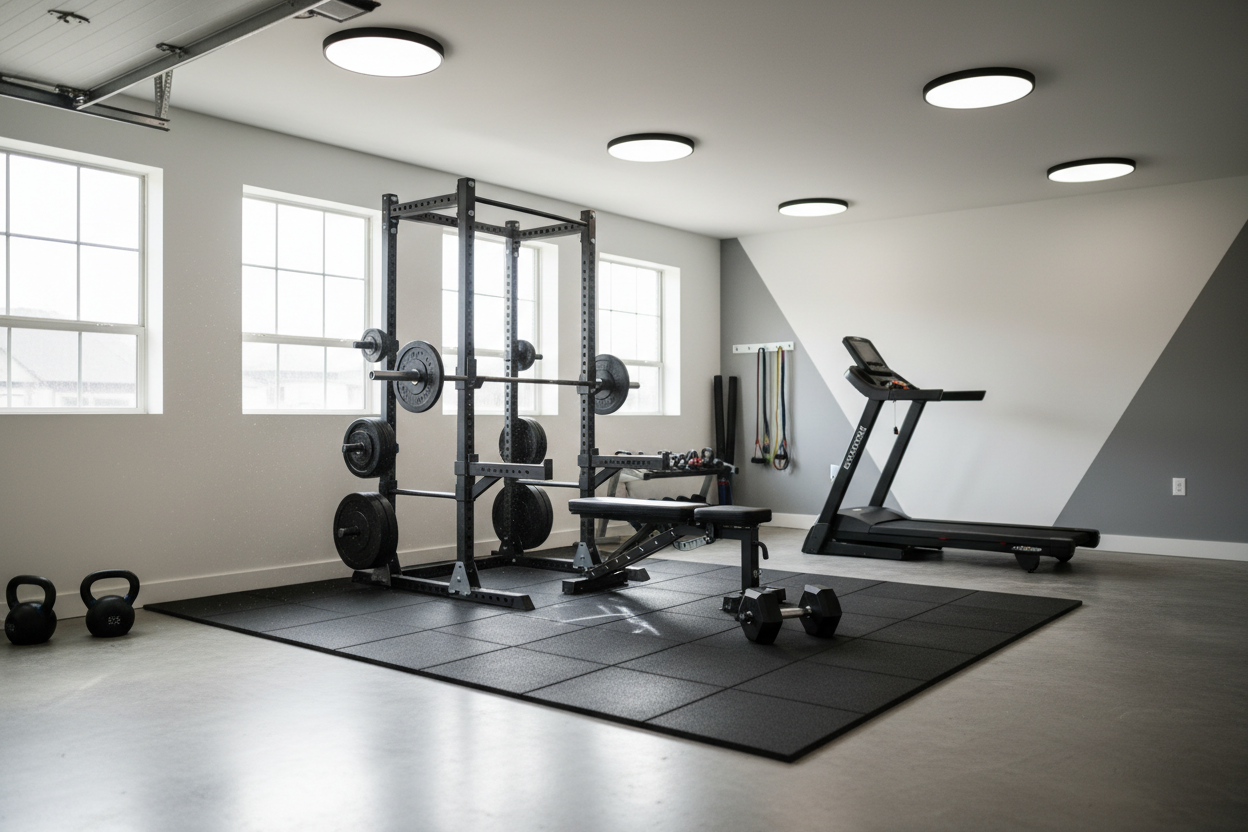
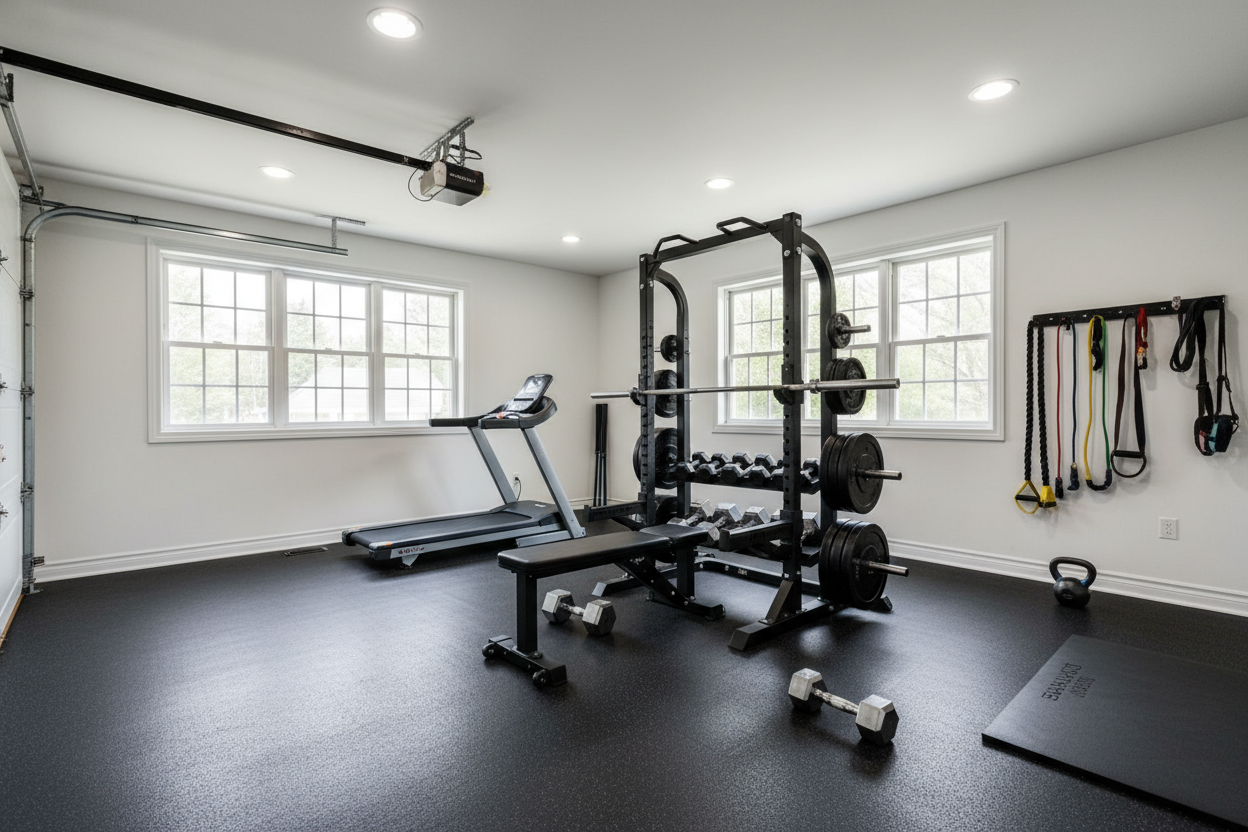
When you’re doing farmer's carries or heavy squats, you need a surface that bites back. Bare concrete is porous and gets dusty, which is basically like standing on ball bearings once you start sweating. Investing in high-quality gym flooring for home workout is just as important as the bar you’re holding. You need that 7mm to 10mm thickness to absorb the vibration and provide the traction required for max effort movements.
I learned this the hard way when my lead foot slipped during a heavy split squat. I didn't tear anything, but I tweaked my groin enough to be out for two weeks. Now, I don't lift on anything that isn't high-density rubber. It’s not just about protecting the floor from dropped plates; it’s about creating a stable platform so you can actually push your limits without worrying about a slip.
My Personal Mistake: The 'More is Better' Trap
A few years ago, I convinced myself that I needed a 6-day PPL (Push/Pull/Legs) split. I was obsessed. I had the rack, the competition bumpers, and the fancy Ohio Power Bar. But I was exhausted. My 'lean muscle' was disappearing because I wasn't recovering, and my joints felt like they were filled with sand. I was doing 'Chest Day' on Monday and then 'Shoulder Day' on Tuesday, not realizing my triceps and front delts were getting hammered 48 hours in a row.
I swallowed my pride and cut back to three full-body days. I focused on getting my squat from 275 to 315 and my weighted pull-up from a 25-lb plate to a 45-lb plate. Within three months, I looked bigger and leaner than I ever did on the 6-day split. Intensity and recovery beat 'busy work' every time. If you can't get it done in five movements, you're probably just playing around.
FAQ
How long should these sessions take?
If you’re focused, 45 to 60 minutes. That includes a 5-minute dynamic warm-up. If you’re spending two hours in the garage, you’re talking too much to your dog or scrolling Instagram between sets.
Can I build muscle without a squat rack?
You can go a long way with heavy dumbbells and a bench, but a rack is the gold standard for safety and loading. If you're serious about the 'Squat' and 'Hinge' pillars, you'll eventually need a way to get a heavy bar onto your back.
What if I only have 20 minutes?
Pick two: A Squat and a Pull. Or a Hinge and a Push. Do them as a circuit with minimal rest. It’s not the 'ideal' full body session, but it’s infinitely better than doing nothing.