Stop Ruining Your Gains: The Best Legs Workout Routine Decoded
Leg day is the ultimate litmus test for any lifter. It separates those who want a balanced physique from those who just want to look good in a t-shirt. But here is the problem: most people overcomplicate the process with endless variations, forgetting that the best legs workout routine relies on intensity and mechanical tension, not just variety.
If you have been skipping lower body sessions or just going through the motions on the leg press, you are leaving massive systemic growth on the table. We are going to strip away the fluff and look at how to construct a leg day that actually forces adaptation.
Key Takeaways for Leg Development
- Prioritize Compound Lifts: Start with multi-joint movements (Squats, Deadlifts) when your central nervous system is fresh.
- Volume vs. Intensity: You don't need 30 sets. You need 10-12 sets taken close to muscular failure.
- posterior Chain Neglect: Most lifters are quad-dominant. A balanced routine must hammer the hamstrings and glutes equally.
- Progressive Overload: If you aren't adding weight or reps every week, you aren't growing.
The Anatomy of an Effective Leg Day
To build a complete lower body, you need to understand what you are targeting. An effective at gym leg workout needs to hit three main areas: the Quads (front thigh), the Hamstrings (back thigh), and the Glutes.
Many lifters make the mistake of piling on quad exercises while ignoring the posterior chain. This not only looks unbalanced but leads to knee injuries down the road. The routine below balances anterior (push) and posterior (pull) movements.
The Core Routine: Heavy & High Tension
This is not a list of random exercises. This is a structured approach designed for hypertrophy.
1. The Primary Knee-Dominant Lift (Squat Variation)
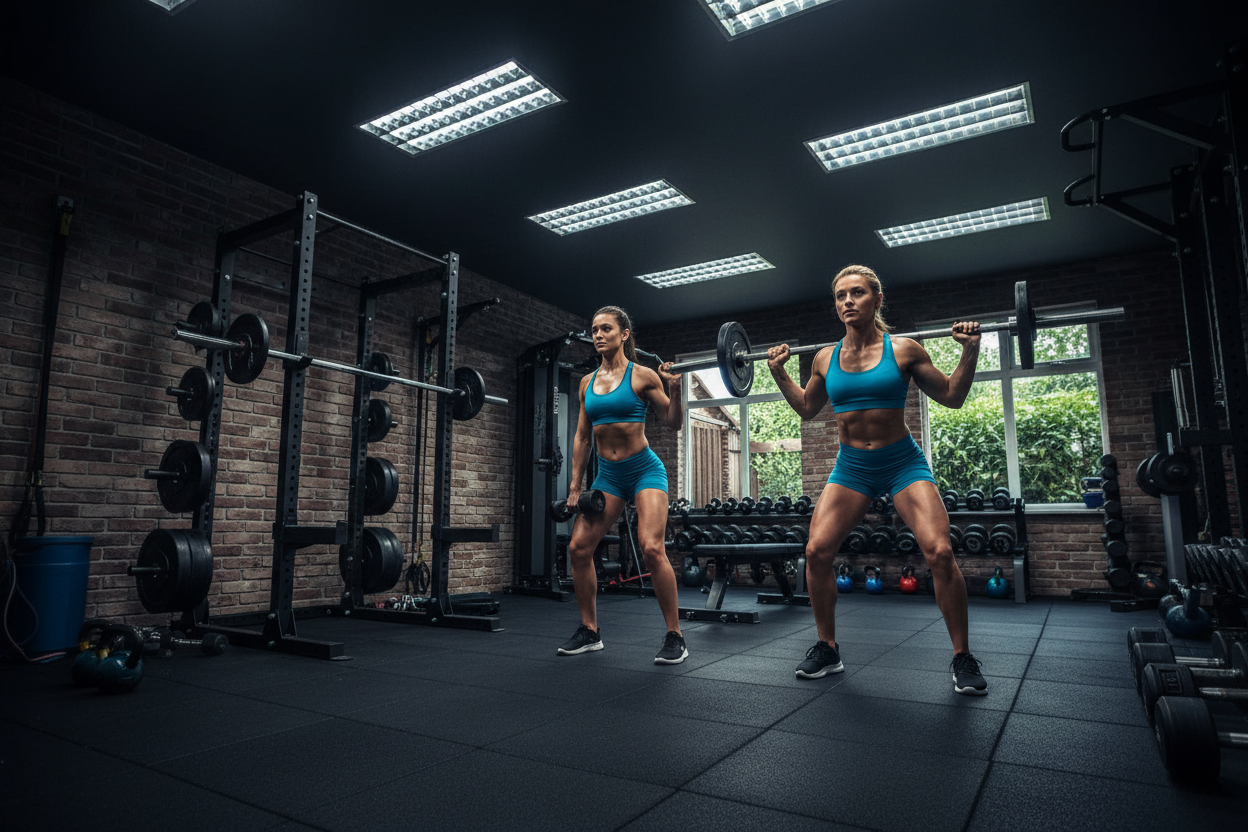
Whether it is a High-Bar Back Squat, Front Squat, or a Hack Squat, this is your bread and butter. The goal here is mechanical tension.
The Focus: Control the eccentric (lowering) phase. Don't just drop into the hole. Fight gravity on the way down, pause for a split second, and explode up.
2. The Primary Hip-Hinge (Romanian Deadlift)
For the hamstrings and glutes, the Romanian Deadlift (RDL) is superior to the standard deadlift for pure muscle growth because it keeps constant tension on the muscle belly.
The Cue: Imagine trying to shut a car door with your butt. Keep your knees soft but fixed, and shove your hips back until you feel a deep stretch in the hamstrings.
3. Unilateral Movement (Bulgarian Split Squats or Lunges)
This is where the intense leg workout at gym reality sets in. Unilateral work fixes imbalances and places immense load on the stabilizers.
Why it works: It removes the lower back as a limiting factor, allowing you to take the quads and glutes to absolute failure safely.
The "Finisher" Circuit
If you are looking for a leg day circuit gym style ending to torch calories and induce metabolic stress, use this tri-set. Perform these back-to-back with no rest.
- Leg Extensions: 15 reps (Hold the peak contraction for 1 second).
- Lying Leg Curls: 15 reps (Control the negative).
- Calf Raises: 20 reps.
Repeat this loop 3 times. This floods the muscles with blood (the pump), stretching the fascia and signaling growth factors.
Short on Time? The Condensed Version
Sometimes you don't have 90 minutes. The best quick leg workout strips away the isolation movements and focuses purely on supersets.
The Strategy: Superset a Goblet Squat with a Dumbbell RDL. Do 4 sets of 10 reps each, resting only 90 seconds between supersets. You will be done in 25 minutes, but if you lift heavy enough, you won't be able to walk straight.
My Training Log: Real Talk
I want to be honest about what this routine actually feels like. I remember the first time I truly committed to the "tension over weight" principle on this specific routine.
It was the Bulgarian Split Squats that humbled me. On paper, holding 40lb dumbbells doesn't look impressive. But I was focusing on keeping all the weight in my front heel and not bouncing off the bottom.
By the third set, I experienced that specific, nauseating wobble in my VMO (the teardrop muscle above the knee). It wasn't just general fatigue; it was a localized failure where my leg simply refused to extend. The worst part? The drive home. My foot was shaking so badly on the brake pedal at a red light that I had to shift into park just to relax the tension. That is the difference between "exercising" legs and training them.
Conclusion
Building massive legs isn't about finding a secret machine or a magic rep range. It is about executing the basics with violent intensity. Whether you are doing a long session or a best quick leg workout, the effort you put in determines the output. Stop skipping the hard reps.
Frequently Asked Questions
How often should I perform this leg routine?
For most natural lifters, hitting legs twice a week is the sweet spot. This allows for sufficient volume (10-20 sets per week) while giving you 2-3 days of recovery between sessions to repair tissue.
Can I do this workout with just dumbbells?
Absolutely. While an at gym leg workout usually implies barbells, you can swap Back Squats for Goblet Squats and RDLs for Dumbbell RDLs. The key is to increase the reps or decrease rest time to compensate for the lower absolute load.
What if I don't feel my glutes activating?
This is common. Before your heavy lifts, do 2 sets of bodyweight glute bridges or band walks. This "wakes up" the neuromuscular connection, ensuring your glutes—not your lower back—take the load during squats and lunges.