Stop Ruining Performance: The Real Shoulder Workout for Athletes
Most athletes train their shoulders incorrectly. They walk into the weight room and default to the same bodybuilding isolation movements that aesthetic lifters use: seated dumbbell presses, lateral raises, and machine flyes. While these build muscle size, they often fail to address the dynamic stability required for high-performance sports.
If you want to throw harder, punch faster, or absorb contact without injury, you need a shoulder workout for athletes that prioritizes the entire kinetic chain, not just the deltoid cap. It is time to shift your focus from mirror muscles to movement mechanics.
Key Takeaways: Athletic Shoulder Training
- Function over Isolation: Athletes must train shoulders to work in coordination with the hips and core, rather than isolating the muscle while seated.
- Scapular Health is Priority: If the shoulder blade (scapula) doesn't move correctly, the rotator cuff takes the beating.
- Unilateral Movement: Single-arm work corrects imbalances and forces the core to stabilize against rotation.
- Time Under Tension: For stability, controlled tempos often outperform explosive reps in accessory work.
Why Bodybuilding Routines Fail Athletes
Traditional bodybuilding focuses on the "pump" and isolating a specific head of the deltoid. For a linebacker or a tennis player, this is counterproductive. In sports, the shoulder never works in isolation.
When you perform a seated military press, you remove the legs and core from the equation. You create a false sense of stability provided by the bench. On the field, that bench isn't there. If you cannot transfer force from the ground, through your torso, and out through your arm, that strength is useless.
The Core Pillars of Athletic Shoulder Exercises
To build a bulletproof upper body, we need to integrate athletic shoulder exercises that respect the anatomy of the joint. The shoulder is a ball-and-socket joint designed for immense mobility, which makes it inherently unstable. Your training must add the stability back in.
1. The Scapulohumeral Rhythm
Your arm bone (humerus) and shoulder blade (scapula) must move in sync. Many machines lock the scapula in place, which leads to impingement over time. We need exercises that allow the shoulder blade to glide freely around the ribcage.
2. The Transverse Plane
Athletes rotate. Whether swinging a bat or throwing a hook, force is generated rotationally. Your shoulder routine must include movements that challenge the joint while the body is rotating or resisting rotation.
The Best Shoulder Exercises for Athletes
Forget the Smith Machine. Here are the movements that translate directly to sport performance.
The Half-Kneeling Landmine Press
This is arguably the king of overhead pressing for sports. By using a landmine setup (barbell anchored in a corner), you press at an arc rather than straight up. This is much friendlier on the shoulder joint.
Doing this in a half-kneeling position creates a massive stretch through the hip flexor and forces the glute to stabilize the pelvis. It connects the driving force of the hip to the extension of the arm.
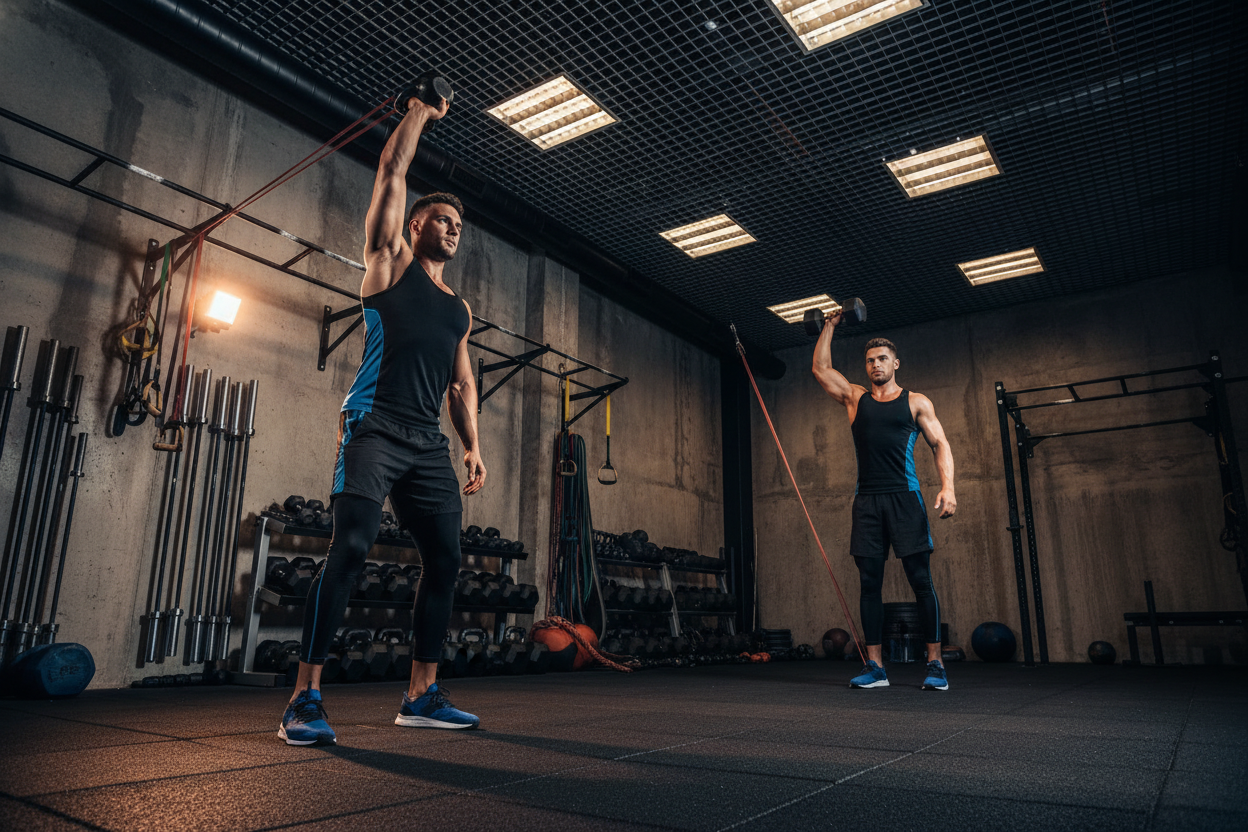
Bottoms-Up Kettlebell Press
If you want to expose weak stabilizers instantly, try this. Hold a kettlebell upside down (handle in palm, heavy bell facing the ceiling) and press.
Because the center of gravity is unstable, your rotator cuff has to scream to keep the bell upright. You physically cannot press heavy weight if your mechanics are sloppy. It is self-correcting and builds incredible grip strength alongside shoulder stability.
Face Pulls with External Rotation
Most athletes are internally rotated (hunched forward) due to tight pecs and lats. Face pulls are essential for structural balance. They target the rear delts and the external rotators of the cuff.
Don't just pull to your face; pull apart and rotate your hands back as if you are hitting a double-bicep pose. This resets the shoulder posture.
My Training Log: Real Talk
I remember the first time I swapped my heavy seated dumbbell presses for the bottoms-up kettlebell press. I thought I was strong. I was pressing 80lb dumbbells for reps easily. I grabbed a 12kg (26lb) kettlebell, flipped it upside down, and tried to press it.
I couldn't even get it past my ear. The bell flopped over immediately, twisting my wrist with it. The humiliation was instant.
The wobble was uncontrollable. I could feel the tiny muscles around my shoulder blade spasming, trying to find stability that just wasn't there. It wasn't that I lacked the raw horsepower; I lacked the transmission system to control it. That specific, shaky feeling—where the weight feels light but impossible to control—was the wake-up call I needed. It took me three months of dropping the ego to finally press that 12kg bell with a vertical forearm. My bench press didn't go down; my shoulder pain just disappeared.
Conclusion
Building shoulders for sports isn't about how wide you look in a jersey; it's about how well your joint functions under stress. By focusing on stability, kinetic linking, and scapular health, you build durability.
Stop training for the mirror. Train for the movement.
Frequently Asked Questions
How often should athletes train shoulders?
Direct shoulder work can be done 2 times per week, but remember that shoulders are involved in almost every other upper body movement (bench press, rows, chin-ups). Volume management is key to preventing overuse injuries.
Is the overhead press dangerous for overhead athletes?
It can be if mobility is lacking. If an athlete lacks thoracic (upper back) extension, they will compensate by arching their lower back. The Landmine Press is often a safer alternative as it requires less overhead mobility while still training the pressing pattern.
Should athletes do upright rows?
Generally, no. Upright rows place the shoulder in a position of internal rotation while lifting under load, which significantly increases the risk of shoulder impingement. Face pulls or high pulls are superior best shoulder exercises for athletes looking for upper back development.