
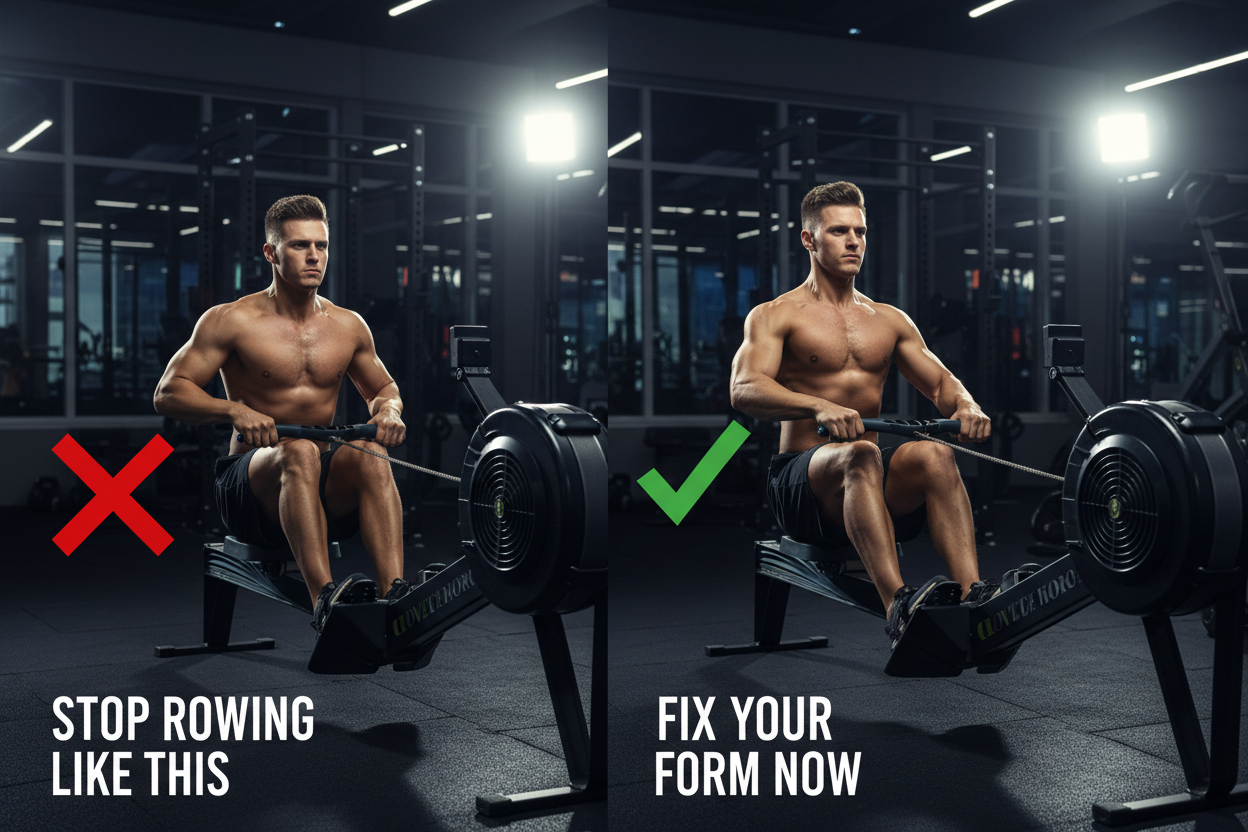
Stop Rowing on Machine Like This (Fix Your Form Now)
Walk into any commercial gym, and you will see a familiar sight: the rowing machines (often called ergs) sitting empty. Or worse, you see someone thrashing back and forth, risking a lumbar injury with every stroke. Rowing on machine setups offers one of the highest calorie burns and muscle engagement ratios of any cardio equipment, yet it is the most frequently misused tool on the floor.
The problem isn't the machine; it's the lack of intuition. Unlike a treadmill where you just run, the rower requires a specific mechanical sequence. If you get the sequence wrong, you kill your momentum and hurt your back. If you get it right, you unlock a total-body power endurance workout that running simply cannot match.
Key Takeaways: The 4-Step Stroke Summary
- The Setup: Place foot straps over the widest part of your foot (not the toes). Set the damper between 3 and 5, not 10.
- The Catch: Shins vertical, arms extended, core braced. Do not over-compress the knees.
- The Drive (Power Phase): Push with legs first. Swing the body second. Pull arms last. (Legs-Body-Arms).
- The Finish: Handle touches the sternum, slight lean back (11 o'clock position), elbows tucked.
- The Recovery: Extend arms, swing body forward, then bend knees. (Arms-Body-Legs).
Getting Started: Setup and Settings
Before you pull the handle, you need to understand the hardware. If you are wondering what does a rowing machine look like up close, it is essentially a sliding seat, a footplate, and a flywheel. The most critical adjustment is the damper lever on the side of the flywheel fan.
The "Damper Setting 10" Myth
A common error in how to use a rowing machine in the gym is cranking the lever to 10. This does not necessarily increase the workout intensity; it increases the drag factor (like rowing a heavy wooden boat vs. a sleek racing shell). For 90% of athletes, a setting between 3 and 5 is optimal. It allows for a quick catch and sustainable rhythm. A setting of 10 often leads to fatigue before your cardiovascular system actually gets a workout.
How to Use a Rowing Machine Correctly: The Stroke Cycle
To learn how to row correctly, you must view the movement as a pushing exercise, not a pulling one. The power comes from the hips and quads, not the biceps. Here is the step-by-step breakdown of how to use a rowing machine properly.
1. The Catch (Starting Position)
Slide forward until your shins are vertical. Keep your heels down as long as possible, though they may lift slightly at the very end. Your arms should be straight out, holding the handle loosely. Think of your body like a compressed spring ready to uncoil.
2. The Drive (The Work)
This is where people get confused about how to work a rowing machine. The sequence is non-negotiable: Legs, Body, Arms.
- Legs: Explode back by driving your heels into the footplates. Keep your arms straight and back upright.
- Body: Once the legs are nearly straight, swing your torso backward from the hips.
- Arms: Finally, pull the handle to your lower chest/sternum.
If you pull with your arms while your knees are still bent, you lose power. This disconnect is the main reason people feel it in their lower back instead of their lats and glutes.
3. The Finish
At the back of the stroke, your legs are flat, shoulders are behind your hips, and the handle is touching your body. Do not pause here. The flywheel is spinning, and you need to move with it.
4. The Recovery (The Reset)
This is the relaxation phase. To perform the proper way to use rowing machine mechanics, reverse the drive sequence: Arms, Body, Legs.
- Arms: Punch the hands away from your chest.
- Body: Pivot the torso forward (hip hinge).
- Legs: Once the handle clears your knees, bend the knees to slide forward.
A major mistake is bending the knees too early. If you do this, you have to lift the handle over your knees to get back to the catch. This creates a "rainbow" motion with the chain that ruins your efficiency.
Common Mistakes When Using a Rowing Machine
Shooting the Slide
This happens when your seat shoots backward, but the handle doesn't move. It means your legs pushed, but your core wasn't braced to transfer that power to the handle. To fix this, visualize hanging off the handle with your lats as you push.
The Death Grip
Don't strangle the handle. How to properly use a rower machine involves grip endurance. Hook your fingers around the handle; thumbs can even rest on top. Squeezing too hard wastes forearm energy and raises your blood pressure unnecessarily.
My Training Log: Real Talk
I remember my first 2,000-meter time trial on a Concept2. I thought I was fit because I lifted heavy. I set the damper to 10 because I had an ego. By the 800-meter mark, my forearms were pumped so hard I couldn't open my hands, and my lower back felt like it was being compressed by a vice.
But the real reality check wasn't the pain; it was the "Concept2 Cough." After finishing (with terrible form), I spent 20 minutes coughing because the dry air and intensity dried out my trachea. That metallic taste in the back of your throat? That's when you know you actually pushed the pace.
Another detail manuals won't tell you: check the monorail for black gunk before you sit down. If the previous user didn't wipe the rail, the rollers will feel bumpy, like driving a car over a gravel road. It ruins the smooth sensation of the drive. I now run a rag over the rail before I even strap my feet in.
Conclusion
Mastering rowing machine usage is about patience and sequencing. It is a cerebral exercise as much as a physical one. When you stop fighting the machine and start syncing your body with the flywheel, the erg becomes the best tool in the gym for building a wide back and an iron-clad cardiovascular system. Slow down the stroke rate, focus on the power of the drive, and respect the sequence.
Frequently Asked Questions
What is the correct way to use a rowing machine for beginners?
Beginners should focus on the "pick drill." Start by rowing with only your arms, then add the body swing, and finally add the legs. This isolates the body segments so you can feel the correct sequence (Legs-Body-Arms) before trying to do it all at once.
How long should I row for a good workout?
It depends on intensity. Because rowing on a rowing machine is full-body, 20 minutes of steady-state rowing is equivalent to 30-40 minutes on a stationary bike. For high-intensity intervals (HIIT), 10 to 15 minutes is often enough to reach exhaustion.
Is the rowing machine good for back pain?
If done with the proper way to row on a rowing machine, it strengthens the posterior chain (hamstrings, glutes, erectors), which protects the back. However, if you round your spine (slouch) or open your back too early during the drive, it can aggravate back issues. Form is paramount.

%20sitting%20empty.%20Or%20worse,%20you%20see%20someone%20thrashing%20back%20and%20forth,%20risking%20a%20lumbar%20injury%20w...)