Stop Planning By the Day: A Better Week Workout Schedule for Beginners
I remember staring at a color-coded spreadsheet I printed out years ago. It had Monday as 'International Chest Day' and Wednesday as 'Leg Day.' By Tuesday night, my kid had a fever, my boss wanted a late-night report, and that week workout schedule for beginners I spent two hours designing was already in the trash. I felt like a failure before I even broke a sweat.
Most beginner plans are built for people with zero responsibilities. They assume your life is a static grid where nothing ever goes wrong. But if you are training in a garage or a spare bedroom between life’s chaos, you need a system that bends so it doesn't break. You need a schedule that doesn't care what day of the week it is.
Quick Takeaways
- Stop tying specific muscle groups to specific days of the week.
- Use an 'A/B' rotation that simply moves to the next available day if you miss a session.
- Focus on full-body movements like hinges, pushes, and carries to get more bang for your buck.
- Prioritize consistency over intensity during the first 90 days.
The Trap of the 'Perfect' Seven-Day Calendar
The biggest mistake I see novices make is trying to follow a rigid workout for beginners schedule. When you tell yourself 'Wednesday is Leg Day,' you create a psychological trap. If your car breaks down on Wednesday, you feel like you've ruined the whole week. You either try to do a double workout on Thursday—which usually leads to injury or burnout—or you just give up until next Monday.
I’ve been there. I used to think if I missed my specific 'back and bi' day, the whole program was a wash. It’s a recipe for quitting. Real life doesn't respect your calendar. A better approach is to view your workouts as a queue. You have Workout A and Workout B. You just do the next one in line whenever you actually have 45 minutes to get to your rack or dumbbells.
Enter the 'Floating' Week Workout Schedule for Beginners
The floating schedule is stupidly simple: you rotate between two full-body sessions. If you train Monday, Wednesday, and Friday, great. If you can only train Tuesday and Saturday this week? That’s fine too. You just keep alternating A, B, A, B. This ensures every muscle group gets hit frequently enough to grow without the stress of 'catching up.'
This method removes the decision fatigue that kills most routines. You don't have to wonder what to do today. You just look at what you did last time and do the other one. If you need form checks on the basics, I always point people toward the free resources in our workout hub to make sure their hinges aren't turning into squats.
Workout A: Push, Pull, and Hinge
Session A is built around the big movers. I like to start with a push-up variation—elevate your hands on a bench if you're just starting. Follow that with a dumbbell row. If you've got a set of adjustable 52.5-lb dumbbells, this is where they earn their keep. Finish with a Romanian Deadlift (RDL) to target the hamstrings and glutes. These three movements cover almost every major muscle group in about 30 minutes.
Workout B: Squat, Carry, and Core
Session B balances things out. Start with a Goblet Squat, holding a weight at your chest to keep your torso upright. Then, move into a Farmer's Carry. This is my favorite 'secret' exercise. Just pick up the heaviest weights you can hold and walk. It builds grip strength and stability like nothing else. For this, you really want reliable gym flooring for home workout so you aren't scuffing your hardwood or slipping on dusty concrete while carrying 50-plus pounds.
How to Handle 'Missed' Days Without the Guilt Trip
Here is the magic of the floating schedule: there are no missed days. If life gets sideways and you can't train for three days, you don't 'skip' anything. You just pick up where you left off. If your last session was Workout A, your next one is Workout B. Period.
This shift in mindset is massive. It turns exercise from a pass/fail test into a continuous loop. I’ve found that my clients who adopt this stay active for years, while the ones obsessed with 'Monday/Wednesday/Friday' usually disappear after a month. It’s about total volume over the month, not whether you hit a specific lift on a specific Tuesday.
Scaling Up When You Actually Have the Time
Once you’ve successfully rotated A and B for a few weeks and the habit is locked in, you might find yourself wanting more. That’s the time to look at an at home workout schedule for beginners that uses the 'add-a-day' method. You don't jump from two days to six; you just gradually increase the frequency of your A/B rotation.
Eventually, you might move to an A/B/C split or add a dedicated cardio day, but don't rush it. The goal is to make the gym a permanent part of your house, not a temporary guest that leaves as soon as things get busy.
Personal Experience: The 10-Day Gap
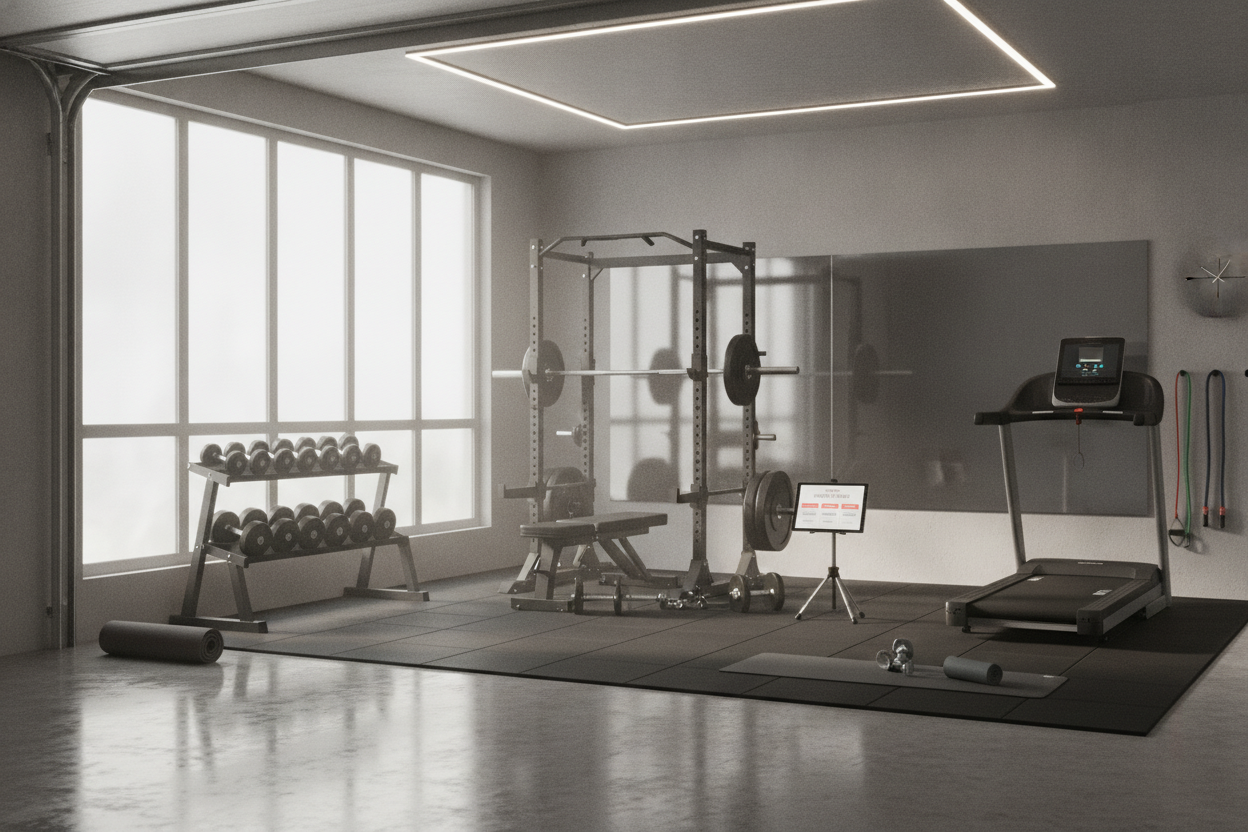
A few winters ago, I got hit with a nasty flu followed by a massive project at work. I didn't touch a barbell for 10 days. In the past, I would have felt like I had to 'restart' my program from week one. With the floating schedule, I just walked into the garage on day 11, saw 'Workout B' on my whiteboard, and did it. I didn't lose my progress, and more importantly, I didn't lose my momentum. The biggest mistake I ever made was thinking I had to be perfect to see results.
FAQ
Do I need a full power rack for this?
Nope. You can run this entire floating schedule with a pair of dumbbells and a bit of floor space. A rack is nice once you're moving heavy weight, but it's not a Day 1 requirement.
How long should each session take?
Aim for 30 to 45 minutes. If you're spending 90 minutes in the gym as a beginner, you're likely doing too much 'fluff' work that won't actually help you get stronger.
What if I want to do cardio?
Treat cardio as a 'bonus' day. If you have the energy on a non-lifting day, go for a walk or a rucking session. Just don't let it replace your strength sessions in the A/B queue.