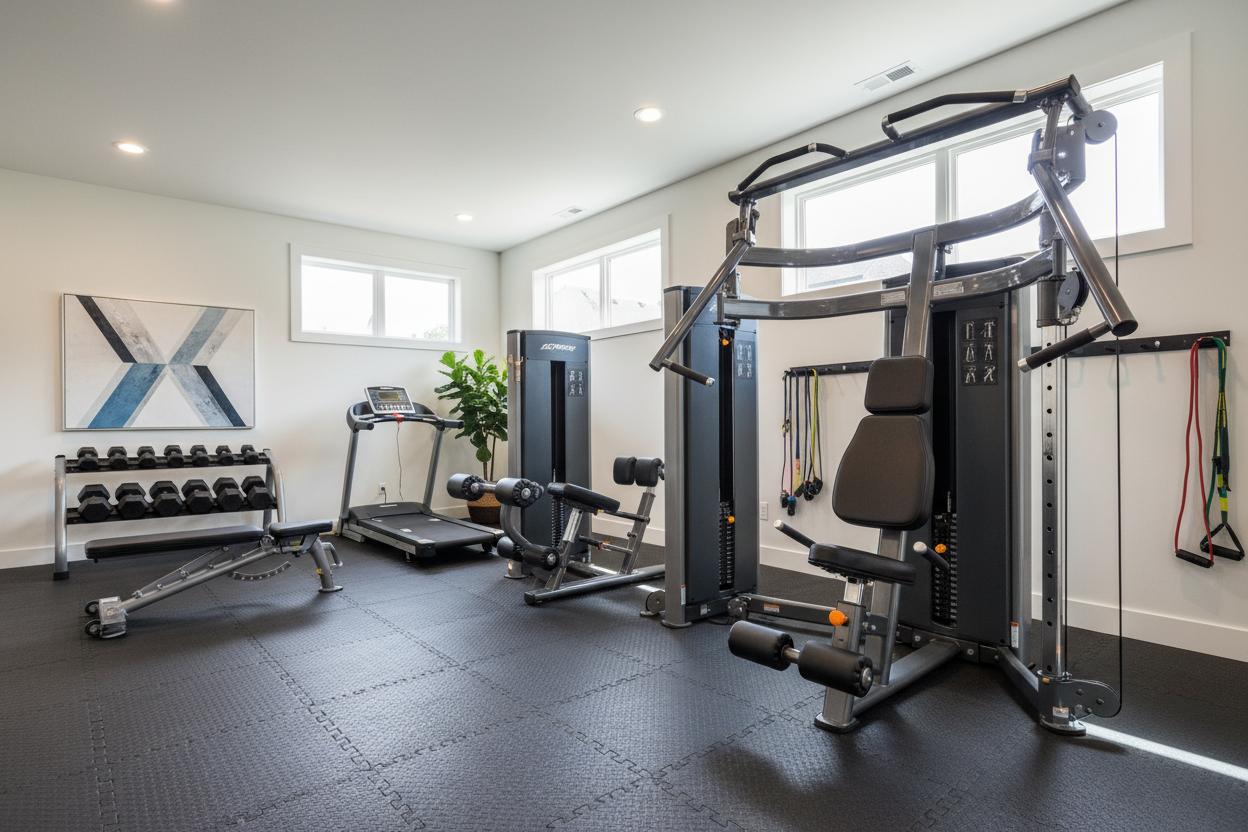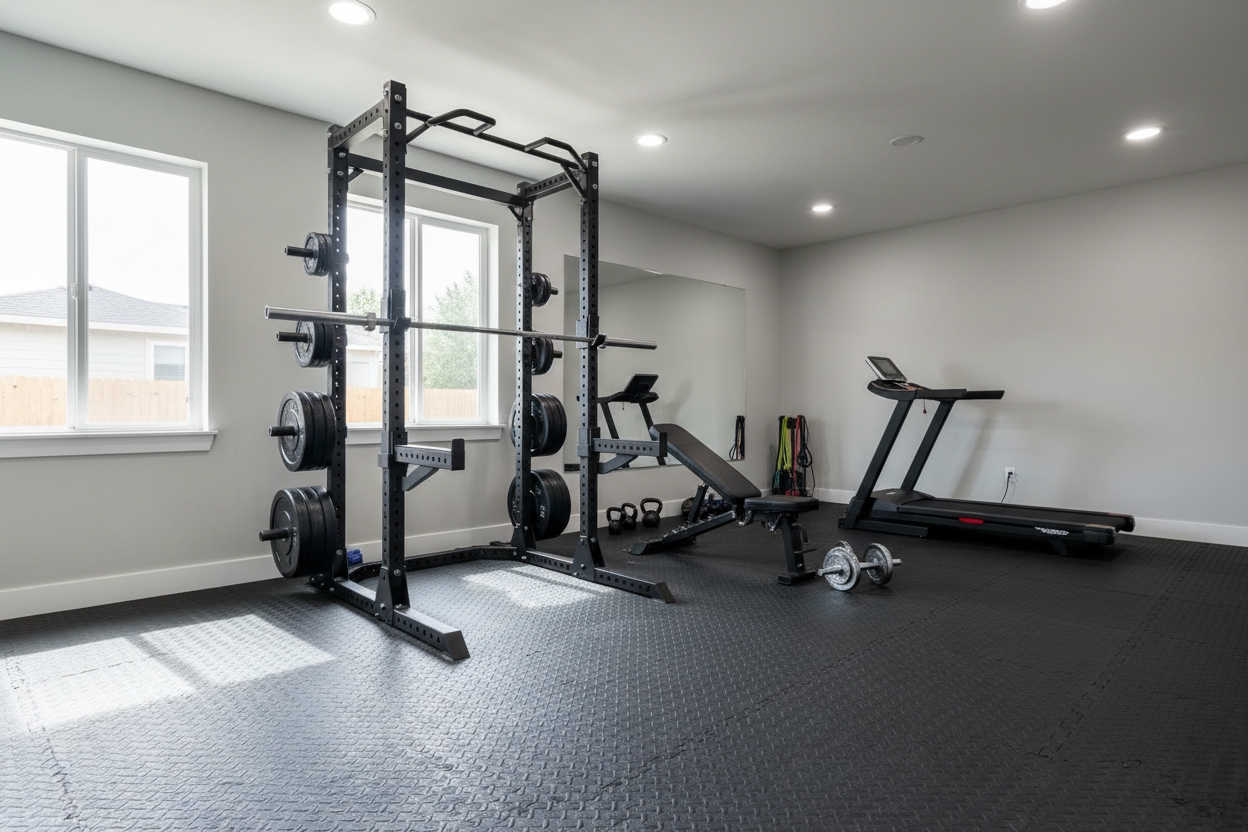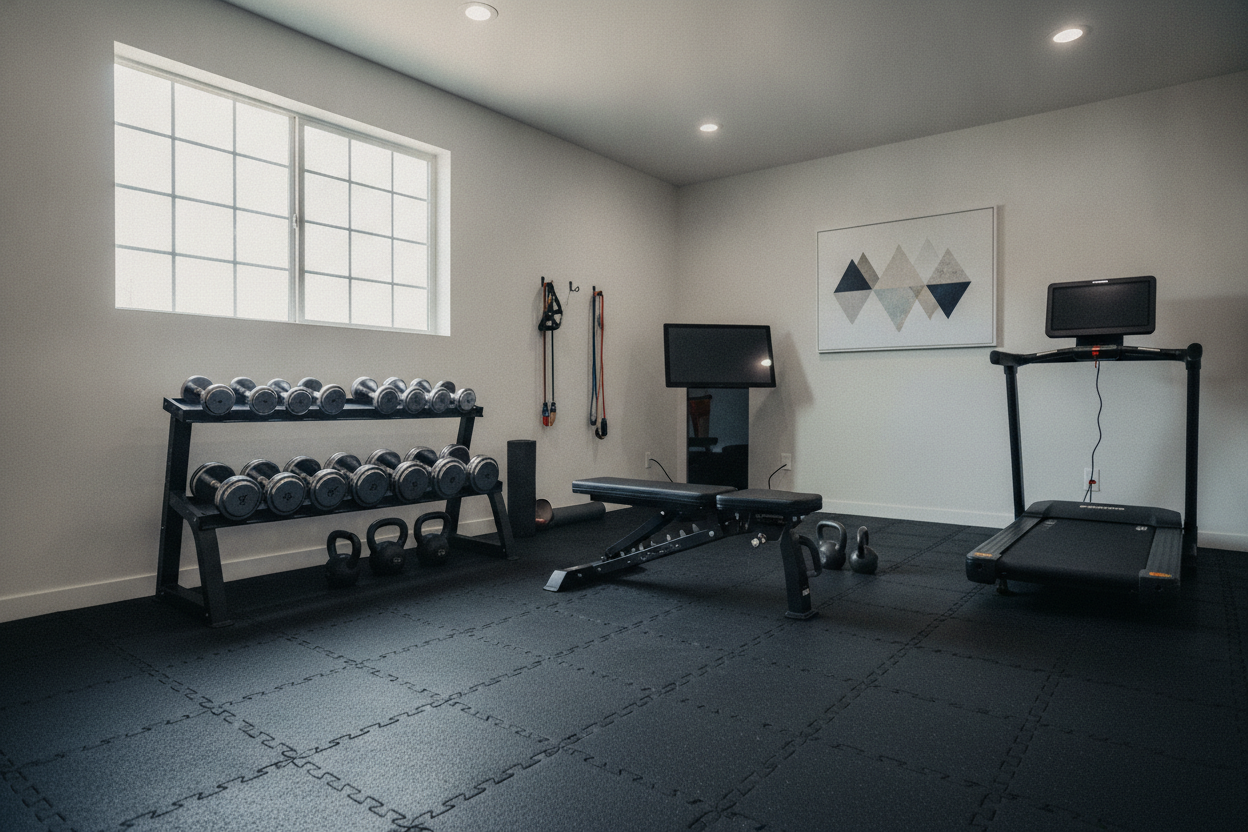
Stop Pasting Your Fitness Gym Workout Into Your Living Room
I remember the day my local chain gym hiked its membership to $120 a month for the privilege of waiting twenty minutes for a squat rack. I walked home, grabbed a pair of dusty 25-lb hex dumbbells, and tried to do the exact same leg extension and leg press circuit I had been doing for years. It was a disaster. Trying to force a fitness gym workout into a spare bedroom usually ends with a hole in the drywall or a tweaked lower back.
- Machines provide stability; home workouts require you to create it through better floor contact.
- Floor space is your most undervalued piece of equipment—treat it as a foundation.
- Tempo is the dial you turn when you run out of heavy iron plates.
- Stop chasing 'big' machine movements and start mastering unilateral exercises.
The Copy-Paste Trap: Why Commercial Routines Fail at Home
Commercial gyms are built around the machine. You sit down, the path of motion is fixed for you, and you just push. It is easy to move 400 lbs on a leg press because you aren't balancing anything. When you try to replicate those fitness gym exercises at home with free weights, you realize very quickly that your stabilizers are weak. You can't just sub a 300-lb machine press for a 50-lb dumbbell press and expect the same stimulus.
Standard commercial routines rely on massive weight stacks that are impossible to safely replicate on a hardwood floor. If you try to go heavy without the fixed path of a machine, you risk dumping weight into your floorboards or, worse, your shins. The mechanics are fundamentally different. You have to stop thinking about moving the weight from point A to point B and start thinking about how your body moves through space.
Swapping Iron for Floor Space (Your New Foundation)
The first upgrade for an at-home routine shouldn't be a fancy adjustable bench or a cable tower. It should be the floor. Most people try to train on carpet, which is a recipe for a rolled ankle, or bare concrete, which eats your joints alive. I have spent years training in garages, and I can tell you that traction is the difference between a productive session and a frustrated one.
Investing in a dedicated, non-slip area is the first real move toward a professional setup. Proper traction changes the mechanics of a gym fitness workout by allowing you to safely perform dynamic movements. When your feet aren't sliding out during a lateral lunge, you can actually load the muscle instead of just trying to stay upright. You need that 'bite' on the floor to generate power.
The Secret Weapon: Manipulating Tension Over Load
Since you probably don't have a 250-lb weight stack for lat pulldowns in your closet, you have to find another way to make the muscle grow. This is where most home trainees fail—they just do more reps until they get bored. Instead, you need to use time under tension. This is the primary mechanism for progressive overload when you are limited by the equipment at hand.
Take a standard fitness gym exercise like the chest press. At the gym, you just blast through reps. At home, try a 4-second eccentric (lowering phase) and a 2-second pause at the bottom. This forces the muscle to work significantly harder without requiring you to buy a 100-lb dumbbell set. It’s a more efficient way to train, and it’s a lot easier on your elbows and shoulders than trying to heave heavy, awkward weights in a cramped room.
Three Smart Swaps to Save Your Joints
Let's get practical. If your fitness workout at gym involved the leg press, swap it for a tempo Bulgarian split squat. It hits the same muscle groups but requires way more core stability. If you loved the cable rows, try a tripod row with a kettlebell. These movements are 'home-friendly' because they require minimal space but offer maximum intensity.
You will need a reliable exercise mat for these swaps, specifically for knee and joint protection during unilateral movements. I have done split squats on bare tile before; it’s a mistake you only make once. A good mat provides the cushion you need to actually reach a full range of motion without fearing the impact when your knee kisses the floor.
Building a Home Setup That Actually Sticks
Your home gym doesn't need to look like a commercial facility to be effective. In fact, trying to make it look like one is usually a waste of money. Focus on creating a space that removes friction. If you have to move a coffee table and a rug every time you want to sweat, you are going to quit by week three. Set up a permanent 'zone' where the equipment is ready to go.
How much space do I really need?
A 6x8 foot area is the sweet spot. It is enough room to sprawl out for burpees or lunges without hitting a wall, but small enough to fit in most spare rooms or garages.
Can I build muscle without machines?
Absolutely. Some of the best physiques in the world are built with just barbells and bodyweight. The key is mastering tempo and increasing the difficulty of the movement rather than just adding plates.
What is the biggest mistake home lifters make?
Buying cheap, thin yoga mats and expecting them to handle a high-intensity workout. You need density and grip, not just a piece of purple foam from a big-box store.
Personal Experience: My Hardest Lesson
I once tried to do heavy overhead presses on a cheap puzzle-piece foam mat I bought on clearance. Halfway through a set, the 'teeth' of the mat slid apart. I lost my balance, nearly put a 45-lb plate through my TV, and spent the next week icing a strained hip. I learned the hard way: if your foundation is garbage, the rest of your workout will be too. Don't skimp on the stuff that connects you to the ground.