Stop Doing Your Chest Exercise on Smith Machine Like This
Let’s address the elephant in the weight room. For years, gym purists have looked down on the Smith machine, claiming it's merely a coat rack or a shortcut for people who can't handle free weights. They are wrong.
When hypertrophy (muscle growth) is the goal, stability is king. By removing the need to balance a wobbly barbell, you can direct 100% of your effort into the pectorals. However, the fixed path of the bar is a double-edged sword. If you don't set up your chest exercise on smith machine correctly, you aren't just missing out on gains; you are actively grinding your shoulder joints into dust.
Key Takeaways: Mastering the Smith
- Stability Equals Isolation: The machine handles the stabilization, allowing you to focus purely on the concentric and eccentric contraction of the pecs.
- Bench Placement is Critical: Since the bar moves in a fixed vertical line, you must align your body perfectly under it. The bar cannot adjust to you; you must adjust to the bar.
- Safety for Solo Lifts: The built-in safety hooks allow you to train to absolute failure without a spotter, a crucial factor for muscle growth.
- Elbow Path Control: Tuck your elbows slightly (about 45 degrees) to protect the rotator cuff, as the fixed bar path can force unnatural movement patterns if you flare too wide.
Why the Smith Machine Belongs in Your Chest Workout
Many lifters treat the Smith machine as a regression from the standard barbell bench press. Instead, view it as a completely different tool. In a standard chest workout on smith machine, the primary benefit is the removal of the "stability requirement."
When you bench free weights, your rotator cuff and triceps work overtime to keep the bar from crashing onto your face. On the Smith, that energy is conserved. This allows for a harder contraction and a slower, more controlled negative (eccentric) phase. Science tells us that mechanical tension and metabolic stress are drivers of growth; the Smith machine excels at generating both safely.
Top Smith Machine Chest Exercises
1. The Incline Smith Press
This is arguably superior to the barbell incline press. Upper chest fibers are notoriously hard to recruit because the front delts love to take over. By locking into a fixed path, you can mentally connect with the upper pecs. Set the bench to a 30 or 45-degree angle. Ensure the bar comes down to the clavicle, not the sternum, to fully engage the clavicular head.
2. The Flat Smith Bench Press
This mimics the standard bench but allows for heavier loading with less risk. It’s excellent for overloading the mid-pecs. Focus on the "squeeze" at the top. Because you don't have to balance the weight, you can pause at the bottom of the rep (dead stop) to eliminate momentum, making the lift significantly harder and more effective.
3. The Guillotine Press (Advanced)
This is a controversial chest on smith machine variation. You lower the bar to your neck rather than your chest. With free weights, this is dangerous. On a Smith machine with safety stops set correctly, it stretches the pecs more than almost any other movement. Use light weight and high reps here. If you have shoulder issues, skip this one.
Technique: The Setup is Everything
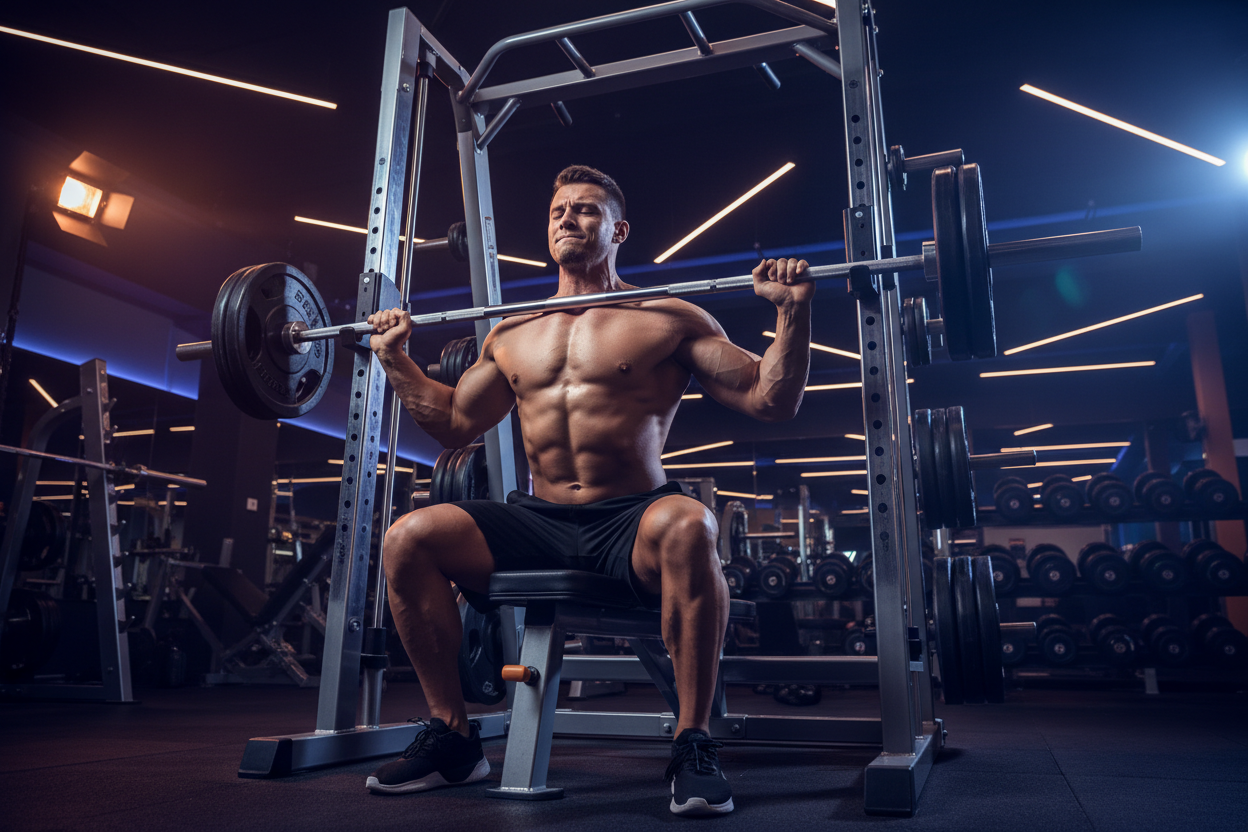
Here is where most people fail. In a free-weight bench press, the bar moves in a slight "J" curve (from chest to over shoulders). On a Smith machine, the bar moves in a straight line.
If you set up with the bar directly over your eyes (like a normal bench press), the bar will land too high on your neck when you lower it. You need to scoot down the bench. When the bar is at its lowest point (touching your chest), it should be aligned with your nipples or slightly above. Do a few empty reps to find this groove before loading plates.
My Training Log: Real Talk
I want to be honest about my relationship with smith machine chest exercises. For a long time, I avoided them because of the "bro-science" stigma. But after a minor rotator cuff tweak a few years back, I was forced to switch.
The first thing I noticed wasn't the pump—it was the annoyance of the setup. I remember vividly spending five minutes just nudging the bench an inch to the left, then an inch to the right, trying to get it perfectly centered. Unlike a barbell where you can just shift your grip, if the bench is crooked on a Smith machine, one arm pushes harder than the other.
There’s also the friction. I train at a commercial gym, and one of the machines has a distinct "gritty" feeling on the descent because the rails haven't been oiled in months. It creates this weird drag that actually increases the eccentric load. I learned to love that friction. It forces me to fight for every inch of the negative. Another unpolished reality? The sound of the hooks slamming against the catch when you fail a rep. It’s loud, it’s embarrassing, and it echoes. But that noise means I pushed to failure safely, something I never dared to do alone with a 225lb free barbell.
Conclusion
The Smith machine isn't a crutch; it's a scalpel. It allows you to dissect the pectoral muscle with surgical precision, removing the variables that often lead to injury or momentum-based lifting. If you stop worrying about how much weight you are moving and start focusing on how the muscle feels during the movement, the Smith machine becomes one of the most potent tools in your arsenal.
Frequently Asked Questions
Is the Smith machine effective for chest growth?
Absolutely. While free weights are generally better for overall strength and stabilizer muscle development, the Smith machine is highly effective for hypertrophy (muscle size) because it allows you to isolate the chest muscles and safely train to failure.
Does the Smith machine bar weigh 45 lbs?
Usually not. Unlike a standard Olympic barbell, Smith machine bars are often counterbalanced. They can weigh anywhere from 15 to 25 lbs depending on the manufacturer. Always check the label on the machine if you are tracking specific numbers.
Why does my shoulder hurt when benching on the Smith machine?
Shoulder pain usually stems from an incorrect bar path. Because the bar moves in a straight line, you cannot flare your elbows out 90 degrees. You must tuck your elbows and ensure the bar lands on the mid-chest, not near the neck (unless specifically performing a Guillotine press with caution).