

Stop Doing Rotator Cuff External Rotation Wrong (Fix It Now)
If your shoulder clicks when you reach for a seatbelt or feels unstable during a heavy bench press, you likely have a hidden weakness. Most lifters obsess over internal rotation (pecs, lats) but completely neglect rotator cuff external rotation. This imbalance is the silent killer of overhead performance.
Ignoring this movement pattern doesn't just stall your lifts; it sets the stage for impingement. Understanding how to properly strengthen these small stabilizers is the difference between a healthy shoulder and chronic rehab.
Key Takeaways
- Primary Muscles Involved: The Infraspinatus and Teres Minor are the specific rotator cuff external rotation muscles responsible for this motion.
- The Function: These muscles decelerate the arm during throwing motions and stabilize the humeral head in the socket.
- Common Error: Using momentum or the rear deltoid instead of isolating the cuff.
- The Fix: Keep the elbow pinned to the side (use a towel roll) and focus on high reps with low resistance.
The Anatomy of Stability
To fix the issue, you have to know what you are targeting. When we talk about the external rotator cuff, we are primarily discussing two specific muscles within the cuff complex:
- Infraspinatus: The powerhouse of external rotation.
- Teres Minor: Assists with rotation and adduction.
These muscles are small. They are not designed for moving massive loads. Their job is to keep the ball of your arm bone (humerus) centered in the socket (glenoid) while the big movers do the heavy lifting. If they are weak, the joint slides around, causing friction and pain.
Why Your Technique is Probably Flawed
Walk into any gym, and you will see someone standing with a dumbbell, swinging their arm back and forth like a pendulum. This is useless for rotator cuff rotation.
When you stand upright and rotate a dumbbell, gravity is pulling the weight down, stressing your bicep and forearm, not your rotator cuff. To effectively load the external rotation, the resistance vector must come from the side (using a cable or band) or you must change your body angle to work against gravity.
The Side-Lying Wiper
This is the gold standard for isolation. Lie on your side. Tuck your elbow against your ribs. Hold a light dumbbell. Rotate the arm upward toward the ceiling.
The Science: By lying sideways, gravity provides maximum resistance at the point where the external rotators are most active. Standing up removes this tension almost entirely.
How to Train the Rotator Cuff External Rotation Muscle
You do not need to max out here. In fact, if you are grabbing the 20lb dumbbells, you are likely cheating using your rear delts.
1. Use the "Towel Trick"
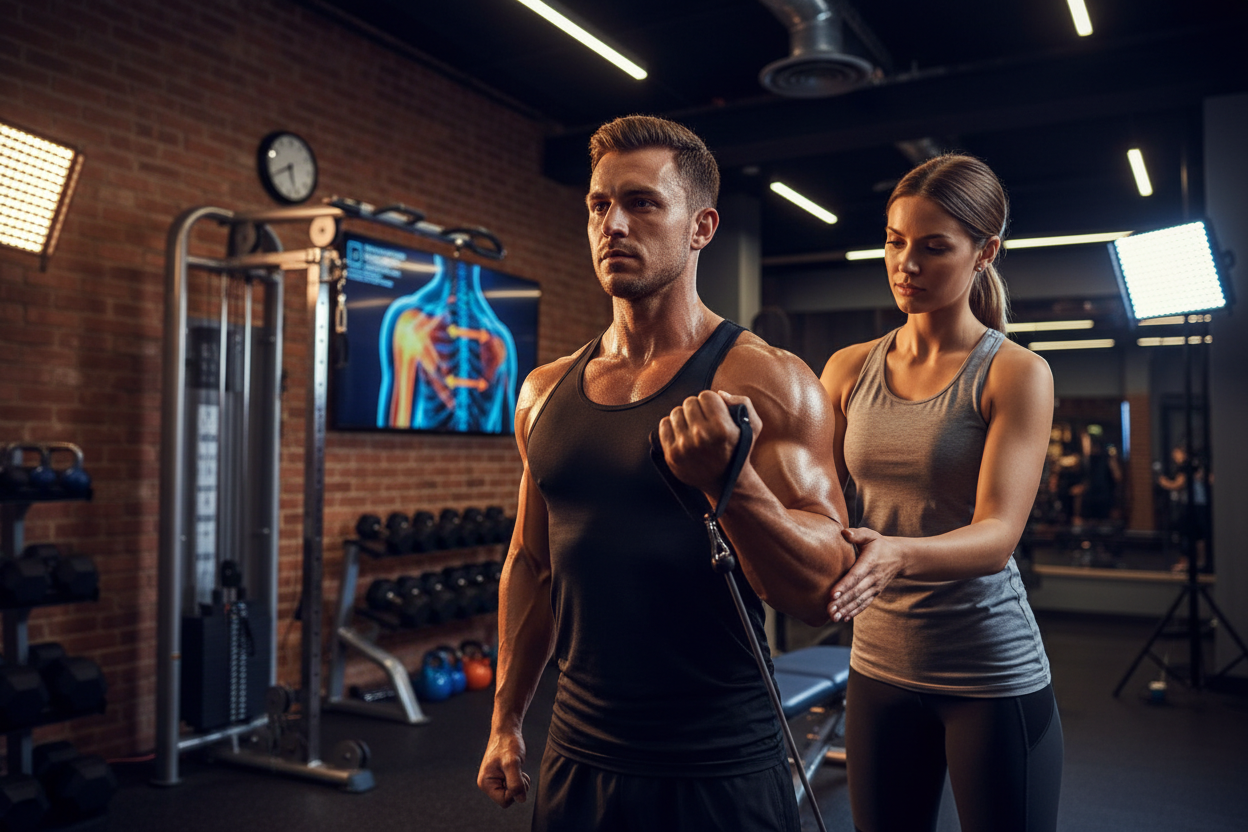
Place a small rolled-up towel between your elbow and your ribcage. Squeeze it gently. Now perform your cable or band external rotations.
Why? This forces proper joint centration. If the towel drops, your elbow drifted away from your body, meaning you recruited the deltoid instead of the cuff. This simple cue isolates the rotator cuff external rotation muscle more effectively than any machine.
2. Tempo Control
Explosive movements are for power cleans, not rehab. Use a 3-1-3 tempo. Take three seconds to rotate out, hold for one second, and take three seconds to return. The eccentric (lowering) phase is where the tendon strength is built.
My Training Log: Real Talk
I spent years ignoring this until I couldn't sleep on my left side. I started incorporating banded external rotations, but for the first month, I was doing them completely wrong.
I remember using a black resistance band (way too heavy) and just cranking out reps. I felt a massive burn in my rear delt, so I thought it was working. It wasn't until I dropped down to a flimsy red mini-band and used the towel cue that I felt the difference.
The sensation wasn't a "pump" like you get in the biceps. It was a deep, dull ache underneath the shoulder blade. It felt almost like a cramp deep inside the joint structure. That specific, annoying burn is exactly what you are looking for. Also, the knurling on a metal dumbbell handle is often too aggressive for these light movements; I found that holding the rubber hex head of a 5lb dumbbell actually allowed for a smoother rotation without my grip strength taking over.
Conclusion
Strengthening your rotator cuff external rotation isn't glamorous. You won't get huge muscles from it, and no one will be impressed by the weight you use. But if you want to press heavy without pain for the next decade, it is non-negotiable. Drop the ego, grab a light band, and master the mechanics.
Frequently Asked Questions
What is the main muscle for rotator cuff external rotation?
The Infraspinatus is the primary muscle responsible for external rotation, assisted significantly by the Teres Minor. These muscles work together to rotate the arm outward and stabilize the shoulder joint.
How often should I train rotator cuff external rotation?
Because these are endurance-based stabilizer muscles, they respond well to frequency. You can train them 2-3 times per week. Perform 2-3 sets of 15-20 repetitions with low weight to avoid fatigue-induced form breakdown.
Can external rotation exercises fix shoulder clicking?
Often, yes. Clicking is frequently caused by the humeral head not sitting centered in the socket due to muscle imbalances. Strengthening the external rotators helps pull the humerus back into a centered position, reducing friction and clicking.

%20but%20co...)