Stop Doing Quad Recovery Exercises Wrong: The Smart Way to Heal
We have all been there. You wake up two days after a heavy squat session, swing your legs out of bed, and realize your legs simply refuse to cooperate. Walking down stairs feels like a high-stakes negotiation with gravity.
Most athletes think the solution is to sit on the couch and wait it out. That is a mistake. To bounce back, you need to facilitate blood flow, not stagnate.
This guide breaks down the science of active recovery and the specific quad recovery exercises that will get you back under the bar faster without compromising your tissue health.
Key Takeaways: The Recovery Protocol
- Motion is Lotion: Complete rest often stiffens the muscles; light movement flushes metabolic waste.
- Isometrics First: Static holds (like Spanish Squats) reduce pain perception better than stretching in the acute phase.
- Soft Tissue Work: Focus on the VMO (teardrop muscle) and Rectus Femoris, but avoid aggressive rolling on bruised tissue.
- Timing Matters: Perform these exercises on rest days or as a warm-up before your next lower-body session.
The Science: Why Your Quads Are Screaming
Before we look at the movements, you need to understand the mechanism. That stiffness isn't just lactic acid—that was gone an hour after your workout. You are dealing with Delayed Onset Muscle Soreness (DOMS) and micro-trauma to the muscle fibers.
When you damage the muscle, the body creates inflammation to heal it. This is good, but too much inflammation restricts range of motion. The goal of quadriceps recovery exercises is to pump fresh, nutrient-rich blood into the area to cycle out the cellular waste products.
Phase 1: Low-Impact Flux
Do not start with stretching. Stretching a cold, damaged muscle triggers a protective reflex that can make tightness worse. Start here instead.
The Backward Sled Drag
This is the gold standard for knee health and quad flushing. By walking backward with a weighted sled, you load the quads concentrically (shortening) without the eccentric damage (lengthening under load) that caused the soreness in the first place.
Keep your chest up, arms straight, and drive through your toes. Aim for 5-10 minutes of continuous movement. No sled? Walking backward on a treadmill set to the highest incline (power off) works too.
Phase 2: Isometric Loading
Isometrics are magical for pain relief. They induce something called "analgesic cortical inhibition." Essentially, they tell your brain it's safe to load the muscle again.
The Spanish Squat Hold
Use a heavy resistance band looped around a rack. Step inside with the band behind your knees. Sit back into a squat so your shins remain vertical.
Hold this position for 30 to 45 seconds. You aren't moving up and down; you are just fighting gravity. This loads the patellar tendon and the quad muscle without the friction of joint movement.
Phase 3: Targeted Mobility
Once the blood is flowing and the pain signals have dampened, you can introduce length.
The Couch Stretch
This is the ultimate test for tight quads and hip flexors. Place your knee against a wall (or couch) and your other foot flat on the floor in a lunge position.
Squeeze your glute on the stretching side. This is non-negotiable. If you don't squeeze the glute, you are likely just hyperextending your lower back. You should feel a deep pull from the top of the hip down to the knee.
My Training Log: Real Talk
I want to be transparent about the Spanish Squat hold I mentioned earlier. On paper, it sounds easy. "Just sit there," right?
The first time I used these to rehab a strained rectus femoris, I learned the hard way about band placement. I was using a cheap, thin resistance band I found at a commercial gym. About 15 seconds into the hold, the rubber started rolling down and digging into the back of my knees like a dull knife. I was shaking—not just from the muscle fatigue, which sets in like a deep, burning vibration around the 30-second mark—but from the pinching skin.
My legs felt like jelly afterward, the kind of wobble where you have to grab the squat rack to stabilize. But the next morning? The sharp pain near my kneecap was almost completely gone. It works, but do yourself a favor: wear long socks or leggings, or use a wide fabric band. That "burn" should be in the muscle, not your skin.
Conclusion
Recovery is not passive. It is an active process. If you wait for your legs to feel 100% before you move them again, you will be waiting a long time. Implement these protocols, respect your body's signals, and turn your recovery days into growth days.
Frequently Asked Questions
Should I use ice or heat for quad recovery?
For recovery 24+ hours after training, heat is generally better. Ice reduces inflammation but can also slow down the healing process. Heat promotes blood flow, which helps deliver nutrients to the repairing muscles.
Can I train legs if my quads are still sore?
Yes, provided the soreness doesn't alter your movement mechanics. If you are compensating or limping, skip the heavy lifts. Opt for the active recovery exercises listed above to flush the legs instead.
How often should I foam roll my quads?
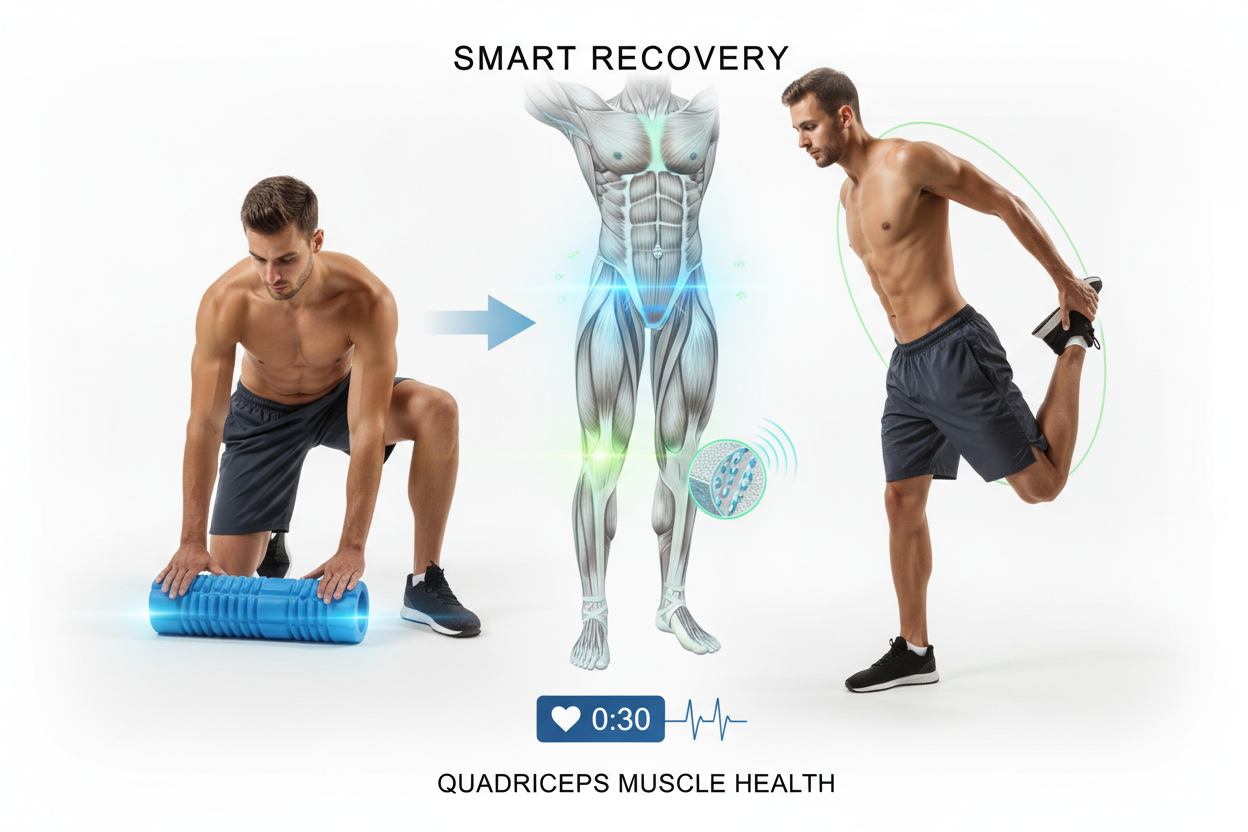
You can foam roll daily, but be gentle. Avoid rolling directly over the IT band (the side of the leg) as it can irritate the nerve. Focus on the fleshy part of the muscle and move slowly.