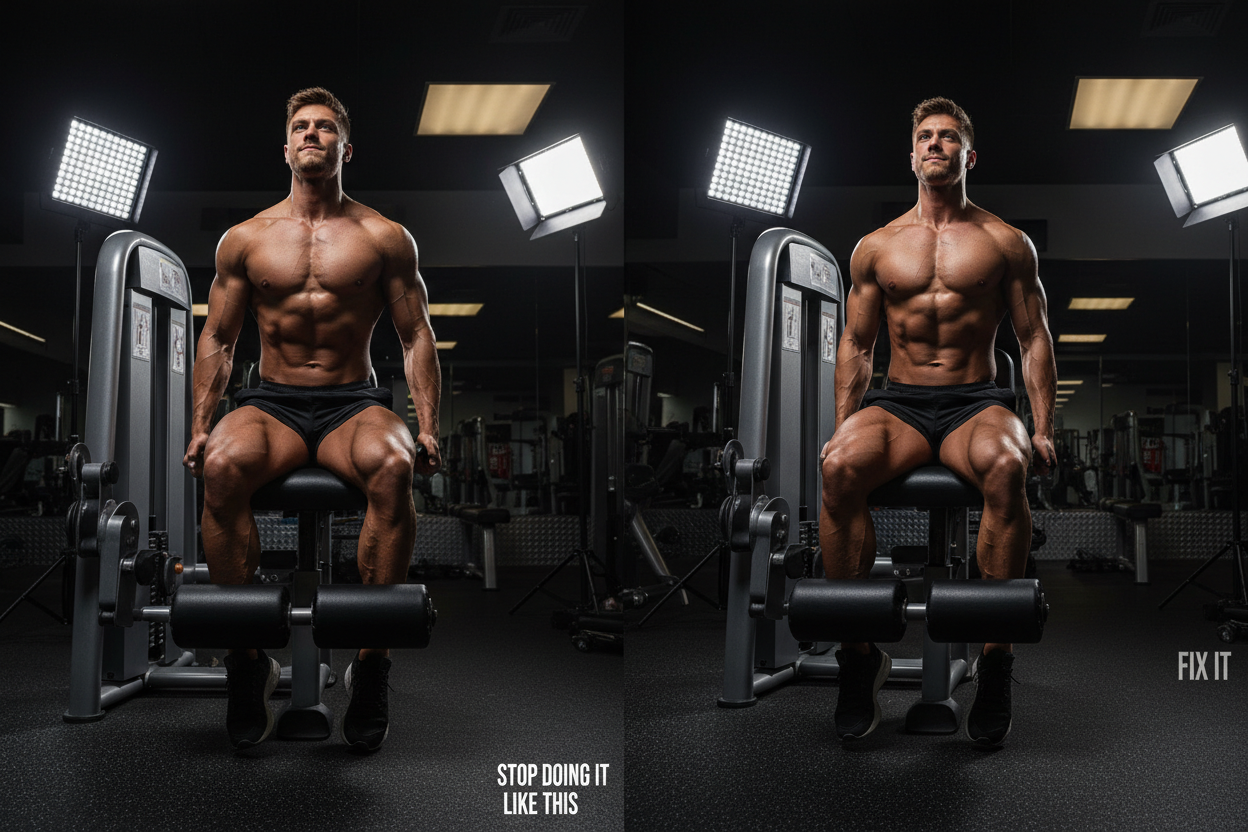
Stop Doing Knee Extension Machine Reps Like This (Fix It)
Squats and lunges are often hailed as the kings of leg day, and for good reason. But if you rely solely on compound movements, you are leaving significant quad growth on the table. The knee extension machine is the single best tool for isolating the quadriceps without involving the hips or lower back.
However, this machine has a bad reputation. You might have heard it’s "unnatural" or dangerous for your ligaments. The truth? It’s usually not the machine that’s the problem; it’s the user error. Let’s break down how to use this tool to build steel-cord quads without wrecking your joints.
Key Takeaways
- Target the Rectus Femoris: This is the only quad muscle that crosses the hip. Squats don't fully shorten it; extensions do.
- Align the Pivot Point: The machine's axis of rotation must line up perfectly with your knee joint to prevent shearing force.
- Control the Eccentric: Never kick the weight up. A slow lowering phase is where the hypertrophy magic happens.
- Adjust the Pad: On a seated knee extension machine, the pad should rest above the ankle, not on the foot or mid-shin.
Why You Need This Isolation Movement
Many lifters skip extensions because they believe squats cover everything. Here is the science they are missing.
Your quadriceps are made of four muscles. Three of them (the vastus group) only cross the knee joint. The fourth, the rectus femoris, crosses both the knee and the hip.
When you squat, you are flexing the hip while bending the knee. This puts the rectus femoris in a weird spot where it maintains a relatively constant length, meaning it doesn't get a maximal stimulus. The knee extension fixes this by locking the hip in place and forcing the quads to work through a full range of motion, specifically targeting that shortened position at the top.
Setting Up the Seated Knee Extension Machine
Most injuries happen before a single rep is performed. If your setup is sloppy, your knees will pay the price.
1. The Axis of Rotation
Look at the side of the machine. There is usually a bolt or a sticker indicating the pivot point of the lever arm. This must align directly with your knee joint. If your knees are too far back or too far forward, you create unnecessary shear force on the ACL.
2. The Backrest
Adjust the back pad so that when you sit, your knees line up with that pivot point mentioned above. Your lower back should be pressed firmly against the seat. If you are slouching or your hips are lifting off the seat during the rep, you are cheating.
3. The Shin Pad
The roller should sit just above your feet, on the lower shin. If it’s too high up the shin, you lose leverage. If it’s on your toes, you risk straining your ankle.
Common Mistakes That Kill Progress
You see it in every gym: the "momentum kicker." This is the guy who swings his legs violently to get the weight up.
Stop kicking. The goal isn't to move the weight from point A to point B; the goal is to contract the muscle against resistance. Use a tempo of 1-1-2. Take one second to lift, hold for a hard one-second squeeze at the top, and take two seconds to lower it.
Another error is locking out the knees aggressively. While you want full extension, snapping the joint into a locked position under heavy load can irritate the connective tissue. Stop just millimetres short of a bone-on-bone lockout if you have a history of knee pain.
My Personal Experience with the Knee Extension Machine
I have a love-hate relationship with leg extensions, primarily stemming from my early days of lifting in a garage gym with a cheap, plate-loaded attachment.
The specific issue I always ran into wasn't the weight—it was the friction. On older machines, or when I'm wearing shorts, the vinyl shin pad tends to grab the skin. I vividly remember the distinct, sharp pinch of my leg hair getting caught in the roller mechanism as the pad rotated during the eccentric phase. It distracted me enough that I’d break form.
Now, I actually bring a small towel or wear high socks specifically for this machine. It sounds minor, but eliminating that friction allows me to focus entirely on the burning sensation in the vastus medialis (the teardrop muscle) rather than the skin irritation on my shins. That mental switch changed the exercise from a "painful chore" to my primary finisher.
Conclusion
The knee extension machine isn't a villain. It is a precision instrument. When used with controlled tempo and perfect alignment, it builds quad separation that squats simply cannot achieve alone. Treat it with respect, drop the ego-lifting, and focus on the squeeze.
Frequently Asked Questions
Is the knee extension machine bad for your knees?
Not inherently. It becomes dangerous when the user sets the machine up incorrectly (misaligned pivot point) or uses excessive momentum. For healthy individuals, it strengthens the tendons and ligaments around the patella when done with control.
Should I do knee extensions before or after squats?
It depends on your goal. Doing them first (pre-exhaustion) warms up the knees and allows you to squat with lighter weight while still feeling the muscle. Doing them last allows you to fully burnout the quads safely without worrying about balancing a barbell.
What is the best rep range for knee extensions?
Since this is an isolation movement, moderate to high reps work best. Aim for 12 to 20 reps. Going extremely heavy (1-5 reps) increases shear force on the knee joint and often leads to form breakdown.