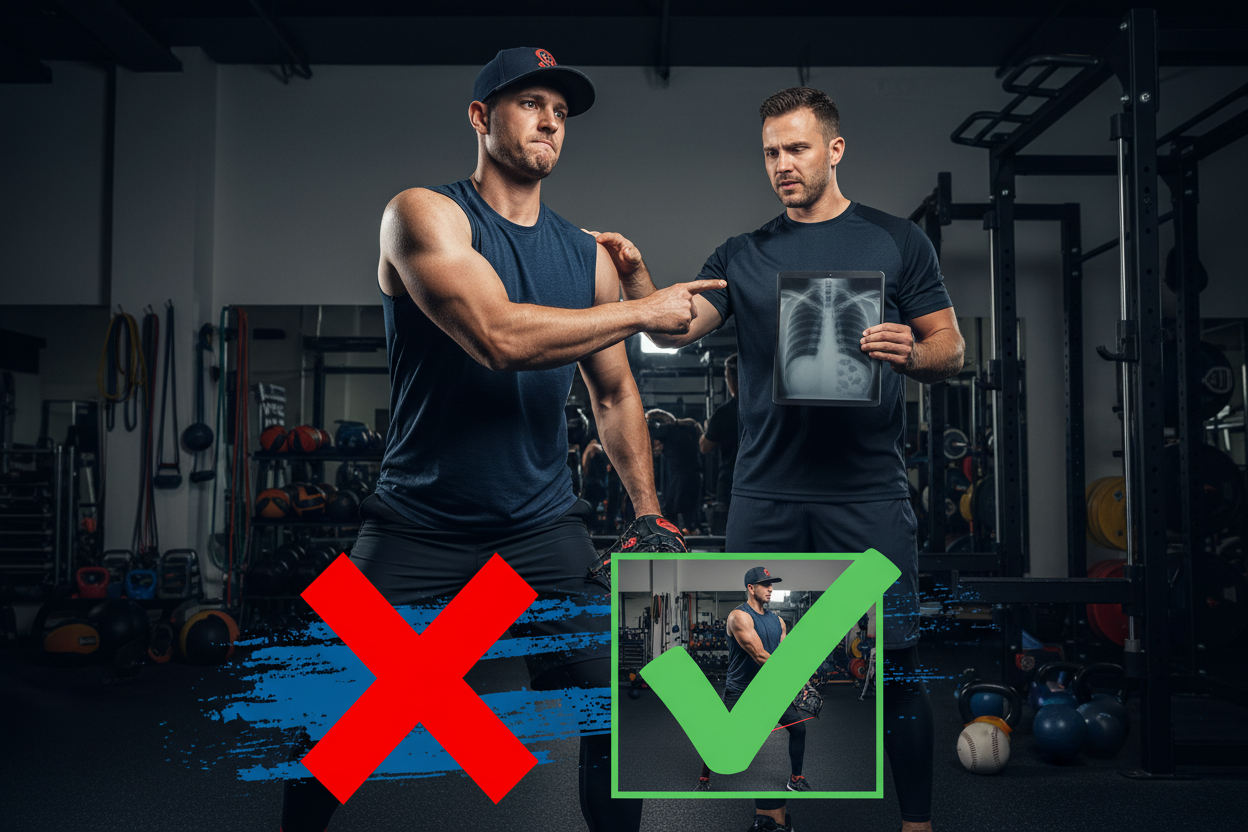
Stop Doing Baseball Shoulder Workouts Like This (Read First)
Throwing a baseball is one of the most violent actions you can perform in sports. Your arm accelerates from zero to 90+ mph in a fraction of a second, placing immense stress on the connective tissue. If your routine only consists of bench presses and military presses, you are setting yourself up for failure. Effective baseball shoulder workouts aren't about building beach muscles; they are about building armor for your rotator cuff and scapula.
Key Takeaways: The Healthy Arm Checklist
If you want to throw harder and last longer, your training must include these core pillars:
- Posterior Dominance: Prioritize the back of the shoulder over the front to aid in deceleration.
- Scapular Stability: The shoulder blade is the launchpad; if it's unstable, the cannon misfires.
- Rotator Cuff Endurance: High-rep, low-weight work is superior to heavy lifting for these small stabilizers.
- Thoracic Mobility: A stiff spine forces the shoulder to do work it wasn't designed for.
The Science of Arm Care: Deceleration Matters
Most young athletes focus purely on acceleration—the muscles that push the ball forward. However, the body has a governor mechanism. Your brain will not allow your arm to accelerate faster than your shoulder exercises for baseball players can decelerate it. If your brakes (posterior cuff and scapula) are weak, your body inhibits your velocity to protect the joint.
This is why pitcher exercises for shoulder health must focus heavily on the eccentric phase (the slowing down) of the motion. Strengthening the external rotators allows you to throw harder because your body knows it can safely stop the arm after the release.
Essential Components of a Pitcher Shoulder Workout
1. Soft Tissue Quality and Activation
Before you grab a weight, you need to ensure the tissue is pliable. Using a lacrosse ball or foam roller on the pecs and lats can free up range of motion. Tight lats drag the shoulder forward, leading to impingement. Once loose, move to activation. Simple shoulder exercises for baseball pitchers like arm circles or band pull-aparts wake up the stabilizers without exhausting them.
2. Rotator Cuff Specifics
The rotator cuff keeps the ball of the humerus centered in the socket. When these muscles fatigue, the head of the humerus migrates up, pinching the structures above it. This is where rotator cuff exercises baseball players rely on come into play.
The Protocol: Focus on external rotation at 90 degrees of abduction (arm out to the side). This mimics the cocking phase of throwing. Whether you are doing rotator cuff exercises for pitchers with bands or light dumbbells, the goal is perfect form, not heavy weight. If you engage your big deltoid muscles, you are missing the point.
3. Scapular Control (The Foundation)
Think of your scapula (shoulder blade) as the ground you stand on. You can't fire a cannon from a canoe. Shoulder workouts for baseball pitchers must include exercises like Ys, Ts, and Ws. These target the lower trapezius and serratus anterior, muscles often neglected in standard lifting programs. Strong scapular stabilizers transfer energy from your legs and trunk to your arm efficiently.
Common Mistakes in Shoulder Workouts for Baseball Players
Over-Training the Mirror Muscles
Bench pressing heavy loads locks down the scapula and tightens the pecs, pulling the shoulders forward into a rounded posture. While general strength is good, excessive chest work without counter-balancing pulling movements is a recipe for disaster. For every pushing exercise, aim for two pulling exercises in your baseball shoulder exercises routine.
Ignoring Pain Signals
There is a difference between muscle burn and joint pain. If you are looking for shoulder pain throwing exercises because you already hurt, stop throwing. Structural damage cannot be fixed with more throwing. However, if you are healthy, preventative maintenance is key. Don't wait for the ache to start your rotator cuff workouts for pitchers.
My Personal Experience with Baseball Shoulder Workouts
I learned the hard way that "feeling the burn" isn't always the goal. Early in my career, I thought heavy overhead presses were the answer to velocity. I was wrong.
I remember vividly the first time I strictly adhered to a J-Band routine for a full off-season. It wasn't the exercises themselves that stuck with me—it was the specific, annoying friction of the velcro wrist cuffs rubbing against my skin when I started sweating. But mostly, it was the feeling in my rear delt. It wasn't the pumped-up, swollen feeling you get from lifting weights. It was a deep, nagging fatigue that felt like it was right against the bone.
The biggest realization came during long toss. Usually, my arm would feel "dead" or heavy around the 15-minute mark. After focusing on scapular stability, that heaviness disappeared. I didn't feel stronger in the gym sense, but the ball just seemed to jump out of my hand with a "whip" sensation I hadn't felt before. That specific, deep stability burn is now the only metric I trust.
Conclusion
Building a bulletproof arm requires patience and attention to detail. It’s not about how much weight you can move, but how well you can control your mechanics. By incorporating specific throwing shoulder exercises that target the cuff and scapula, you aren't just protecting your career; you're unlocking your velocity ceiling. Start light, stay consistent, and listen to your body.
Frequently Asked Questions
How often should I do rotator cuff exercises for baseball?
You should perform maintenance work daily, especially during the season. However, heavy loading or high-volume rotator cuff exercises for baseball pitchers should be done 2-3 times a week, ideally on days you are not pitching, to allow for recovery.
Can shoulder workouts increase pitching velocity?
Yes, indirectly. While leg and core power generate the force, strong pitcher shoulder exercises allow you to transfer that force efficiently. More importantly, a strong posterior shoulder acts as a brake, allowing your brain to authorize faster arm speeds without fear of injury.
What should I do if I feel shoulder pain while throwing?
Stop immediately. Shoulder pain throwing exercises are for rehab under supervision, not for pushing through injury. Consult a physical therapist or orthopedic specialist to rule out structural damage like a labral tear before resuming any shoulder workout for pitchers.