Stop Destroying Your Lower Back With Leg Lifts (Read This)
You want a stronger core, but your lower back screams every time you lower your feet toward the floor. You aren't alone. Leg lifts are a staple abdominal exercise, but they are also one of the most frequently botched movements in the gym.
When performed correctly, this movement builds incredible lower abdominal strength and hip stability. When done poorly, it acts as a shear force on your lumbar spine. Let’s fix your form before you injure yourself.
Key Takeaways: Perfecting the Movement
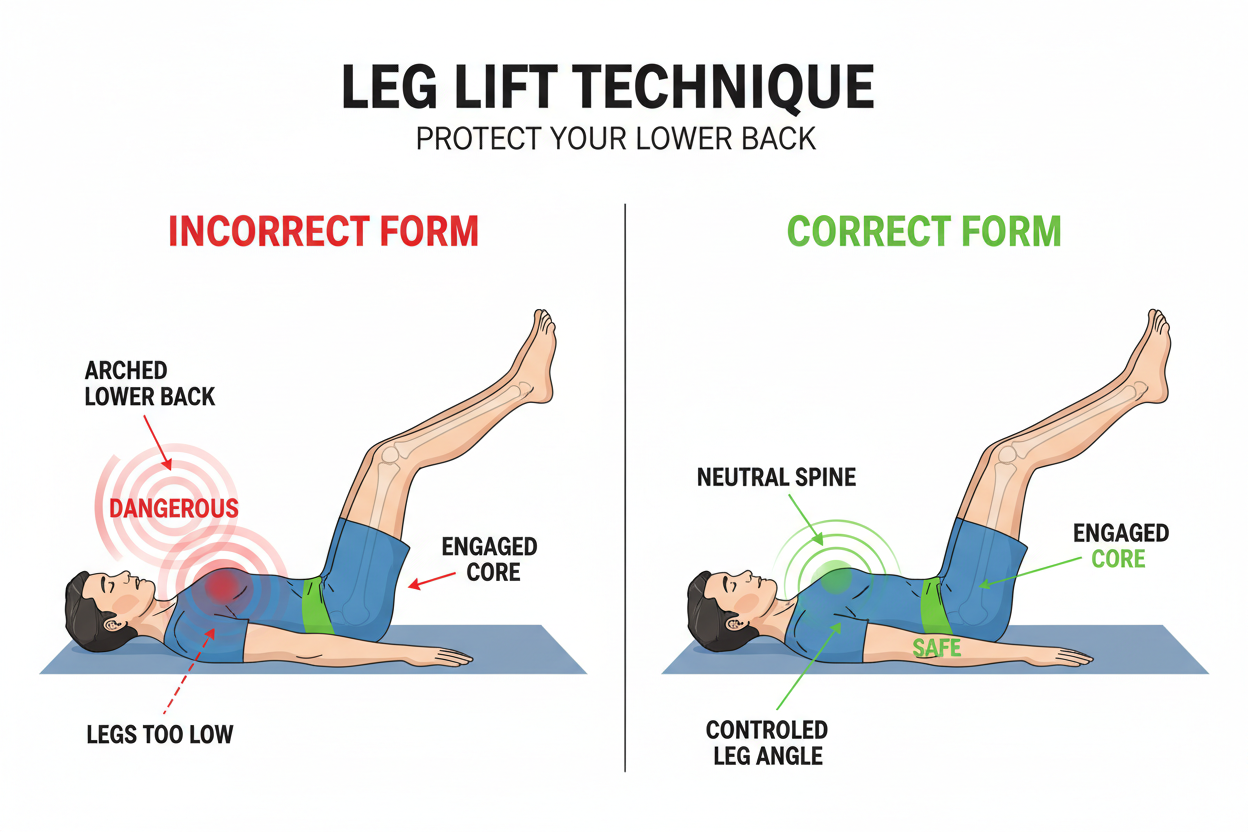
- Posterior Pelvic Tilt is Non-Negotiable: Your lower back must stay glued to the floor throughout the entire range of motion.
- Control Over Reps: Momentum kills the effectiveness of this exercise. Slow down the eccentric (lowering) phase.
- Hip Flexor Management: If you feel the burn only in the front of your hips, you are relying too much on your psoas and not enough on your abs.
- Modification is Strength: Bending your knees reduces the lever arm, making the move safer for beginners.
The Science: Abs vs. Hip Flexors
The biggest misconception about this exercise is that the legs are the weight being lifted by the abs. In reality, your hip flexors (specifically the iliopsoas) are responsible for the actual motion when you lift leg muscles upward.
Your abdominals act as stabilizers. Their job is to prevent your pelvis from tilting forward (anterior pelvic tilt) as the weight of your legs pulls down. If your core is weak, your pelvis dumps forward, your lower back arches off the mat, and the tension shifts directly to your lumbar spine. This is why you feel pain.
How to Execute the Perfect Rep
1. The Setup
Lie flat on your back. Before you even move your legs, focus on your ribcage. Exhale sharply to drive your ribs down. Now, imagine trying to crush a grape placed between your lower back and the floor. This is the posterior pelvic tilt.
2. The Movement
Keep your legs together. If straight legs are too difficult, soften the knees. Raise them until your hips are at a 90-degree angle. This is the easy part.
3. The Descent
This is where the work happens. Lower your legs slowly. The moment you feel your lower back start to peel off the floor, stop. That is your point of failure. Do not go lower than your core can control. Pull the legs back up from that point.
Variations and Progressions
Lying Knee Tucks (Regression)
If the standard version hurts, shorten the lever. Bend your knees at 90 degrees and tap your heels to the floor, then bring them back to your chest. This trains the same motor pattern without the massive strain on the spine.
Hanging Thigh Raises (Progression)
Once you master the floor version, take it to the bar. Hanging thigh raises require you to fight gravity and stability simultaneously. Grip the bar tight, engage your lats, and lift your knees to your chest without swinging.
My Training Log: Real Talk
I used to think volume was king. Years ago, I would lie on the fraying turf in the corner of my local gym, trying to hammer out 50 reps in a single set. I ignored the warning signs completely.
I distinctly remember the feeling—not a muscular burn in my stomach, but a sharp, audible "clunk" in my left hip socket every time my legs passed a certain angle. I also remember the specific grit of sand on the mat digging into my elbows because I was pressing them down so hard to compensate for a weak core.
I wasn't building abs; I was grinding down my hip cartilage and irritating my lumbar discs. It wasn't until I dropped my ego, put my hands under my glutes for support, and reduced my range of motion by half that I actually started feeling my lower abs engage. Now, I do 10 slow, trembling reps, and they are worth more than the 50 sloppy ones I used to do.
Conclusion
Leg lifts are a high-risk, high-reward exercise. If you respect the leverage and focus on spinal position, they will bulletproof your core. If you chase rep counts with bad form, they will sideline you with back issues. Choose quality.
Frequently Asked Questions
Why does my back pop when I do leg lifts?
A popping sound usually indicates tight hip flexors snapping over the pelvic bone or the femur. While not always dangerous, it suggests you need to stretch your hips and perhaps reduce the range of motion until the popping stops.
Can leg lifts burn belly fat?
No exercise can spot-reduce fat. While this movement strengthens the muscle underneath the fat, revealing a six-pack requires a caloric deficit in your diet to lower overall body fat percentage.
Should I put my hands under my butt?
Yes, especially if you are a beginner. Placing your hands under your glutes manually tilts the pelvis into a safer position, helping to keep the lower back flat against the floor.