Stop Copying Commercial Gyms for At Home Weight Training
I remember the day I finally quit my $60-a-month commercial gym. The squat rack was always occupied by someone scrolling through their phone, and the air smelled like a mix of old pennies and disappointment. I bought a set of adjustable dumbbells, cleared a 6x8 space in my garage, and started my journey into at home weight training. But I made a massive mistake: I tried to keep doing my old 'Chest Day' and 'Leg Day' routine.
- Bro-splits fail at home because you lack the machine variety to hit 20+ sets per body part.
- High-frequency full-body training allows you to maximize limited equipment.
- Floor protection isn't just for the house; it's for your mental confidence to lift heavy.
- Consistency in a garage beats a perfect workout you skip because of a commute.
The Trap of the Commercial Gym 'Bro-Split'
Most people start a home weight lifting workout by trying to replicate what they saw on a bodybuilding forum. They dedicate an entire Monday to 'Chest Day.' In a commercial gym, that works because you have flat benches, incline benches, cable crossovers, and three different pec-deck machines. In your living room, you probably have a bench and some dumbbells. By set ten, you're just doing the same movement pattern over and over.
Trying to force this volume into a home setting is a recipe for stalled progress. You don't have a rack of dumbbells up to 120lbs to create mechanical tension through variety. Instead, you end up doing 'junk volume'—sets that tire you out but don't actually stimulate new muscle growth. Your at home weight training needs to be smarter than that.
The reality is that isolation exercises—the 'finishers'—require specific angles that are hard to hit without commercial cables. If you only have 45 minutes, spending 15 of them on concentration curls is a waste of your limited resources. You need to prioritize movements that give you the biggest bang for your buck.
Why High-Frequency, Full-Body Is the Home Gym Cheat Code
The secret to a successful weight training routine at home is frequency, not localized destruction. Instead of hitting chest once a week with 15 sets, you hit it three or four times a week with 3-4 sets. This keeps protein synthesis spiked and allows you to stay fresh for every single rep.
When you're selecting the best at home weight training equipment for this style, focus on the big rocks: a solid barbell, adjustable dumbbells, and a pull-up bar. By hitting a squat, a push, and a pull every session, you're ensuring that no muscle group is left behind just because you don't own a leg press machine.
This approach is also incredibly forgiving. If life gets in the way and you miss a Wednesday session, you haven't missed 'Back Day' for the entire week. You just pick up the full-body routine on Thursday. It removes the 'all or nothing' mentality that kills most home-based programs.
Protecting Your Foundation Before Going Heavy
Here is something nobody tells you about home weights training: if you are scared of cracking your subfloor or waking up the kids, you will subconsciously hold back on your lifts. You won't grind out that last heavy deadlift if you're worried about the 'clack' of the plates on the floor.
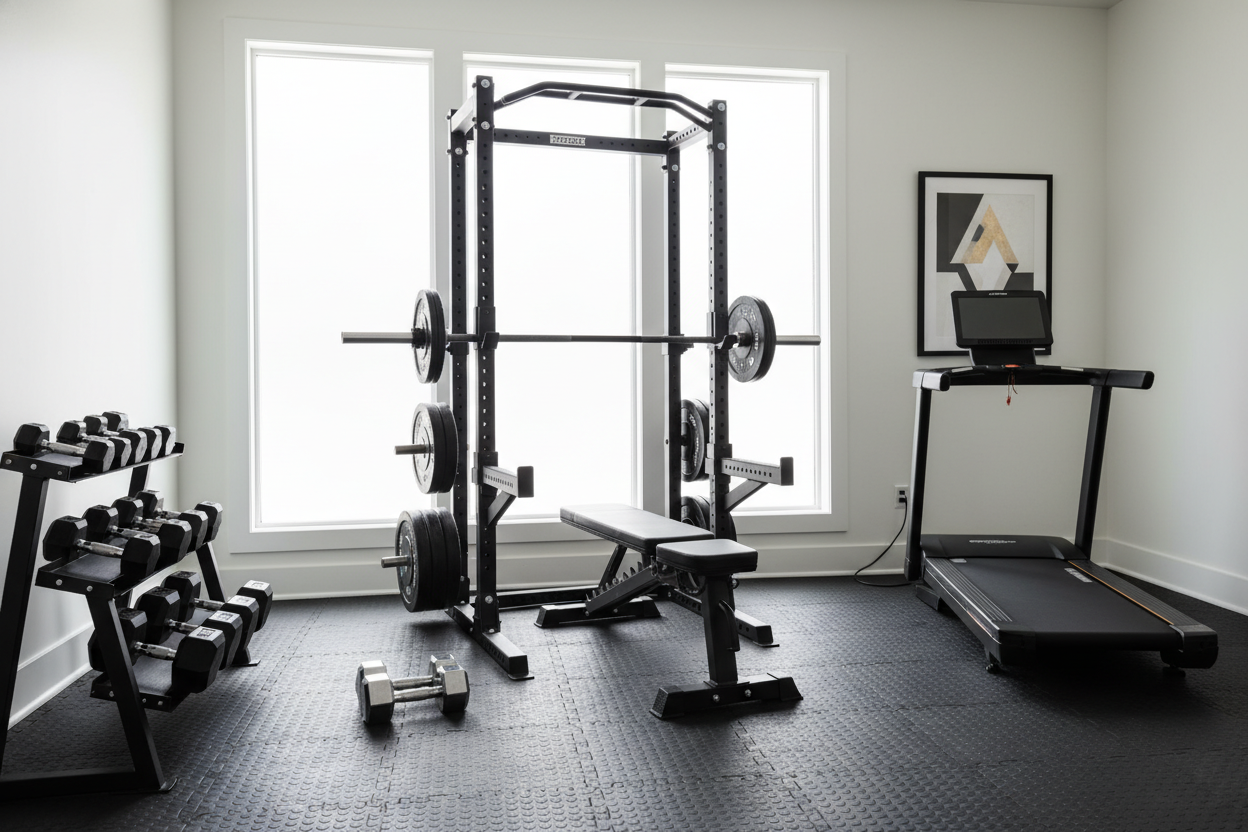
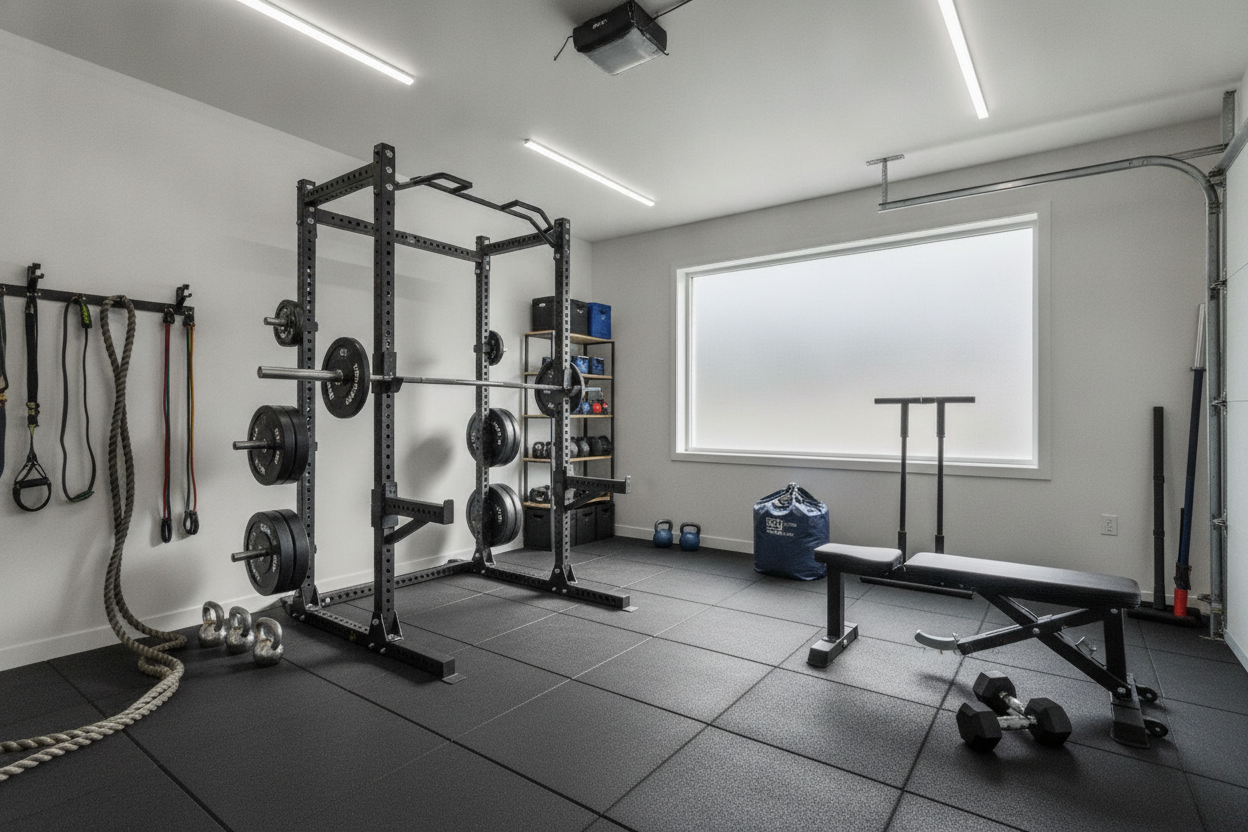
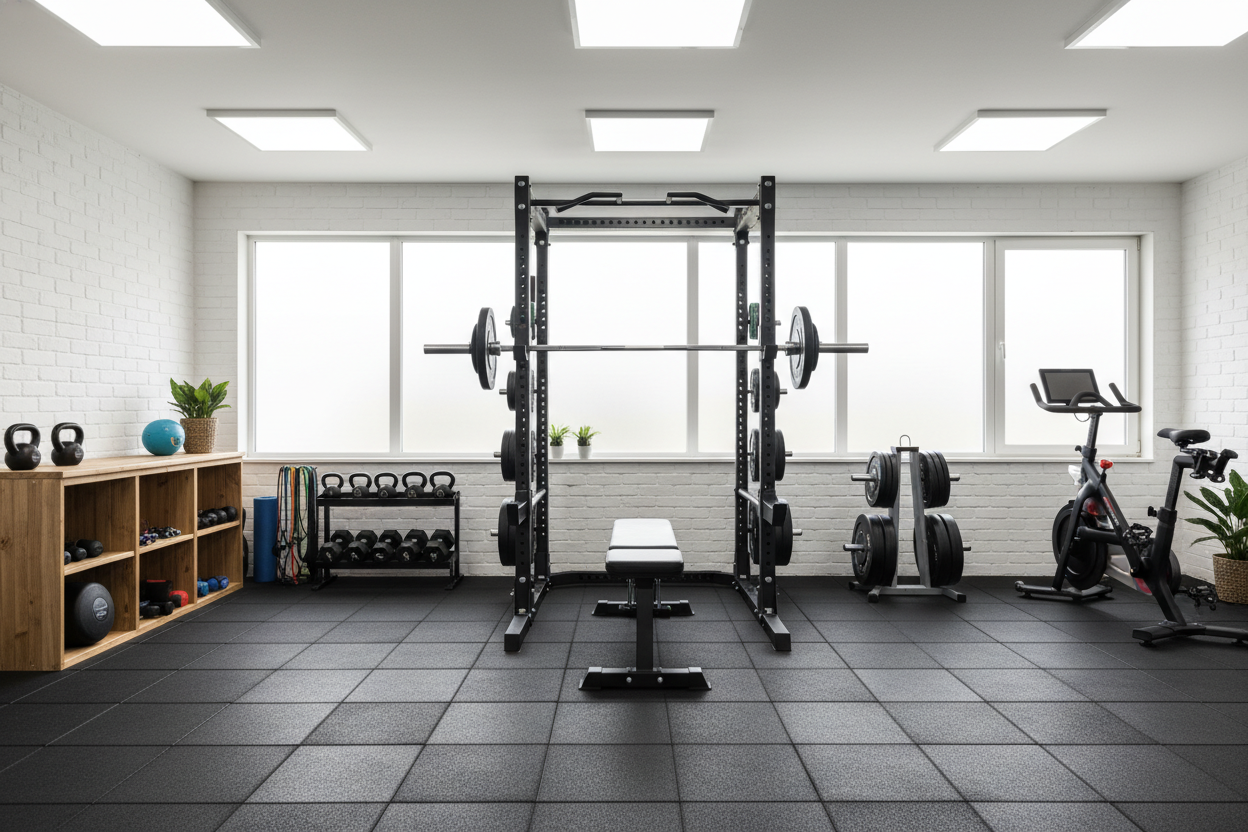
I spent my first year lifting on bare concrete with a thin rug. It was garbage. My joints ached, and I never felt stable. Investing in a heavy-duty 6x8ft exercise mat gym flooring setup changed everything. A solid, non-slip base allows you to root your feet properly during overhead presses and gives you the confidence to drop weights if a set goes sideways.
Structuring Your New Living Room Routine
For a home weight training workout that actually delivers results, I recommend a 3-day or 4-day alternating split. Focus on these movement patterns: a knee-dominant move (squats), a hip-dominant move (deadlifts/hinges), a vertical push, a horizontal push, and a row. This covers 95% of your muscle-building needs without requiring a 2,000-square-foot facility.
If you have a bit more space, you might consider adding one of the best weight training machines designed for compact use, like a wall-mounted cable station. This adds the 'flavor' that dumbbells sometimes lack, allowing for constant tension on things like face pulls or tricep extensions. But remember, the machine is the accessory, not the foundation.
Keep your rest periods tight. Since you aren't waiting for a stranger to finish their sets, you can move through a full-body routine in 40 minutes. Use supersets—pairing a push and a pull—to get more work done in less time. This is how you build a physique that looks like it belongs in a commercial gym while training in your socks.
When Is It Time to Upgrade Your Gear?
You'll know it's time to level up your at home weight lifting workout when you're consistently maxing out your current resistance. If your 'heavy' dumbbells are now your 'high-rep' dumbbells, you've hit a plateau. This is the logical point to start looking at more specialized weight lifting machines or a power rack with a high weight capacity.
Don't buy everything at once. Start with the basics that allow for the most variety. I've seen too many people buy a cheap, shaky multi-gym that ends up as a clothes rack. Buy quality once, and it will last as long as you do. Focus on gear that has a high weight capacity—at least 300 lbs for a bench—so you don't outgrow it in six months.
The 'Good Enough' Rule for Home Lifters
I've been training at home for over a decade now. I've had sessions in 100-degree heat and 20-degree cold. The biggest lesson I've learned is that an imperfect workout done in your garage is infinitely better than the 'perfect' workout you never do because the commercial gym is too crowded or too far away.
Stop worrying about the lack of a leg extension machine or a fancy locker room. Focus on the tension you can create with the iron you have. If you show up three times a week and move heavy stuff with good form, the results will follow. Your home is your sanctuary—treat your training that way.
Personal Experience: My Biggest Home Gym Fail
Early on, I tried to save money by buying 1-inch standard plates instead of Olympic plates. It was a nightmare. The bars felt like they were going to snap, and the selection of attachments was non-existent. I ended up selling it all for a loss on Craigslist and buying a real Olympic set. My advice? Don't go cheap on the core items. Buy the stuff that can handle a real beating.
Frequently Asked Questions
How many days a week should I train at home?
For most people, 3 to 4 days of full-body training is the sweet spot. It provides enough stimulus to grow while allowing for recovery, which is when the actual muscle building happens.
Do I need a squat rack for a home weight lifting workout?
You can get very far with just dumbbells—think Bulgarian split squats and goblet squats—but if your goal is maximum strength, you will eventually need a rack to safely move heavy loads for the back squat.
Is home training as effective as a commercial gym?
Absolutely. Your muscles don't know if you're in a $10 million facility or a basement. They only respond to tension and mechanical load. If you provide that, you will grow.