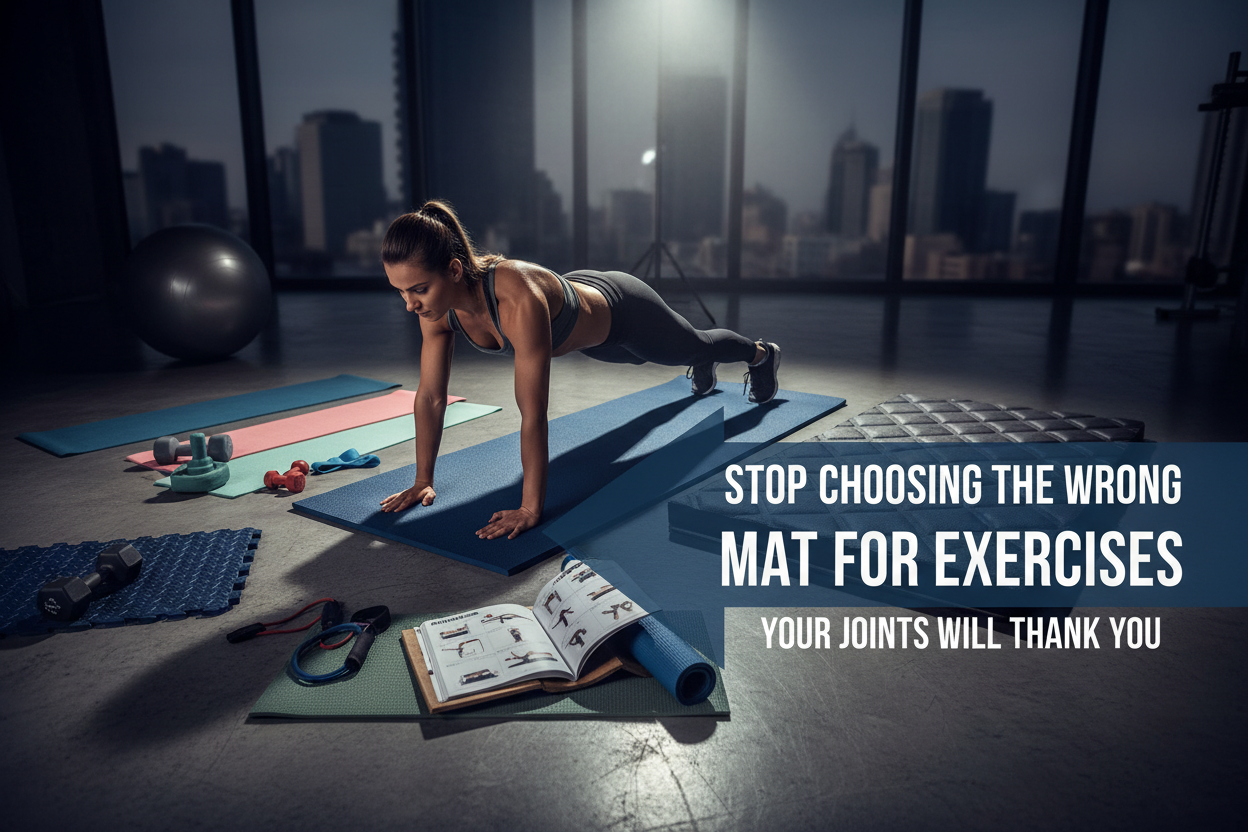
Stop Choosing the Wrong Mat for Exercises (Your Joints Will Thank You)
You know the feeling. You drop down for a set of push-ups or a plank, and the floor digs into your palms so hard it distracts you from the actual movement. Or worse, you're doing burpees and your feet slide out from under you because your gear lacks grip. The foundation of a safe home gym setup starts with the right mat for exercises.
Many beginners grab the first roll of foam they see, assuming a mat is just a mat. That is a quick way to end up with sore knees or a twisted ankle. Whether you are lifting weights or doing high-intensity cardio, the ground beneath you dictates your stability.
Quick Summary: Choosing the Right Mat
If you are in a rush, here is the cheat sheet for selecting the best foundation for your training:
- Density over Thickness: A squishy mat destabilizes heavy lifts. Look for high-density foam or rubber.
- Texture Matters: Open-cell structures absorb sweat (good for grip, hard to clean), while closed-cell repels moisture (easy to clean, slippery when wet).
- Size Requirements: A standard 6-foot mat works for most, but dynamic movements require wider dimensions (4'x6').
- Material Types: TPE is eco-friendly and soft; Rubber is durable and heavy; PVC lasts forever but can be slick.
Why Your Yoga Mat Isn't a Work Out Mat
This is the most common mistake I see. Yoga mats are designed for barefoot, low-impact static holds. They are usually sticky and thin (around 3mm to 5mm) to help you feel the floor. However, a dedicated work out mat serves a completely different purpose.
If you wear shoes on a yoga mat, the friction will shred the surface within weeks. A proper gym exercise mat is constructed to withstand the abrasion of rubber soles and the impact of weights dropping. You need material that resists tearing when you pivot or jump.
Material Science: What's Under Your Feet?
When shopping for a floor exercise mat, the chemical composition determines longevity and performance. Don't just look at the color; look at the tag.
PVC (Polyvinyl Chloride)
These are the industry standard for durability. They last a long time and provide a decent cushion. However, they are often not absorbent. If you sweat heavily during a HIIT session, a PVC work out matt (as it is often colloquially spelled on forums) can become a slip-and-slide hazard unless you have a towel handy.
Rubber (Natural or Recycled)
Gym workout mats made from rubber are heavy and stay flat. They don't curl up at the ends like cheaper foam rolls. They offer superior grip and are dense enough to protect your subfloor from kettlebells. The downside? They often carry a strong scent when new and contain latex, which is an allergen for some.
TPE (Thermoplastic Elastomer)
This is a middle-ground option. It is lighter than rubber and has better cushioning than PVC. It is an excellent choice for a general exercise gym mat if you need to carry it to and from a studio.
Thickness and Stability
Thicker is not always better. While a 1-inch thick mat looks comfortable, it creates instability. Imagine trying to squat on a marshmallow; your ankles have to work overtime to keep you upright.
For plyometrics and weightlifting, you want a mat for floor exercises that is between 6mm and 10mm. This provides just enough shock absorption to protect your joints during jumping jacks without compromising your balance during a deadlift.
Workout Mats for Gym vs. Home Use
In a commercial facility, workout mats for gym settings are usually large, heavy, recycled rubber rectangles glued to the floor. For home use, you likely need versatility. If you have a dedicated space, buy a heavy horse stall mat (4 feet by 6 feet). If you train in your living room, look for a high-density folding mat rather than a rolling one. Folding mats lay flat instantly and store easily behind a couch.
My Personal Experience with mat for exercises
I learned the hard way that "all-purpose" mats are a myth. A few years ago, I was doing a high-intensity interval session in my garage using a cheap, generic foam mat I bought at a supermarket.
I was in the middle of mountain climbers. I was wearing cross-training shoes with a fairly aggressive tread. About twenty seconds in, I felt the surface beneath me start to disintegrate. It wasn't just tearing; little blue crumbs of foam were actually statically clinging to my sweaty forearms and shins. Worse, the mat had stretched out lengthwise from the force of my driving legs, creating a tripping hazard in the middle of the set.
I switched to a high-density rubber mat the next week. The difference was immediate—not just in durability, but in sound. The "thud" of landing a jump lunge was dampened significantly, which my downstairs neighbors definitely appreciated. The rubber smell took about two weeks to fade, but the stability was worth the initial odor.
Conclusion
Your equipment supports your effort. A subpar mat is a distraction that pulls your focus away from your form. Invest in a mat that suits your training style—dense for lifting, shock-absorbing for cardio, and durable enough to handle your shoes. Your joints, and your floorboards, will be better for it.
Frequently Asked Questions
Can I wear shoes on an exercise mat?
Yes, but only if you have the right mat. You should not wear shoes on standard yoga mats as they will tear. Look for high-density PVC or rubber mats specifically labeled for cardio or HIIT, as they are designed to resist abrasion from sneaker treads.
How do I clean my sweaty gym mat?
For closed-cell mats (rubber/PVC), a mixture of water and a few drops of dish soap works well. Wipe it down and let it air dry. Avoid harsh chemicals like bleach, which can break down the materials and cause the mat to crumble over time.
What is the difference between a yoga mat and a Pilates mat?
Pilates mats are generally thicker (around 10mm to 15mm) than yoga mats because Pilates involves more rolling on the spine. However, for general fitness, a Pilates mat might be too soft for standing balance exercises.