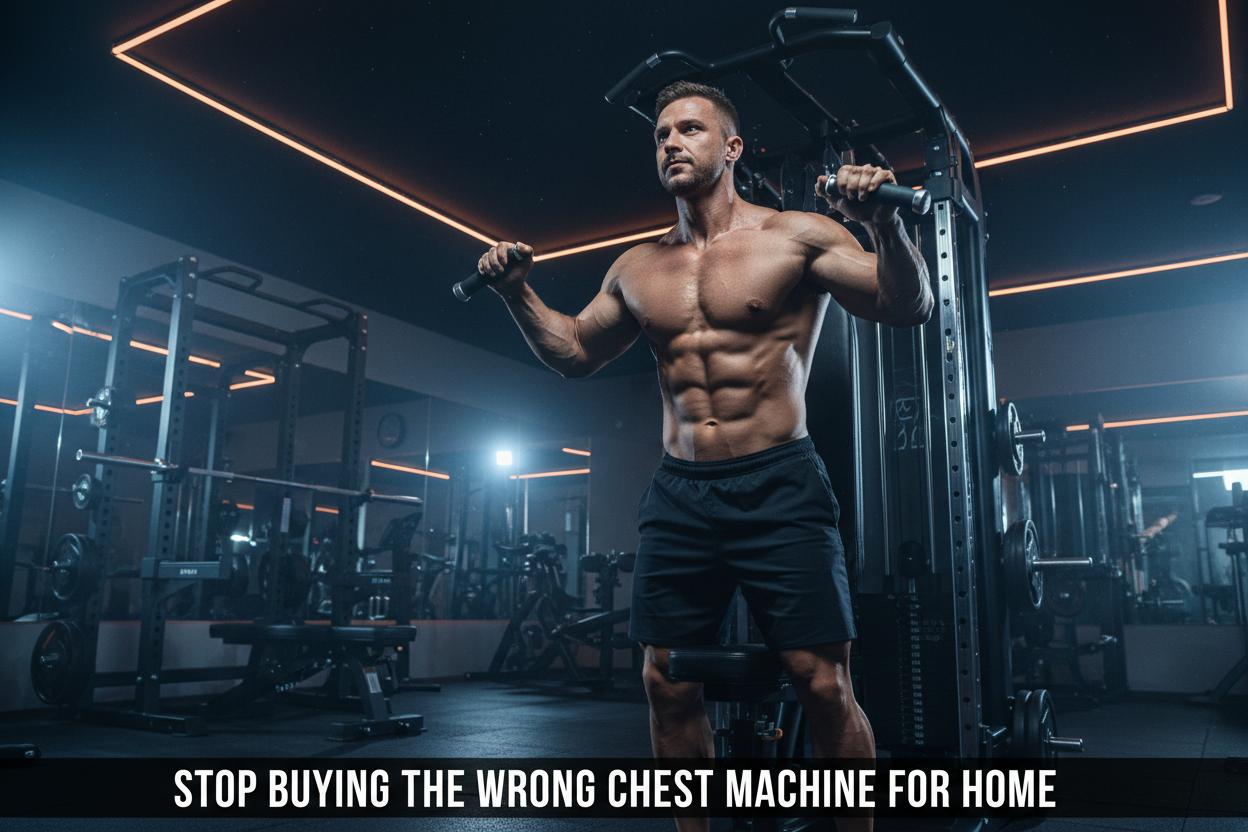
Stop Buying the Wrong Chest Machine for Home (Read This)
You have likely hit that frustrating plateau where pushups just aren't cutting it anymore, or perhaps you are tired of the danger associated with heavy barbell bench pressing without a spotter. You know you need to upgrade your setup. Finding the right chest machine home setup is usually the turning point between a casual workout corner and a serious home gym capable of driving hypertrophy.
But here is the problem: most home gym equipment is marketed with flashy photos and terrible biomechanics. If you buy the wrong piece of gear, you end up with a coat rack that cost you a thousand dollars. Let’s look at how to select a machine that actually stimulates muscle growth rather than just taking up floor space.
Key Takeaways: Choosing Your Equipment
- Biomechanics over Brand: A machine must match your natural converging arm path; if the movement feels linear and stiff, it will stress your joints, not your pecs.
- The Footprint Factor: Leverage arms require significantly more lateral space than cable stacks. Measure your room's width, not just the floor area.
- Constant Tension: Cable machines offer continuous tension throughout the rep, whereas leverage machines mimic the strength curve of free weights.
- Versatility: For home gyms, a functional trainer (dual cable column) often offers a better ROI than a dedicated chest press machine.
The Biomechanics of Home Chest Training
To understand why some machines work and others don't, you have to understand the job of the pectoral muscle. Its primary function is transverse adduction—bringing your arm across your body.
Many budget home machines fail here. They lock you into a fixed, straight line of motion. When you press straight out without your hands coming together at the top, you miss the peak contraction of the chest. This is why you often feel cheap machines more in your front delts than your pecs.
The Leverage Arm Solution
If you have the space, a leverage-style machine (often plate-loaded) is superior for raw strength. These machines move on a pivot point, creating an arc that feels more natural than a sliding rail.
The science here is stability. Because the path is fixed but arced, you don't waste energy stabilizing the weight. This allows you to drive maximum output directly into the muscle fibers. However, be warned: these machines are often huge. They require clearance for the weight plates to move, meaning you cannot push them flush against a wall.
The Case for Cable Stacks
For pure bodybuilding purposes, a functional trainer or a wall-mounted cable crossover is often the superior chest machine home choice. Why? Because of the resistance profile.
When you use a barbell or a leverage machine, the weight feels lighter at the top of the lockout because your joints stack. With cables, the line of pull is perpendicular to your arm, keeping the tension on the pec even when your elbows are locked out. This creates metabolic stress, a key driver for muscle growth.
Common Mistakes When Buying
The biggest error I see home gym owners make is buying "All-in-One" multi-gyms solely for the chest press feature. These units often use a 1:1 or 2:1 pulley ratio that creates excessive drag.
If the machine uses nylon bushings instead of ball bearings, the movement will feel gritty. That friction fights against you during the eccentric (lowering) phase, which is actually where most muscle damage and growth occur. You want a smooth eccentric, not a jerky one caused by cheap parts.
My Training Log: Real Talk
I need to share a specific experience from my own garage gym journey. A few years ago, I bought a mid-range, plate-loaded chest press machine to save space. On paper, it looked perfect. But the moment I loaded it up with anything over 200 lbs, I realized the fatal flaw.
The seat didn't have enough texture, and the back pad was too slick. Every time I went for a heavy press, my torso would slide up the back pad, forcing me to reset my scapula after every second rep. It completely killed my ability to maintain a tight arch. I ended up having to wrap a yoga mat around the back pad just to get enough friction to press safely. It’s those unpolished details—the knurling on the handles, the grip of the vinyl, the wobble of the frame when you re-rack—that determine if you'll actually use the machine or sell it on Facebook Marketplace six months later.
Conclusion
Building a great chest at home doesn't require a commercial gym membership, but it does require being picky about your gear. Don't settle for a machine that forces your body into unnatural positions. Whether you choose a leverage arm for heavy loading or a cable setup for isolation, ensure the biomechanics allow for a full range of motion and a deep stretch. Your joints will thank you, and your results will show it.
Frequently Asked Questions
Can I build a big chest with just a home machine?
Absolutely. As long as the machine allows for progressive overload (adding more weight or reps over time) and provides a sufficient range of motion to stretch the muscle fibers, your chest will grow just as it would with free weights.
How much space do I need for a home chest machine?
It varies wildly. A wall-mounted cable pulley system might only protrude 6 inches from the wall, while a plate-loaded leverage chest press can require a footprint of 5x6 feet, plus an extra 2 feet of clearance on each side to load the plates.
Is a machine safer than a bench press for solo training?
Yes, generally speaking. If you fail a rep on a machine, the weight simply returns to the stops or stack. Failing a rep on a barbell bench press without a spotter or safety arms can be dangerous as the bar can pin you to the bench.