Stop Buying Junk: How to Pick Good Home Workout Equipment
We have all seen it happen. You buy a shiny new machine, use it for two weeks, and six months later, it is the most expensive clothes hanger in your house. Building a garage gym or a living room corner setup is not just about buying things; it is about curating an environment that forces you to work.
The market is flooded with plastic gadgets that promise six-pack abs in four minutes. Navigating this noise to find good home workout equipment requires a shift in mindset. You are not looking for the easiest solution; you are looking for tools that survive the grind. Whether you are hunting for heavy iron or compact cardio, the goal is durability and function over flashiness.
Key Takeaways: Choosing Gear That Lasts
- Prioritize Versatility: The best gear allows for multiple movement patterns (e.g., adjustable dumbbells or kettlebells).
- Check the Footprint: Measure your floor space including the range of motion required for the exercise, not just the machine's dimensions.
- Material Matters: Look for steel gauge thickness on racks and continuous horsepower (CHP) on treadmills, not just peak horsepower.
- User Weight Capacity: A higher weight limit usually indicates better build quality and stability, even if you don't weigh that much.
- Warranty as a Signal: Manufacturers who offer 1-year warranties on frames usually know their product won't last. Look for lifetime frame warranties.
Defining "Good" in a Saturated Market
"Good" is subjective, but in the fitness industry, it comes down to biomechanics and build quality. When analyzing exercise machines reviews, ignore the comments about how easy the assembly was. Instead, look for long-term users discussing the smoothness of the cables or the stability of the bench under load.
If a piece of equipment wobbles when you use it, you will subconsciously stop using it. Stability creates safety, and safety allows you to push intensity.
The Hierarchy of Home Gym Essentials
If you have a limited budget, do not blow it on a single cardio machine. Start with resistance training tools. Popular home exercise equipment often trends toward smart mirrors, but gravity remains the king of muscle building. A pair of high-quality adjustable dumbbells can replace an entire rack, saving you thousands of dollars and precious square footage.
Evaluating At Home Workout Systems
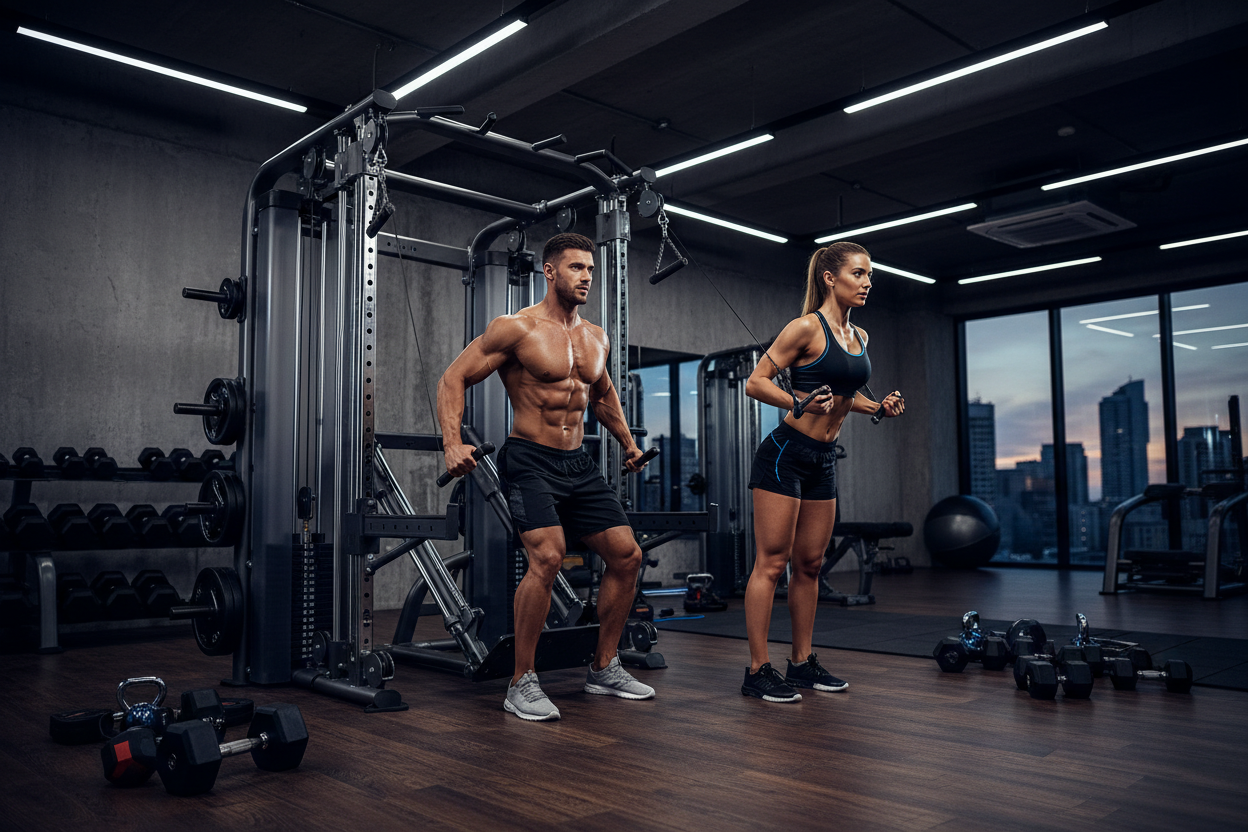
All-in-one trainers are tempting. They promise a full commercial gym experience in a 4x4 footprint. However, at home workout systems often suffer from being a "jack of all trades, master of none."
When looking at these systems, check the pulley ratio. A 2:1 ratio feels smoother and is better for functional movements, while a 1:1 ratio is better for heavy static lifting. If the cables drag or the weight stack sticks, the workout suffers. You want friction-free movement.
Innovation vs. Gimmicks
There is a constant influx of new exercise products hitting Kickstarter and Amazon. Be skeptical. Does this product reinvent the wheel, or does it just add Bluetooth to it? Technology becomes obsolete faster than steel. A cast-iron kettlebell bought today will still be effective in 50 years. A treadmill with a proprietary screen might be bricked in five years if the company goes under.
Integrating Home Gym Equipment Exercises
The gear you buy dictates your programming. If you buy a suspension trainer, you are committing to bodyweight stability work. If you buy a barbell, you are committing to compound lifts.
Home gym equipment exercises should be compound-focused. You don't need a leg extension machine at home; you need a way to squat and lunge. Focus your budget on equipment that allows you to perform the "Big Five": Squat, Hinge, Push, Pull, and Carry.
My Personal Experience with good home workout equipment
I learned the hard way that "budget-friendly" is often code for "dangerous." Years ago, I bought a cheap, no-name adjustable bench off Amazon to save fifty bucks. It looked fine in the photos.
The first time I laid back with a pair of 80lb dumbbells for a chest press, I felt the back pad shift. It wasn't a break, but a distinct lateral wobble in the hinge mechanism. That quarter-inch of play completely wrecked my confidence. Instead of focusing on my pecs, I was bracing my core just to keep the bench from tipping. I couldn't drive through my feet properly.
I also realized the vinyl covering was so slick that once I started sweating, I was sliding down the incline like I was on a water slide. I ended up selling it for scrap and buying a rep-fitness bench with a grippy pad and zero-gap hinge. The difference in my lift numbers was immediate—not because I got stronger overnight, but because the equipment was stable enough to let me actually try.
Conclusion
Building a home gym is a marathon, not a sprint. Buy one piece of high-quality gear at a time rather than filling a room with cheap junk. Good home workout equipment holds its value, keeps you safe, and removes the friction between you and your workout. Treat your home gym like a sanctuary of effort, and it will pay dividends in your health.
Frequently Asked Questions
Is it better to buy free weights or machines for a home gym?
For most home gyms, free weights (dumbbells, kettlebells, barbells) are superior because they require less space, cost less, and offer more versatility. Machines take up a large footprint and usually only perform one specific movement, making them less efficient for home use unless you have unlimited space.
How much space do I really need for a home workout setup?
You can build an effective workout zone in as little as 30 square feet (6x5 area). This is enough room for a yoga mat and adjustable dumbbells. However, if you plan on using a 7-foot Olympic barbell, you need a width of at least 10 feet to load plates comfortably without hitting the walls.
Are smart home gym mirrors worth the money?
Smart mirrors are excellent for motivation and coaching but poor for raw strength gains. If you need an instructor to push you, they are worth it. If your goal is hypertrophy (muscle growth) or maximum strength, your money is better spent on a power rack, weights, and a bench.