Stop Arm-Throwing: The Lower Body Blueprint for Adding Velocity and Power
Most young athletes obsess over arm care bands and weighted balls, assuming that arm speed is the sole generator of velocity. This is a fundamental misunderstanding of biomechanics. Real power, whether you are driving a fastball into the gap or throwing a heater from the mound, originates from the ground. A comprehensive baseball lower body workout is the single most effective way to improve performance metrics across the board. If your legs fatigue by the fifth inning, your mechanics crumble, and your risk of arm injury skyrockets.
I learned this lesson the hard way during my sophomore year of college ball. My velocity had plateaued at 86 mph, and no amount of long toss was fixing it. Late in games, my command would vanish because my drive leg was collapsing. My pitching coach pulled me aside and bluntly told me that I had "high school legs." We completely overhauled my training to focus on heavy compound movements and explosive unilateral work. Within six months of prioritizing a dedicated baseball leg day, I touched 90 mph for the first time. The difference wasn't in my shoulder; it was in my ability to push off the rubber and stabilize upon landing.
The Philosophy of Baseball Legs
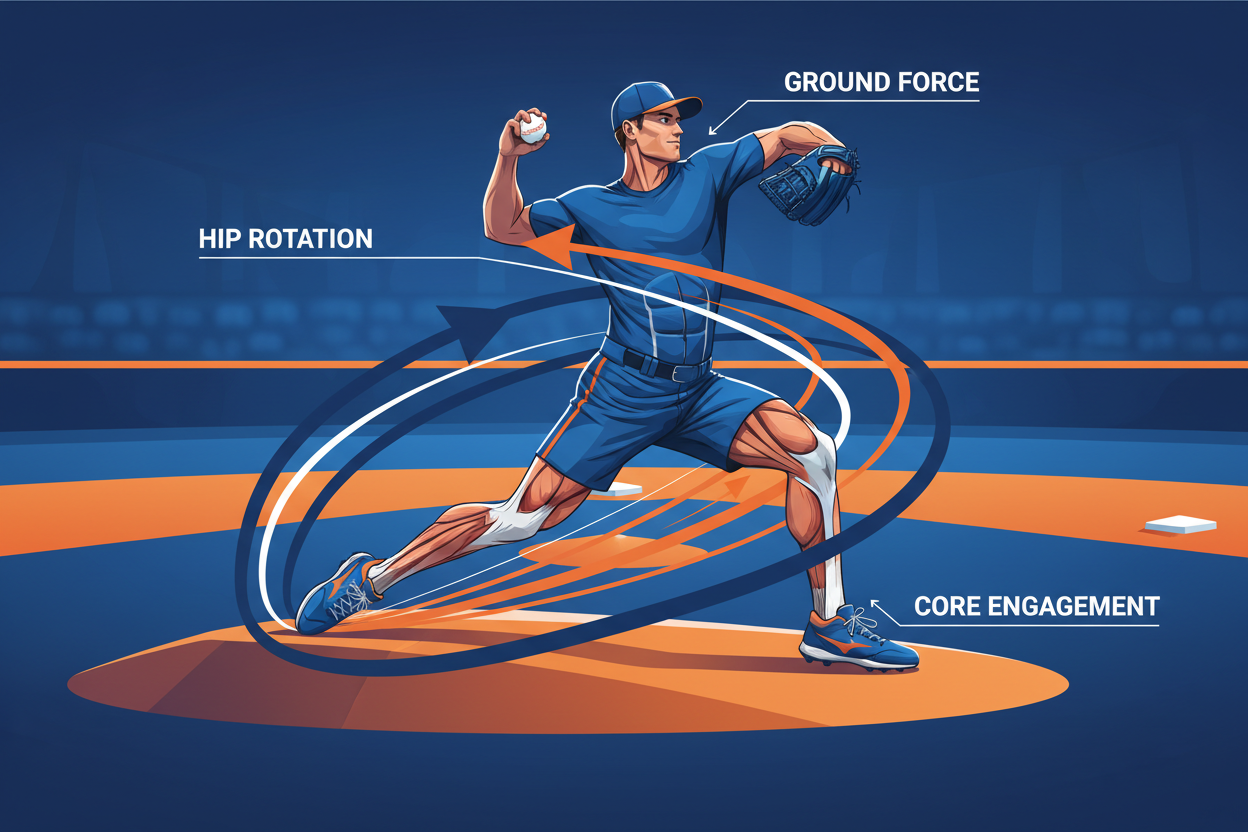
Building baseball player legs is not about training for aesthetics or pure bodybuilding hypertrophy. While size can correlate with strength, the primary goal is force production and force absorption. The kinetic chain relies on the lower half to generate energy, which is then transferred through the core and out through the extremities. If the legs are weak, the arm has to work overtime to compensate, often leading to elbow or shoulder blowouts.
A proper leg workout for baseball must address three distinct areas: absolute strength, explosive power, and unilateral stability. Baseball is a sport played on one leg at a time. Think about it: when you pitch, you balance on the drive leg and land on the lead leg. When you run bases, you are never on two feet simultaneously. Therefore, the best leg workouts for baseball players always prioritize single-leg movements alongside traditional lifts.
Foundational Strength Movements
Before moving to complex plyometrics, you must build a base of absolute strength. These movements recruit the maximum number of muscle fibers and teach the central nervous system to handle heavy loads.
The Trap Bar Deadlift
This is arguably the king of baseball leg exercises. Unlike the straight bar deadlift, the trap bar places less shear force on the lumbar spine while allowing for greater quad engagement. It mimics the "athletic position" used in fielding and hitting. Heavy deadlifts build the posterior chain—hamstrings and glutes—which are the primary engines for rotational power.
Front Squats
While back squats are standard, front squats are often superior for a baseball leg workout. The front-loaded position forces thoracic extension (keeping the chest up), which is vital for posture. It also places a higher demand on the core and reduces the risk of hyperextending the lower back, a common issue for athletes with anterior pelvic tilt.
Unilateral Training: The Secret Weapon
If you skip single-leg work, you are missing the most transferable aspect of training. Leg workouts for baseball players must correct asymmetries between the left and right sides to prevent injury.
Rear-Foot Elevated Split Squats
Often called Bulgarian Split Squats, these are grueling but essential. They stretch the hip flexor of the rear leg while demanding immense drive from the front glute and quad. For pitchers, this directly translates to the stability needed on the lead leg at foot strike. If you cannot control your body weight here, you cannot control your delivery.
Lateral Lunges
Baseball is a lateral sport. You move side-to-side to field grounders, and pitchers drive laterally off the mound. Standard lunges move forward and backward, but a lower body baseball workout needs to move in the frontal plane. Lateral lunges build the adductors and abductors, protecting the groin and knees from the high stress of lateral explosive movements.
Specific Leg Workouts for Pitchers
While position players need speed, pitchers need violent, instantaneous ground force production. The best leg workouts for pitchers focus heavily on the "drive" phase and the "block" phase. Pitching leg workouts should include exercises that teach the body to store and release elastic energy.
Lateral Heiden Bounds (Skaters)
This plyometric exercise mimics the push-off from the rubber. The goal is to jump as far sideways as possible and stick the landing without wobbling. This teaches the nervous system to accept force, which is exactly what happens when a pitcher lands on their front foot. Good leg workouts for pitchers always include a plyometric component to convert strength into speed.
Medicine Ball Scoop Toss
While this involves the upper body, the power comes from the hip hinge and leg drive. Standing sideways to a wall, holding a med ball, you load the back hip and explode rotationally to throw the ball against the wall. This bridges the gap between the weight room and the mound, making it one of the best leg exercises for pitchers looking to synchronize their lower and upper halves.
Structuring the Week: A Sample Routine
Integrating these movements requires balance. You cannot train legs heavily the day before a game or a bullpen session. Here is how you might structure a leg day for baseball players during the off-season to maximize gains.
The Workout
Begin with a dynamic warm-up focusing on hip mobility. Do not skip this; tight hips ruin mechanics.
- 1. Heiden Bounds: 3 sets of 5 jumps per side (Focus: Explosive power)
- 2. Trap Bar Deadlift: 4 sets of 5 reps (Focus: Absolute strength)
- 3. Rear-Foot Elevated Split Squats: 3 sets of 8 reps per leg (Focus: Stability and hypertrophy)
- 4. Lateral Lunges (Goblet hold): 3 sets of 8 reps per side (Focus: Lateral movement)
- 5. Nordic Hamstring Curls: 3 sets of 6 reps (Focus: Injury prevention)
This routine covers all bases: power, strength, stability, and injury prevention. Leg workouts for baseball pitchers might adjust the volume depending on their throwing schedule, but the movement patterns remain consistent. The goal is to build a chassis that can support the high-velocity engine of the arm.
Consistency is the final variable. Performing the best leg workouts for baseball players once a month will yield zero results. You need to progressively overload these movements, adding weight or intensity week over week. When you build a strong foundation, you stop throwing with just your arm and start pitching with your entire body.
Frequently Asked Questions
Should baseball players run long distances for leg strength?
Generally, no. Long-distance running trains slow-twitch muscle fibers, which can actually decrease explosive power. Baseball is a sport of short, violent bursts of energy, so sprints and interval training are far more effective for conditioning than jogging several miles.
How often should pitchers train legs during the season?
In-season training is about maintenance rather than building maximum strength. Pitchers should aim for leg workouts twice a week, ideally scheduling the heavier session immediately after a start to allow for maximum recovery time before the next outing. Keep the intensity high but reduce the overall volume (fewer sets).
Is it safe for young pitchers to lift heavy weights?
Yes, provided they have proper supervision and form. Resistance training is vital for increasing bone density and connective tissue strength. Young athletes should master bodyweight movements first, then progress to light weights with perfect technique before attempting heavy loads.