Standing Shoulder Flexion: The Master Key to Overhead Mobility
Most lifters obsess over how much weight they can press overhead, but few pay attention to the mechanism that allows that movement to happen in the first place. If you have ever felt a pinch at the top of a press or struggled to keep your biceps by your ears, your standing shoulder flexion is likely the culprit.
This fundamental movement pattern is the prerequisite for everything from reaching for a top shelf to snatching a barbell. When you ignore it, you invite impingement. When you master it, you unlock true overhead stability and strength.
Key Takeaways
- Definition: Standing shoulder flexion is the act of raising your arm forward and upward from a neutral standing position.
- Primary Muscles: Anterior deltoid, Pectoralis major (clavicular head), and Coracobrachialis.
- The Goal: To achieve 180 degrees of range of motion without compensating by arching the lower back.
- Progression: Start with bodyweight mechanics, then progress to dumbbell shoulder flexion for hypertrophy and strength.
- Common Error: Flaring the ribs to fake range of motion.
The Biomechanics of Flexion
Shoulder flexion isn't just about the arm bone (humerus) moving in the socket. It requires a symphony of movement between the humerus and the shoulder blade (scapula).
For every 2 degrees your arm moves up, your scapula should rotate upward by roughly 1 degree. This is called scapulohumeral rhythm. If your scapula is stuck—often due to tight lats or a weak serratus anterior—your arm hits a bone block. This is where the grinding sensation comes from.
How to Perform Standing Shoulder Flexion Correctly
Executing this move with precision is harder than it looks. We aren't just swinging arms here; we are training the brain to disassociate the shoulder from the spine.
1. The Setup
Stand with feet shoulder-width apart. Squeeze your glutes and brace your abs slightly. This locks your ribcage down, preventing your lower back from helping the movement.
2. The Movement
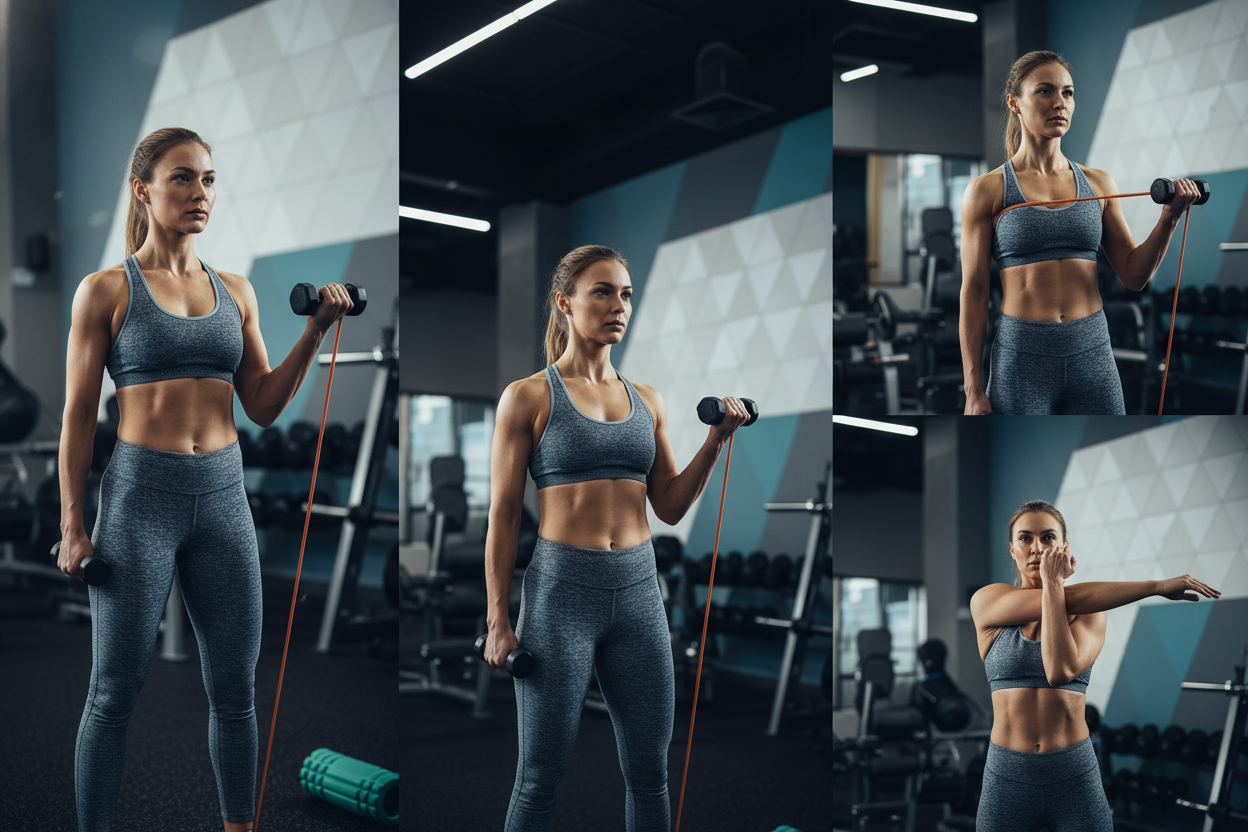
With your thumb pointing up (neutral grip), slowly raise your arm forward. Keep the elbow straight. Aim to bring your bicep next to your ear.
3. The Top Position
Pause at the top. Ask yourself: Did my ribs pop up? If they did, you haven't actually flexed your shoulder; you've extended your spine. Reset and stop at the point just before your ribs want to move.
Loading the Movement: Dumbbell Shoulder Flexion
Once your mechanics are sound, you need to load the tissue to build resilience. This is essentially a front raise, but performed with strict attention to the end-range of motion.
Shoulder flexion with dumbbell resistance changes the torque curve. Gravity pulls the weight down, creating maximum tension on the anterior deltoid when the arm is parallel to the floor. However, lifting past parallel (overhead) with a dumbbell shifts the focus to stability and upper trap engagement.
Pro Tip: Don't swing the weight. Momentum kills the benefit of this exercise. Use a tempo of 3 seconds up, 1 second hold, 3 seconds down.
Common Mistakes That Kill Progress
The Rib Flare
This is the most common cheat. If you lack the mobility to get your arm overhead, your body will naturally arch the lower back to get the hand higher. This creates a false sense of mobility and puts shear force on the lumbar spine.
Hiking the Traps
If you feel your shoulders shrugging up toward your ears as you initiate the lift, your upper traps are taking over. Keep the shoulders depressed (down) for the first 90 degrees of the movement.
My Training Log: Real Talk
I distinctly remember the frustration of rehabbing a minor rotator cuff impingement three years ago. My physio handed me a 5lb pink dumbbell and told me to do standing shoulder flexion. I laughed. I was used to pressing 100lb dumbbells.
But then I tried it with strict form—back flat against a wall to prevent rib flare. The trembling was immediate. I realized that what I thought was "mobility" was actually just me arching my back aggressively to get the weight up.
The most humbling part wasn't the weight; it was the tactile cue of my lower back leaving the wall every time my arm passed eye level. It took me six weeks of doing shoulder flexion with dumbbell loads of just 10lbs to actually own that range of motion. Now, when I overhead press heavy, the "crunchy" feeling in my AC joint is gone. If you feel a shake in your armpit area (that's the serratus anterior working) while doing these, you're finally doing them right.
Conclusion
Standing shoulder flexion is deceptively simple. It exposes the truth about your mobility and forces you to address the weak links in your overhead chain. Whether you use it as a warm-up drill or a loaded hypertrophy exercise, strict execution is the only way to see results. Stop faking your range of motion and start building it.
Frequently Asked Questions
What muscles does standing shoulder flexion work?
It primarily targets the anterior (front) deltoid. However, it also heavily recruits the clavicular head of the pectoralis major and the coracobrachialis. At the top of the movement, the serratus anterior and upper traps assist in upward rotation of the scapula.
Is dumbbell shoulder flexion the same as a front raise?
Technically, yes, they describe the same movement pattern. However, "front raise" usually implies a bodybuilding focus on the anterior deltoid up to shoulder height, whereas "shoulder flexion" implies a biomechanical focus, often taking the arm through the full range of motion (overhead) to improve mobility and stability.
Why does my shoulder click during flexion?
Clicking is often caused by a tendon snapping over a bony prominence or scar tissue. If it is painless, it is usually harmless. However, if it comes with pain, it may indicate impingement (lack of space in the shoulder joint) or a tear. Improving scapular mechanics often resolves the clicking.