Squats with Weights: The Definitive Guide for Total Leg Growth
You have mastered the bodyweight movement. You can sit back, stand up, and repeat it for high reps without breaking a sweat. But now, your progress has stalled. To force your muscles to grow and your strength to skyrocket, you need to introduce an external load. You need to start performing squats with weights.
Adding resistance changes the game entirely. It shifts the exercise from a simple mobility drill to a compound lift that taxes your central nervous system, spikes your metabolism, and builds dense muscle tissue. However, the margin for error shrinks the moment you pick up a dumbbell or step under a barbell.
Key Takeaways: Quick Form Checklist
If you are looking for a quick reference on how to do weighted squats safely, keep these core principles in mind before every set:
- Stance Stability: Feet shoulder-width apart, toes pointed slightly out (15-30 degrees).
- Core Bracing: Take a deep breath into your belly and brace as if you are about to be punched before you descend.
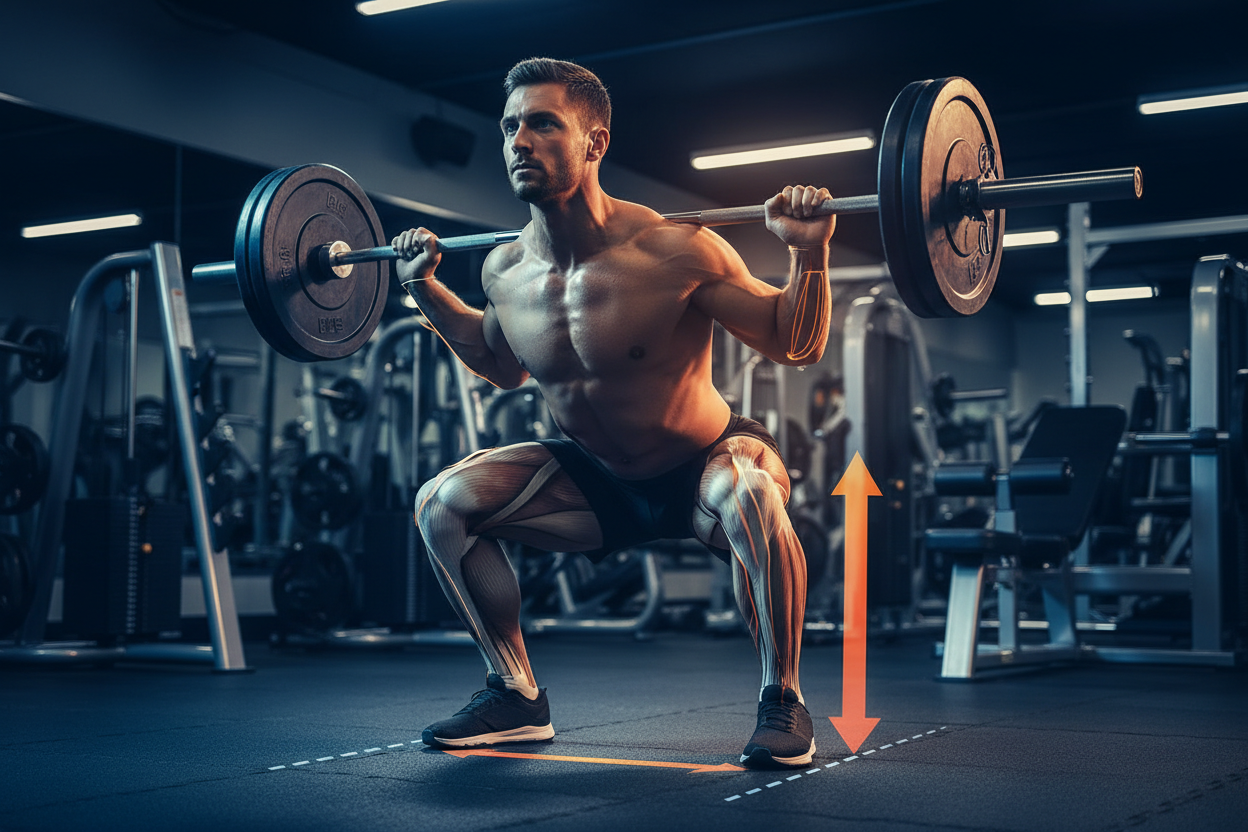
- path of Motion: Hips and knees should break at the same time; the weight should move in a vertical line over your mid-foot.
- Depth: Aim for your hip crease to drop below the top of your knee (parallel) for full muscle activation.
- The Drive: Push the floor away through your whole foot, not just the toes or heels.
Choosing Your Load: Dumbbells vs. Barbells
Before discussing how to do a squat with weights, you must choose your equipment. The best way to do squats with weights depends largely on your experience level and mobility.
The Goblet Squat (Dumbbell/Kettlebell)
This is the entry point. Holding a single weight at chest height forces you to keep your torso upright. It naturally corrects poor posture. If you are learning how to squat with a weight for the first time, start here. It teaches you to sit between your legs rather than folding over them.
The Barbell Back Squat
This is the king of squat lifts with weights. It allows for maximum loading. However, it requires significant shoulder mobility and core stability. The load is placed on the upper back (traps), which changes the center of gravity and demands a more precise hip hinge.
The Setup: How to Do Proper Squats with Weights
Executing proper squats with weights requires a ritualistic approach to your setup. You cannot rush this.
1. The Unrack and Walkout
If using a barbell, step under the bar and set it on your traps—not your neck. Squeeze your shoulder blades together to create a shelf. Stand up tall to unrack. Take two deliberate steps back and one step out to adjust your width. This minimizes wasted energy.
2. The Descent
This is where most people fail when learning how to do squats correctly with weights. Do not just drop down. Control the weight.
Unlock your hips and knees simultaneously. Imagine there is a tripwire behind your heels that you are trying not to touch. Keep your chest proud. As you descend, drive your knees outward to track over your toes. This engages the glutes and prevents the knees from collapsing inward (valgus collapse).
3. The Hole and The Drive
Once you hit depth, do not hang out there. You want to utilize the stretch reflex—the elastic energy stored in your muscles. Drive your upper back into the bar (or the weight into your hands) and push the floor away. Exhale forcefully as you pass the sticking point of the lift.
The Science of Stability
Why do we obsess over proper squat form with weights? It comes down to spinal mechanics. When you add load, shear forces on the spine increase.
By bracing your core (creating intra-abdominal pressure), you turn your torso into a rigid cylinder. This protects the lumbar spine and transfers power from your legs to the weight efficiently. If you lose tightness, you lose power, and you risk injury.
Common Mistakes When Doing Squats with Weights
Even seasoned lifters develop bad habits. Here is how to squat properly with weights by avoiding these errors:
Ego Lifting (Shallow Depth)
Loading the bar with more weight than you can handle usually results in quarter-reps. This places massive stress on the knees without working the muscles effectively. Drop the weight and hit full depth.
The "Good Morning" Squat
If your hips shoot up faster than your chest coming out of the hole, you shift the load entirely to your lower back. This usually indicates weak quads or a failure to drive the upper back into the bar. Focus on keeping your torso angle constant during the first half of the ascent.
Heel Lift
If your heels pop off the ground, your weight has shifted forward. This is often an ankle mobility issue or a result of improper footwear. Proper way to squat with weights involves flat, stable footwear (like lifting shoes or Converse) to maximize ground contact.
My Training Log: Real Talk
I want to share a specific realization from my own training. I spent the first two years of my lifting career thinking I knew how do you squat with weights. I was moving decent numbers, but my lower back always felt "tight" (read: painful) the next day.
It wasn't until I dropped the weight to a humbling 135 lbs and focused on the "shelf" for the bar that things clicked. I realized I had been holding the bar in my hands rather than pinning it to my traps. The moment I learned to actively pull the bar down into my back—engaging the lats—the wobble disappeared.
The specific sensation of the knurling digging into the meat of the traps, rather than resting on the spine, was the game changer. It feels uncomfortable at first, almost like a bruise forming, but that stability is the only reason I was eventually able to break the 300lb barrier without a back injury. If you don't feel tight and slightly uncomfortable before you even start the rep, you aren't braced hard enough.
Conclusion
Learning the correct way to do squats with weights is a marathon, not a sprint. It is a skill that requires constant refinement. Whether you are using a kettlebell or a loaded barbell, respect the movement. Prioritize your form over the number on the plates, and your legs will have no choice but to grow.
Frequently Asked Questions
How much weight should I start with when squatting?
If you are new to the weighted squat, start with a light dumbbell (15-20 lbs) held at chest height (Goblet Squat). If using a barbell, start with just the empty bar (45 lbs). Master the technique for 15 reps before adding load.
Is it better to squat with dumbbells or a barbell?
Dumbbells are safer for beginners learning proper way to do squats with weights because they encourage an upright torso and are easier to bail from. Barbells are superior for maximum strength and muscle gain once your form is solid.
How deep should I go when doing squats with weights?
For proper squats with weights, aim for parallel depth, where the crease of your hip is in line with or slightly below the top of your knee. Going deeper (Ass-to-Grass) is great if your mobility allows, but never sacrifice spinal stability for depth.