Squat Weight Workout: The Definitive Guide for Leg Growth
Let’s be honest: leg day is often the most dreaded day of the week. But if you are serious about building functional strength and a balanced physique, you cannot ignore the king of all exercises. A proper squat weight workout is the cornerstone of athletic performance, yet so many lifters get it wrong.
Whether you are under a heavy barbell or working out in your living room, the mechanics remain the same. This guide cuts through the noise to help you master the movement, avoid injury, and actually see growth.
Key Takeaways
- Form is Non-Negotiable: Depth matters more than ego. Aim for parallel or below to fully activate the glutes and hamstrings.
- Progressive Overload: You must increase weight, reps, or tension over time. A static squat exercise routine yields static results.
- Equipment is Optional: You can generate immense hypertrophy with tempo work and unilateral variations at home.
- Frequency: Squatting 2-3 times a week is generally superior to a single "leg annihilation" day for natural lifters.
The Mechanics: Why Squats Rule
The squat is a compound movement that recruits the quadriceps, hamstrings, glutes, and the entire core. It triggers a significant hormonal response due to the amount of muscle tissue involved. However, the benefits only apply if your mechanics are sound.
Many people treat the squat like a simple knee bend. It isn't. It is a hip movement. You need to break at the hips first, sitting back as if reaching for a chair, before the knees travel forward.
How to Execute the Perfect Squat
1. The Setup
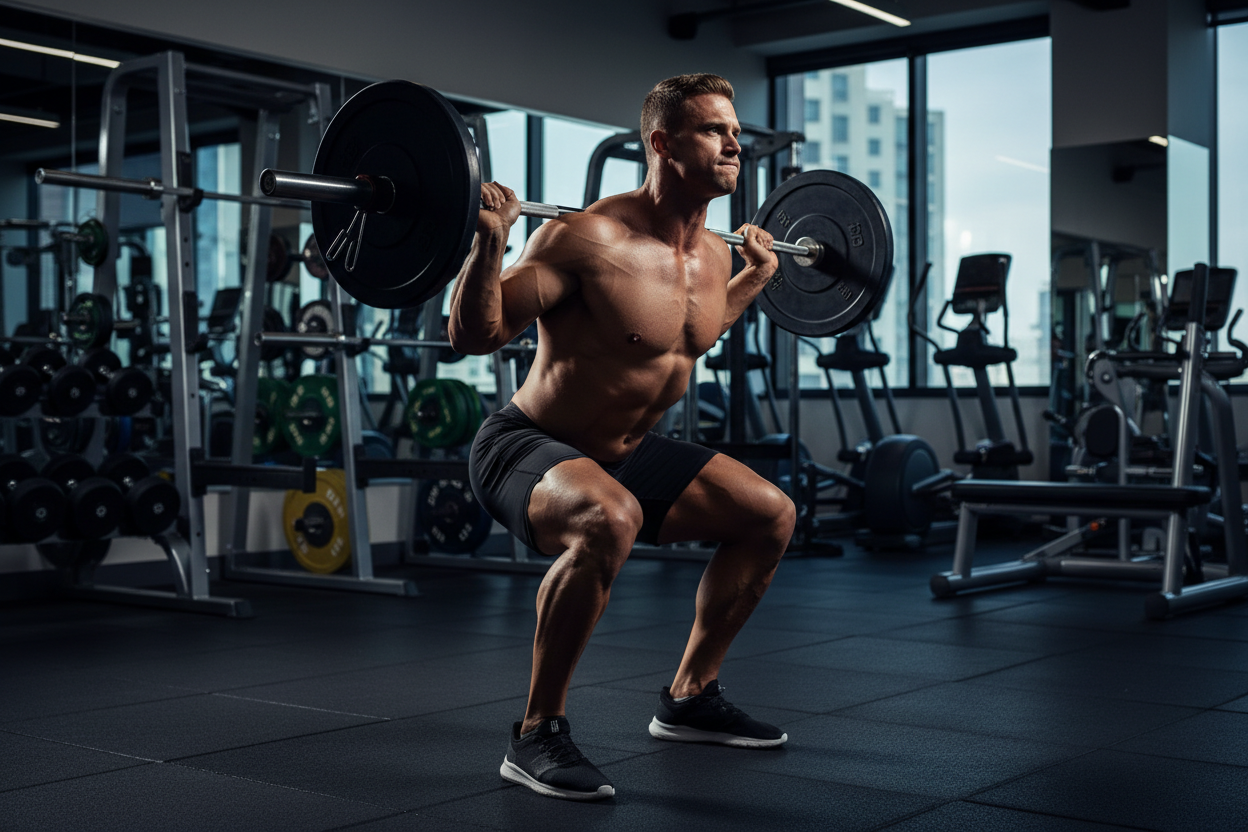
Place the bar on your upper back (traps), not your neck. Keep your feet shoulder-width apart with toes pointed slightly out (about 15 to 30 degrees). Brace your core as if someone is about to punch you in the stomach.
2. The Descent
Inhale deep into your belly. Break at the hips and control the weight on the way down. Do not drop like a stone. Your knees should track over your toes—never let them cave inward.
3. The Drive
Once your hip crease passes your knees, drive upward through your mid-foot. Exhale forcibly as you pass the sticking point. Squeeze your glutes at the top, but don't hyperextend your lower back.
No Gym? No Problem (Home Variations)
You might be wondering how to do squats at home without equipment while still gaining muscle. The secret is increasing time under tension and unilateral loading.
The Pause Squat
Perform a standard bodyweight squat, but hold the bottom position for a full 3-second count. This removes the stretch reflex (the bounce) and forces your muscles to do all the work to get you back up. It turns a basic movement into a grueling challenge.
Bulgarian Split Squats
This is the ultimate squat routine at home for isolation. Place one foot on a couch or chair behind you and squat with the front leg. This variation exposes imbalances and puts an incredible load on the quad without needing heavy iron.
Sample Squat Exercise Routine
If you have access to weights, try this linear progression. If you are looking for squats to do at home, simply replace the barbell movements with the dumbbell or bodyweight variations mentioned above.
- Warm-up: 5 minutes mobility (hip openers, ankle dorsiflexion).
- Main Lift: Barbell Back Squat - 3 sets of 5 reps (Focus on strength).
- Accessory 1: Goblet Squats - 3 sets of 10-12 reps (Focus on depth).
- Accessory 2: Walking Lunges - 3 sets of 12 steps per leg.
My Personal Experience with Squat Weight Workout
I want to talk about the reality of squatting that textbooks don't mention. I remember my first serious attempt at a high-volume squat cycle (Smolov Jr.). On paper, it looked manageable. In reality, the hardest part wasn't my legs giving out—it was the elbows and the skin on my back.
Nobody tells you about the specific, raw abrasion you get on your upper traps from the bar knurling when you're sweating through a cotton shirt. I also learned the hard way about footwear. I used to squat in running shoes with squishy soles. I remember hitting the bottom of a heavy rep and feeling my foot slide laterally inside the shoe, destabilizing my knee. It was a terrifying wobble.
Switching to flat-soled shoes (like Chuck Taylors) or weightlifting shoes changed everything. The ground feedback was instant. If you feel like you're squatting on a mattress, ditch the running shoes immediately. That stability is the difference between a PR and a tweaked lower back.
Conclusion
Building strong legs doesn't require complex machinery. It requires mastering the basics of the squat weight workout and applying consistent effort. Whether you are using a barbell or doing a squat routine at home, focus on your form, control the tempo, and gradually increase the difficulty. Your legs will have no choice but to grow.
Frequently Asked Questions
How often should I do a squat weight workout?
For most intermediate lifters, squatting 2 to 3 times per week is ideal. This frequency allows for sufficient volume to stimulate growth while providing enough recovery time for the central nervous system.
Can I build muscle with just bodyweight squats?
Yes, but you must increase intensity. Since you cannot add external weight easily, you must use techniques like high reps (20+), slowed-down tempo (3-4 seconds down), or single-leg variations like pistol squats to force adaptation.
Why do my knees hurt when I squat?
Knee pain often stems from poor form, specifically "valgus collapse" (knees caving inward) or lack of ankle mobility. Ensure your knees track in line with your toes and that you are sitting back into your hips rather than just loading the knee joint directly.