
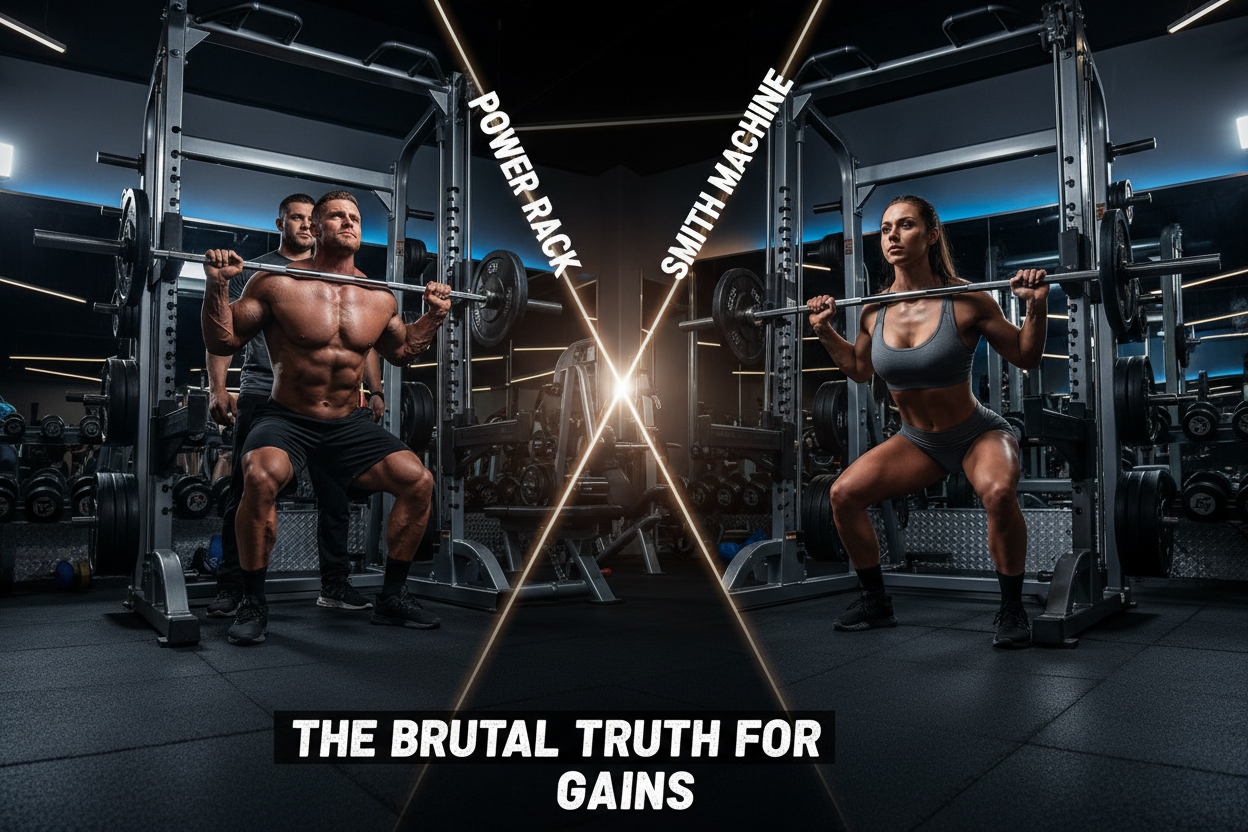
Squat Smith Machine vs Power Rack: The Brutal Truth for Gains
Walk into any commercial gym on leg day, and you will see a silent war being waged. On one side, the purists cling to the barbell inside a cage; on the other, bodybuilders lean into the fixed path of a machine. When comparing the squat smith machine vs power rack, the answer isn't as black and white as internet forums make it seem.
It is not just about which looks cooler on Instagram. It is about biomechanics, joint health, and exactly what you are trying to achieve with your lower body training. Let’s strip away the bro-science and look at the mechanical reality of these two heavy hitters.
Key Takeaways
- Muscle Recruitment: The power rack demands high stabilizer engagement and core strength, while the Smith machine isolates the prime movers (quads/glutes) by removing the need to balance.
- Bar Path: Free weights allow a natural, slightly curved bar path. The Smith machine forces a rigid, vertical line, which can increase shear force on knees if foot placement isn't adjusted.
- Safety: A power cage offers adjustable safety pins for failing safely at the bottom. The Smith machine relies on a hook-and-twist mechanism, which can be dangerous if you fatigue mid-rep.
- Best Use Case: Use the power rack for athletic performance and total body strength. Use the Smith machine for hypertrophy and targeted muscle exhaustion.
The Biomechanics of the Squat
To understand the smith machine vs power rack debate, you have to look at how the bar moves. In a natural squat, the bar does not travel in a perfectly straight line. As you break at the hips and knees, your torso angle changes, and the bar usually creates a very slight curve relative to your center of gravity.
The Fixed Path Problem
The Smith machine forces a linear, vertical path. Because the bar cannot move forward or backward, your body has to adjust around the bar. This often forces users to place their feet further forward to maintain an upright torso.
While this forward foot placement is excellent for isolating the quadriceps, it places different stress on the patellar tendon. If you try to squat with "traditional" mechanics inside a Smith machine, you may feel unnatural compression in your lower back or hips because the machine won't let your body move the way it wants to.
Stabilization and Core Demand
When you step into a power cage vs smith machine, you are responsible for every inch of movement. You have to stabilize the load laterally and anteriorly. This recruits the small stabilizer muscles around the hips and the deep core musculature.
In the Smith machine, stability is outsourced to the guide rods. You can focus entirely on pushing. This isn't inherently "bad." In fact, if your goal is purely muscle growth (hypertrophy) and your core is the limiting factor, the Smith machine allows you to take your quads to absolute failure safely without your lower back giving out first.
Safety Profile: Real Risks vs. Perceived Safety
Most beginners gravitate toward the smith machine or power rack question assuming the machine is safer. This is a half-truth that can get you hurt.
The Bail-Out Factor
In a power rack, you set the safety pins just below your bottom squat depth. If you get stuck, you simply lower the bar to the pins and crawl out. It is foolproof.
In a Smith machine, you must rotate your wrists to re-rack the weight. If you are at the absolute limit of your strength and your hands are slipping, or if you descend too deep below the lowest hook, you can get pinned in a very compromised position. The fixed path can literally fold you if you aren't careful.
Hypertrophy Potential: Which Builds More Muscle?
If you want legs that look like tree trunks, you need volume and tension. A 2020 study published in the Journal of Strength and Conditioning Research suggested that while free weight squats activate more muscles overall (specifically the trunk and stabilizers), the Smith machine is highly effective for isolating the quadriceps.
Think of it this way: The power rack builds the athlete; the Smith machine builds the bodybuilder. If you want functional strength that translates to carrying groceries or playing sports, you need the power rack. If you are trying to bring up a lagging vastus medialis (teardrop muscle) without worrying about balance, the Smith machine is a valid tool.
My Training Log: Real Talk
I have spent years under the bar in both setups, and I want to share a specific detail about the smith machine vs free weights that specs don't tell you. It's about the "grind."
When I am heavy in the hole (the bottom of the squat) in a power rack, I can feel the knurling biting into my back, and I have the freedom to shift my hips slightly to find leverage. There is a "wobble" that tells me my nervous system is firing.
However, my experience with the Smith machine is distinct because of the friction. I remember specifically training at a commercial gym where the guide rods hadn't been oiled in months. On the eccentric (lowering) phase, I could feel a gritty vibration through the bar. It threw off my tempo completely. Also, there is a psychological panic in the Smith machine when you are fatigued; trying to roll your wrists back to catch the hook when your forearms are pumped is terrifying. I have never felt that fear in a cage with properly set safety pins.
Conclusion
Stop looking for a winner and start looking for the right tool. If your goal is total body strength, athletic power, and coordination, the power rack is non-negotiable. It is the king of compound movements.
However, if you are working around a lower back injury or specifically trying to torch your quads at the end of a workout, the Smith machine is a valuable asset. Don't let dogmatic trainers tell you it's useless. Just use it for what it was designed for: isolation and stability, not a direct replacement for the barbell squat.
Frequently Asked Questions
1. Is the Smith machine bad for your knees?
Not inherently, but it can be if you use the wrong form. Because the bar path is fixed, you must place your feet further forward than a standard squat. If you try to squat with your feet directly under the bar (like a free weight squat), it creates excessive shear force on the knee joint. Adjust your foot placement, and it is safe.
2. How much more can I lift on a Smith machine vs power rack?
Most lifters can squat 5% to 10% more on a Smith machine because they don't have to waste energy stabilizing the weight. However, this varies. Some people find the unnatural track harder to push against. Do not equate a 300lb Smith squat to a 300lb free-weight squat; they are different metrics.
3. Can I replace barbell squats with Smith machine squats?
If you are a bodybuilder, yes, you can build big legs with just the Smith machine. However, if you are an athlete or looking for functional strength, you cannot replace the barbell. The Smith machine does not train your stabilizers, meaning you might have strong legs but a weak core and poor balance in real-world situations.


