Squat Day Exercises: Two-Day Movement Blueprints, Lower-Body Sequencing, and Home Floor Stability
Foundational Principles of Squat Day Programming
Executing an effective routine around squat day exercises requires a clear understanding of lower-body movement mechanics. A balanced squat leg workout balances knee-dominant movements with hip-dominant patterns to develop the quadriceps, glutes, hamstrings, and core stabilizers evenly. While the barbell back squat remains a centerpiece for many lifters, relying exclusively on a single bilateral movement can create muscular imbalances or mobility plateaus over time.
A well-sequenced leg workout with squats addresses both primary compound strength and multi-planar joint function. Knee flexion movements place direct demand on the anterior chain, whereas complementary movements load the posterior chain through controlled hip extension. For lifters transitioning into split routines, reviewing beginner leg training routines offers foundational insight into managing training volume and frequency before advancing to multi-day lower-body splits.
Essential Squat Day Exercises: Movement Selection and Form Mechanics
Constructing a complete lower-body session involves selecting variations that fit individual joint anatomy, mobility constraints, and strength goals. Integrating a spectrum of bilateral and unilateral patterns ensures symmetrical muscle recruitment and balanced joint loading.
Primary Bilateral Squats
- Back Squats (High-Bar and Low-Bar): High-bar squats emphasize an upright torso and deep knee flexion for quadriceps engagement, while low-bar setups distribute load toward the posterior chain and hips.
- Front Squats: By positioning the load across the anterior deltoids, front squats demand heightened thoracic extension and recruit the anterior core alongside the quadriceps.
- Goblet Squats: Serving as an accessible entry point or a high-rep accessory, goblet squats reinforce proper upright posture and hip mobility.
Unilateral and Secondary Variations
- Bulgarian Split Squats: Elevated rear-foot positioning isolates single-leg drive, improves hip flexor mobility, and reduces bilateral spinal compression.
- Walking Lunges: Dynamic lunges challenge hip stabilization, balance, and unilateral leg drive across a functional movement path.
- Romanian Deadlifts: As a posterior accessory, hip-hinge patterns support hamstring and lower-back resilience to balance heavy knee flexion.
Lifters looking to expand their movement repertoire across various training blocks can consult a structured training directory to align accessory movements with primary strength objectives.
Structuring a Two-Day Squat Workout Split
Dividing lower-body training into two distinct weekly sessions allows athletes to focus on specific movement qualities without accumulating excessive systemic fatigue in a single day. A dedicated squat leg day split provides adequate recovery time while maintaining consistent neuromuscular stimulus.
Day 1: Heavy Bilateral Loading and Quad Emphasis
The first session of the week prioritizes compound strength and knee-dominant mechanics:
- Primary Movement: Barbell Back Squats (focused strength sets with full recovery)
- Secondary Movement: Front Squats or Hack Squats (moderate volume for quadriceps hypertrophy)
- Unilateral Accessory: Bulgarian Split Squats (controlled tempo)
- Posterior Accessory: Standing or Lying Leg Curls
- Core Work: Hanging Leg Raises or Weighted Planks
Day 2: Posterior Balance, Unilateral Stability, and Tempo Work
The second session balances the weekly workload by incorporating unilateral drive and posterior chain development:
- Primary Movement: Romanian Deadlifts or Trap Bar Deadlifts
- Secondary Movement: Goblet Squats with pause intervals or Safety Bar Squats
- Dynamic Unilateral Movement: Walking Dumbbell Lunges
- Glute and Hamstring Accessory: Hip Thrusts or Back Extensions
- Calf and Ankle Accessory: Standing Calf Raises with paused stretches
For lifters training in unconventional spaces or commercial facilities with high rack demand, utilizing alternative leg day setups without a rack can maintain progression using dumbbells, kettlebells, and bodyweight tempo variations.
Training Surface Dynamics: Floor Stability and Joint Cushioning for Heavy Squats
The surface beneath a lifter directly affects force transmission, balance, and joint comfort during heavy squats for leg day. Performing heavy compound lifts on soft, compressible carpeting or uneven flooring can cause lateral foot instability, shifting the center of mass and placing undesirable torque on ankles and knees.
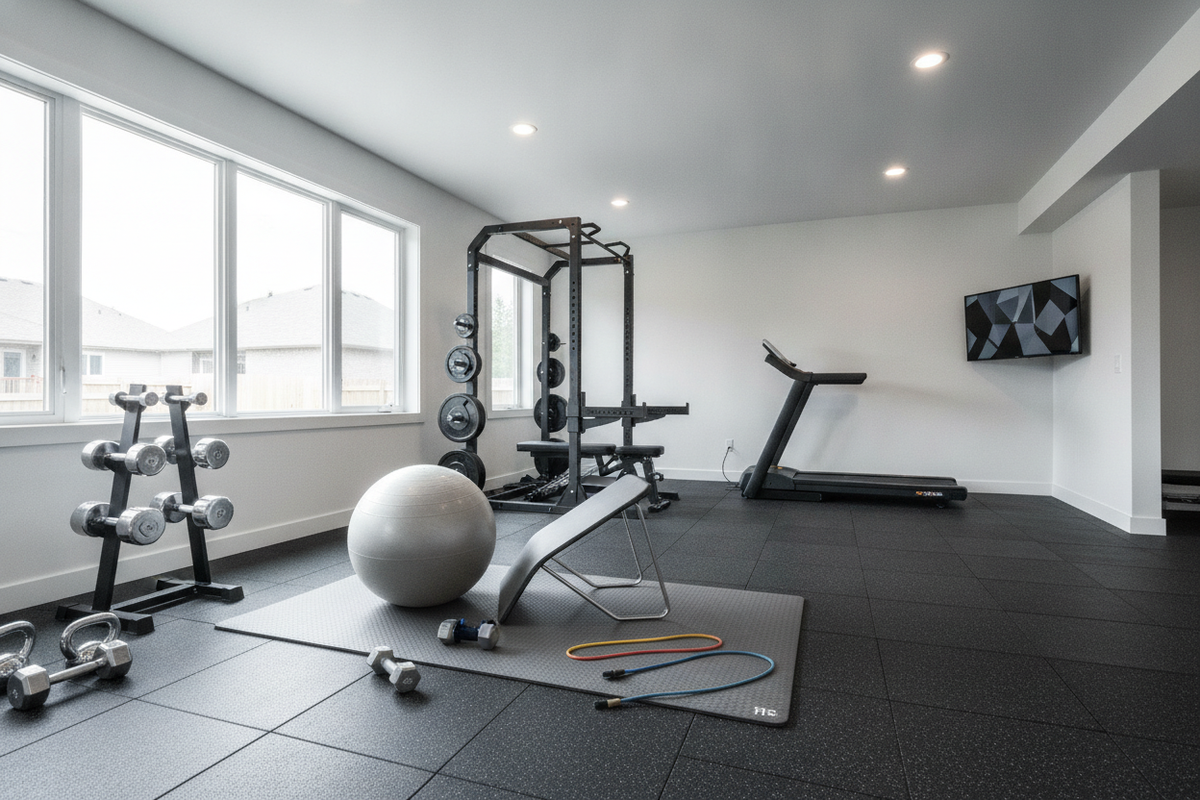
Utilizing dedicated high-density home gym flooring creates a firm, non-slip foundation that supports solid foot anchoring during deep knee flexion. A high-density mat provides sufficient firmness to eliminate energy loss during heavy walkouts while offering enough base cushioning to protect underlying subfloors from dropped dumbbells or kettlebells during high-intensity accessory work.
Home Gym Zoning and Equipment Placement for Squat Sessions
A well-organized home lifting zone optimizes workout efficiency and minimizes setup hazards. Proper zoning around the squat station ensures unhindered walkouts, safe bail trajectories, and smooth plate transitions throughout the workout.
- Rack Positioning and Walkout Clearance: Position power racks or squat stands with ample clear space behind and around the uprights to allow a stable two-to-three-step walkout.
- Weight Plate Distribution: Store weight plates symmetrically on storage horns or nearby floor trees to maintain rack balance and keep the lifting platform clutter-free.
- Accessory Staging: Keep dumbbells, kettlebells, and bands arranged along the perimeter of the mat area so movement transitions remain seamless without creating tripping hazards.
- Surface Care: Periodically wipe down rubber and high-density foam surfaces to remove dust, chalk residue, and moisture, maintaining optimal shoe traction across all working sets.
Practical Execution Tips and Common Movement Pitfalls
Executing a productive leg squat workout relies on sound biomechanical cues and intentional warm-up protocols. Implementing small technical refinements can substantially improve lifting comfort and consistency across training cycles.
Establish a stable three-point foot contact—the heel, base of the big toe, and base of the small toe—distributing pressure evenly through the floor. Prior to unbracing or initiating the descent, create 360-degree intra-abdominal pressure through deep diaphragmatic breathing. Avoid initiating the descent purely from the knees; instead, coordinate simultaneous hip flexion and knee flexion to maintain an even center of mass over midfoot.
Prioritize dynamic warm-ups that incorporate hip rotations, ankle mobilization drills, and unloaded bodyweight squats before adding external resistance. By combining structured movement selection, purposeful two-day programming, and a stable floor setup, lifters can sustain progressive lower-body strength development over the long term.