
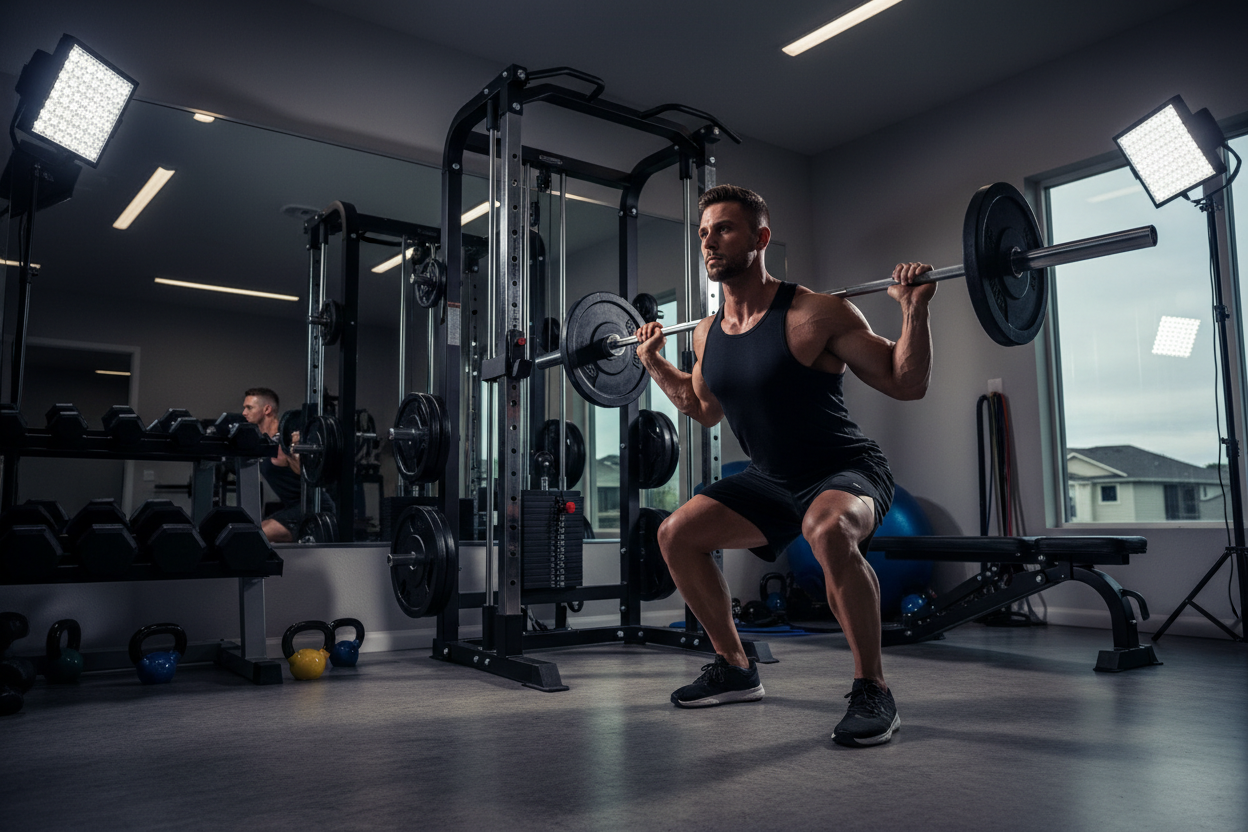
Smith's Machine: The Definitive Home Gym Guide for 2024
You have likely heard the criticism. Purists often dismiss it as a "coat rack" or a cheating tool. But if you ignore the smith's machine, you are leaving gains on the table. The fixed plane of motion isn't a handicap; it is a tactical advantage for hypertrophy.
When your goal is strictly muscle growth rather than functional stabilization, removing the balance factor allows you to overload the target muscle safely. Whether you are outfitting a garage gym or navigating a commercial floor, understanding this equipment is crucial for breaking through plateaus.
Key Takeaways: Why Use a Smith Machine?
- Safety Without a Spotter: The integrated latch system allows you to train to failure safely, which is vital for home gym settings.
- Targeted Isolation: The fixed path eliminates the need for stabilizer muscles, placing 100% of the load on the prime mover (e.g., quads during a squat).
- Versatility: Modern setups often combine the bar with cable systems, acting as a full-body functional trainer.
- Rehab & Mobility: The controlled motion is excellent for those recovering from injury who cannot risk the instability of free weights.
The Mechanics: Why the Fixed Path Matters
The defining feature of this equipment is the vertical or near-vertical fixed path. In the realm of smith machine fitness, this constraint is actually a freedom. When you squat with a free barbell, a significant amount of your energy goes into simply not falling over.
By using a Smith machine, you remove that variable. You can place your feet further forward than gravity would normally allow, targeting the quads or glutes with surgical precision. This is why bodybuilders often prefer it for high-volume leg days; it forces the muscle to work without the central nervous system fatigue caused by balancing heavy loads.
Integrating into Home Gyms
Space is the ultimate luxury in a garage setup. This has led to a surge in home gym smith machines that are no longer single-use behemoths. The days of a standalone unit taking up half the room are gone.
The Rise of the Multi-Functional Trainer
If you are looking for efficiency, look for a multi functional trainer smith machine. These hybrid units are the gold standard for 2024. They combine the guided barbell with a power rack for free weights and a dual-pulley system.
A smith machine with cable system allows you to superset a heavy, stable compound movement (like a Smith bench press) with a dynamic isolation movement (like cable flys) without moving your feet. This density of training is impossible with standard racks.
Equipment Nuances: Weights and Engineering
Not all machines are built the same. The engineering behind smiths machinery varies wildly between commercial and residential grades. The biggest differentiator is the glide mechanism.
Linear Bearings vs. Bushings
High-quality home gym equipment smith machine options use linear bearings. These provide a glassy, smooth motion. Cheaper models use plastic bushings, which can feel gritty and add unnecessary friction to the lift.
Plate Compatibility
You also need to consider the resistance type. A standard smith machine and weights setup usually utilizes Olympic plates (2-inch holes). However, some older or budget-friendly smith machine with plates setups utilize standard 1-inch posts. Always check the sleeve diameter before buying, or you will end up with iron you can't lift.
Common Mistakes to Avoid
The most frequent error is trying to mimic free weight form exactly. Because the bar moves in a straight line, your body must adjust around the bar, not vice versa.
For example, during a bench press, the bar path on a smith machine multi function unit won't curve back toward your face like a natural barbell press. You must position your body so the bar lands exactly where you want it at the bottom of the rep every single time.
My Training Log: Real Talk
I want to be transparent about my history with the smith's machine. For years, I was a free-weight snob. I wouldn't touch the thing.
That changed when I bought a mid-range combo unit for my basement. The first time I used it for calf raises, I realized what I was missing. But here is the unpolished reality: the "knurling" on that specific bar was barely existent. I remember sweating through a set of shrugs and feeling the bar start to slip because the manufacturer skimped on the grip texture.
There is also a specific, terrifying moment when you are grinding out the last rep of a heavy bench press alone. You have to rotate your wrists to hook the bar back onto the safety latches. On my machine, if you didn't rotate it aggressively enough, the hook would graze the metal post and slide down rather than lock. That "clack-clack-clack" sound of the hook missing the catch as the weight drops toward your chest is a sound you never forget. It taught me to always, always set the safety stops before I start the set, no matter how confident I feel.
Conclusion
Whether you are looking for home gyms with smith machine capabilities or just trying to utilize your local gym better, this tool is a powerhouse for hypertrophy. It offers safety, stability, and the ability to take muscles to absolute failure without a spotter. Don't let ego dictate your equipment choices. Use the machine, control the negative, and watch the growth follow.
Frequently Asked Questions
Does the Smith machine count as real weight?
Yes, but with a caveat. The machine balances the weight for you, and the bar itself often has a counter-balance system reducing its starting weight (sometimes to as little as 15 lbs). While you are moving mass, the recruitment of stabilizer muscles is lower than with free weights.
Is a Smith machine good for beginners?
It can be excellent for learning movement patterns without the risk of dropping the weight. However, beginners should also practice with free weights to develop balance and coordination, which the Smith machine does not provide.
Can I deadlift on a Smith machine?
You can, but it is effectively a "rack pull." Because the bar path is fixed and cannot move toward your body, it changes the leverage. It is great for targeting the upper back and traps, but less effective for the full posterior chain compared to a standard barbell deadlift.


