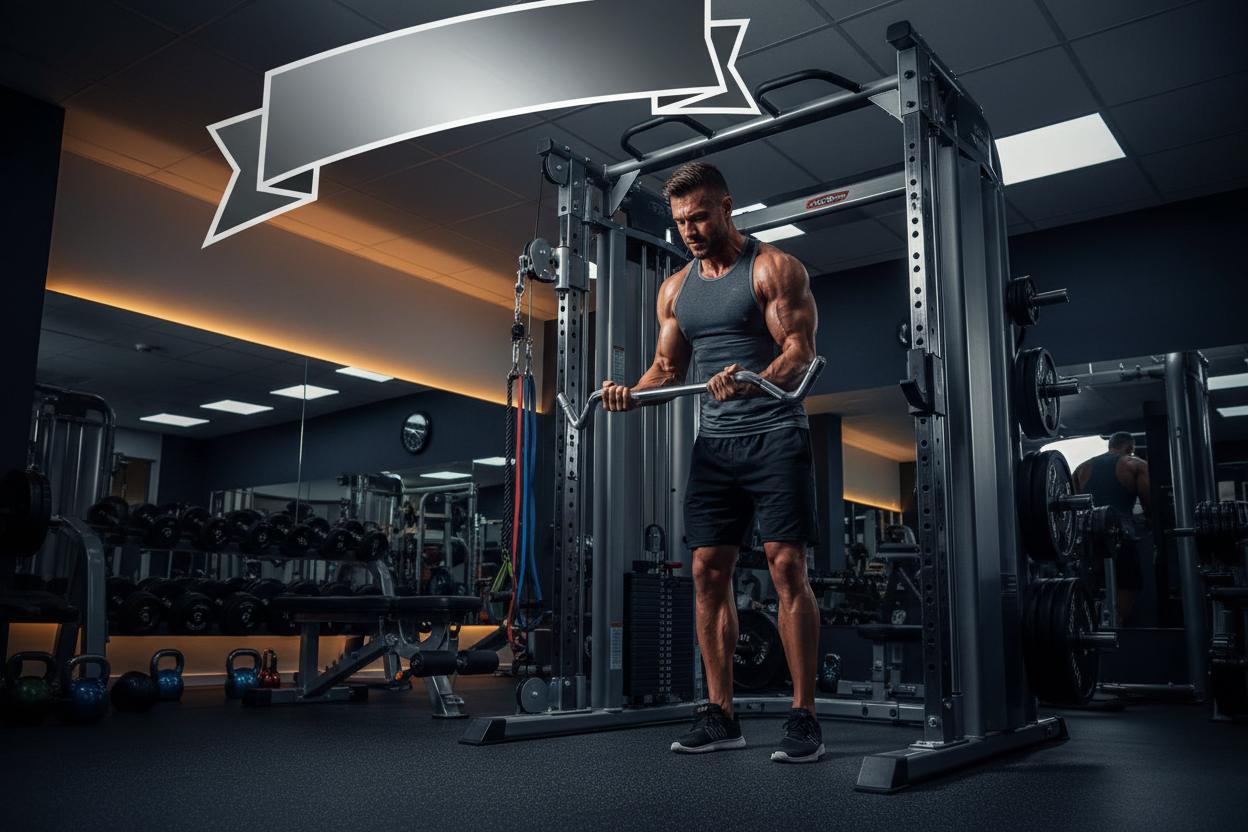
Smith Machine with Pulley: The Only Home Gym Setup You Actually Need
Building a home gym usually involves a frustrating trade-off: you either sacrifice half your garage to fit a power rack, functional trainer, and bench, or you settle for minimal gear and limited gains. This is exactly where the hybrid design of a smith machine with pulley system changes the calculus.
It is no longer just a coat rack for expensive towels. Modern iterations have morphed into functional training powerhouses that bridge the gap between bodybuilding isolation and heavy compound lifting. If you are trying to maximize hypertrophy while minimizing footprint, you need to understand the mechanics of this combination.
Key Takeaways
- Hybrid Functionality: Combines the safety of fixed-path movements (Smith) with the constant tension of free-motion cables (Pulleys).
- Space Efficiency: Eliminates the need for a separate functional trainer and squat rack, often fitting within a 20 sq. ft. footprint.
- Safety Profile: Built-in safety catches allow for training to failure without a spotter.
- Versatility: Supports everything from heavy squats and bench presses to intricate cable flys and face pulls.
The Mechanics: Why Combine Fixed and Free Motion?
To understand why this equipment works, we have to look at the physics of resistance profiles. A standard barbell relies on gravity, which pulls straight down. However, your muscle fibers don't always run vertically.
The Smith component provides a fixed vertical (or slightly angled) path. This stability removes the need for stabilizer muscles to balance the load, allowing you to focus entirely on the prime mover. This is exceptional for overloading muscles safely during squats or overhead presses.
Conversely, the pulley system allows you to manipulate the angle of resistance. By adjusting the pulleys, you can align the force with the direction of your muscle fibers (like in a cable crossover or lateral raise). Having both in one unit means you can hit a heavy compound lift and immediately switch to a metabolic isolation movement without moving your feet.
Critical Features to Inspect
The Pulley Ratio
Not all pulleys feel the same. You will typically see 1:1 or 2:1 ratios. A 2:1 ratio means 100lbs of weight feels like 50lbs. This is actually preferred for functional movements and smaller muscle groups because the cable travel is smoother and longer, allowing for more explosive movements without the weight stack jumping.
Linear Bearings vs. Bushings
This is the difference between a smooth lift and a gritty one. High-quality machines use linear ball bearings for the Smith bar. If you see nylon bushings, understand that the friction will increase as the bar gets heavier, potentially altering your movement pattern.
Common Mistakes When Buying
The biggest error I see lifters make is ignoring the internal width of the cage. If the pulley system is integrated into the uprights, you need enough width to perform cable flys without the weights clanging against the sides or restricting your stretch. Ensure the machine offers a "walk-through" design or sufficient internal clearance.
My Training Log: Real Talk
I want to be transparent about what living with this machine is actually like. On paper, it’s perfect. In reality, there is a maintenance curve.
I remember clearly the first month I owned a high-end plate-loaded unit. I neglected to wipe down the guide rods. About three weeks in, during a heavy incline press, I felt this distinct, stuttering "drag" on the descent. It wasn't heavy; it was friction. It threw off my tempo completely. I learned the hard way that you absolutely must keep a can of silicone spray nearby. If those rods get dry or dusty, the smooth "gliding" feeling vanishes instantly.
Another nuance is the cable changeover. On some cheaper models, swapping the carabiner from a low row to a lat pulldown setup isn't instant—the cable can sometimes twist inside the upright if you release tension too fast, leading to a frustrating five minutes of fishing for the loop. It’s a minor annoyance, but when you’re in the zone, it feels like a major roadblock.
Conclusion
A Smith machine with pulley capabilities is arguably the highest ROI piece of equipment for a solo lifter. It solves the safety issue of training alone while providing the cable versatility usually reserved for commercial gyms. If you choose a unit with linear bearings and a proper pulley ratio, you aren't just buying a machine; you're buying a complete training ecosystem.
Frequently Asked Questions
Is a Smith machine with pulley effective for building muscle?
Absolutely. The Smith machine allows for heavy mechanical tension (the primary driver of growth) without stability limitations, while the pulleys provide metabolic stress and constant tension. This combination covers both main mechanisms of hypertrophy.
Does the pulley system get in the way of the Smith bar?
On well-designed machines, no. The pulley carriages usually slide to the very bottom or top of the uprights, and the Smith bar docks high enough to clear your head. However, always check the "docking height" if you are tall to ensure you don't hit your head during pull-ups.
Do I need plate-loaded or a weight stack?
A weight stack (selectorized) is faster for drop sets and changing weights, making it better for bodybuilding. Plate-loaded versions are generally cheaper and allow for heavier maximum loads, but require more time to load and unload between sets.