Smith Machine v Squat Rack: The Honest Truth for Gains
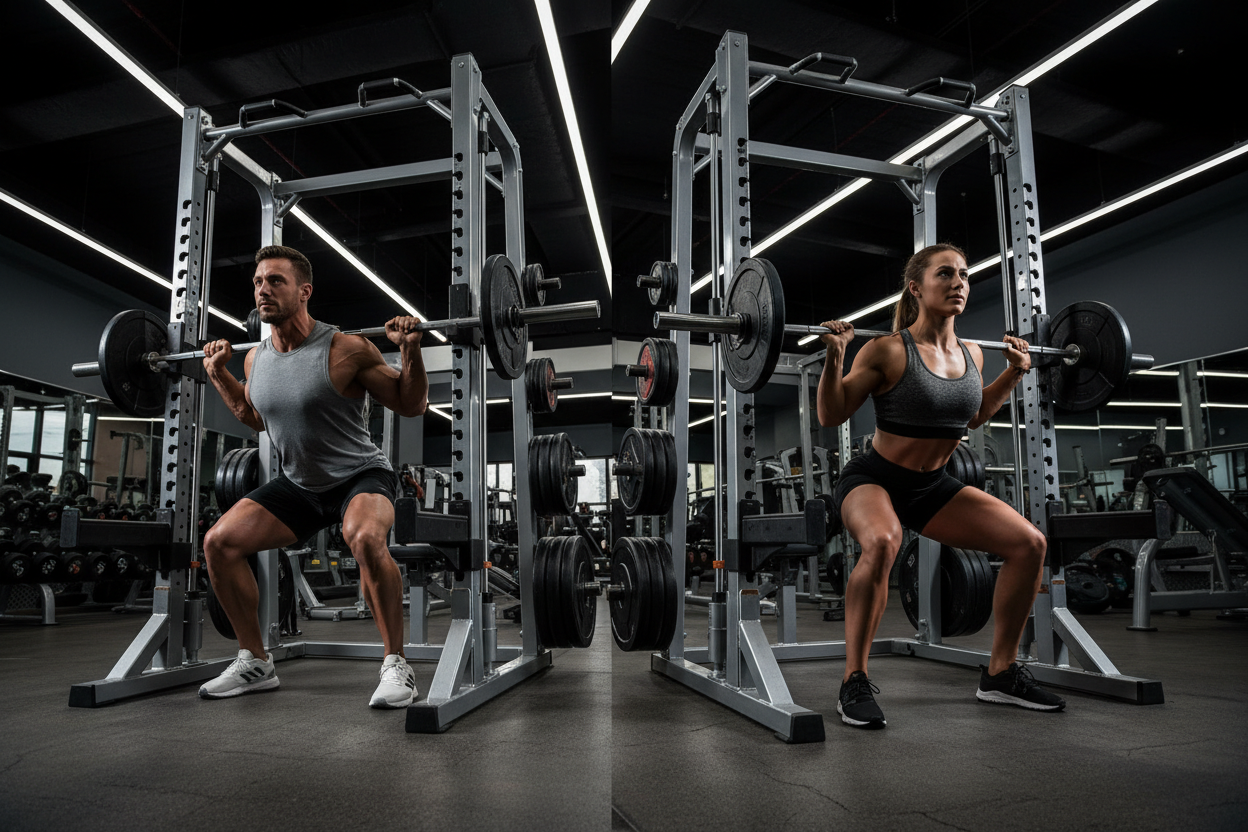
You walk into the gym, ready for leg day, and you see two stations. One looks like a cage with a barbell resting on hooks. The other looks similar but has the barbell attached to vertical steel rails. Ideally, you know exactly which one serves your current goal.
But for many lifters, the smith machine v squat rack debate is a source of constant confusion. Are they interchangeable? Is one safer than the other? Does one kill your gains?
Here is the reality: treating these two pieces of equipment as equals is a mistake that can stall your progress or, worse, lead to injury. Let’s break down the mechanics, the muscle recruitment, and the specific use cases for each so you stop guessing and start growing.
Key Takeaways
- Bar Path: The Smith machine forces a fixed, vertical plane of motion, while the squat rack requires you to control the bar in three-dimensional space.
- Stabilization: Free weight squats in a rack demand significant core and stabilizer muscle engagement; the Smith machine removes this requirement.
- Safety: The Smith machine is safer for solo training to failure due to the hook system, but the fixed path can be harder on joints if your form isn't adjusted.
- Foot Placement: You can place your feet further forward on a Smith machine to target quads, a stance that would cause you to fall over in a squat rack.
The Mechanics: Fixed vs. Free Motion
To understand the difference between smith machine and squat rack setups, you have to look at the bar path.
In a squat rack, you are moving a free weight. Gravity pulls the bar straight down, but you are responsible for keeping it over your mid-foot. If you lean too far forward or shift your hips, the bar moves with you. This forces your body to develop coordination and balance.
The Smith machine eliminates horizontal movement. The bar travels on a fixed guide rod. You cannot fall forward or backward. This isolation allows you to push heavier loads or focus entirely on the prime mover (like the quads) without worrying about balance. However, this fixed path forces your body to adapt to the machine, rather than the machine adapting to your natural biomechanics.
Muscle Activation: The Stabilization Factor
When analyzing squats on smith machine vs squat rack, the biggest variable is stabilizer recruitment.
Because the squat rack forces you to balance the load, your core, lower back, and smaller hip muscles work overtime to keep you upright. This is why free weight squats are often called the king of compound movements—they are a full-body structural exercise.
The Smith machine stabilizes the weight for you. Research suggests that muscle activation in the primary leg muscles (quads) can be similar between the two, but the stabilizer activity is significantly lower in the Smith machine. If your goal is functional strength or athletic performance, the rack wins. If your goal is pure hypertrophy (muscle growth) and you want to exhaust the quads safely without your lower back giving out first, the Smith machine is a valid tool.
Safety: Spotter Arms vs. The Hook System
Safety is usually the main argument for the Smith machine. The bar has hooks along the entire rail. If you get stuck at the bottom of a rep, you simply rotate your wrists, and the bar locks into place. It is excellent for training to failure without a spotter.
However, the squat rack is not inherently dangerous if used correctly. Modern power racks come with safety pins or spotter arms. If you fail a rep, you simply lower the bar onto the safeties and exit the rack.
The hidden danger of the Smith machine lies in its rigidity. Because the bar doesn't move naturally with your body, it can place shearing forces on the knees and lower back if you try to squat with the exact same upright stance you use for free weights.
My Training Log: Real Talk on Smith Machine v Squat Rack
I’ve spent years under both bars, and I want to share a specific nuance that specs don't tell you.
When I’m in the squat rack using my Ohio Power Bar, there is a specific "wobble" at the bottom of a heavy rep—about 315 lbs for me—where I can feel my glutes fighting to keep the bar path centered. That struggle is where the real strength is built. You feel the knurling digging into your back, and you have total ownership of that weight.
Contrast that with my high-volume hypertrophy blocks on the Smith machine. There is a specific friction—a slight mechanical "drag"—on the rails that you don't get with free weights. It feels less organic.
But here is the thing: I can place my feet six inches further forward on the Smith machine than I ever could with free weights. When I do this, the isolation on my teardrop (vastus medialis) is unmatched. I don't have to worry about falling backward. I just drive. The first time I did this, the soreness was completely different from a free squat—it was localized entirely in the quads, with zero lower back fatigue. That’s the real utility here.
Final Verdict
So, who wins the squat rack vs smith machine debate? It depends entirely on your "why."
If you are an athlete, a powerlifter, or someone looking to build total body strength and coordination, the squat rack is your home. It should be the foundation of your program.
If you are a bodybuilder looking to isolate a muscle group safely, or you are working around a specific injury that prevents you from stabilizing a free weight, the Smith machine is not "cheating." It’s a tactical tool.
Frequently Asked Questions
Is the Smith machine bar actually lighter?
Yes, usually. A standard Olympic bar in a squat rack weighs 45 lbs (20kg). A Smith machine bar is often counterbalanced, meaning it can weigh anywhere from 15 to 25 lbs depending on the manufacturer. Always check the label on the machine if you are tracking specific numbers.
Can I bench press in a squat rack?
Absolutely. Most squat racks allow you to slide a flat or incline bench inside. In fact, benching in a rack with safety pins set at chest height is the safest way to bench press alone, as it prevents the bar from crushing you if you fail.
Why do my knees hurt after Smith machine squats?
This often happens because lifters try to use free-weight form on a fixed-path machine. Because the bar travels straight down, you often need to place your feet slightly further forward to allow your hips to sink properly without placing excessive shearing force on the knee joint.