Smith Machine Hip Thrust: The Ultimate Glute Building Guide
Setting up for a heavy barbell hip thrust can feel like a workout in itself. You have to roll the bar over your legs, balance it precariously on your hips, and hope the plates don't slide off. This is exactly why the **hip thrust on smith machine** has become a staple in hypertrophy programs.
It removes the instability of free weights, allowing you to focus entirely on driving weight through your heels and contracting the glutes. If you want to isolate the posterior chain without the balancing act, this variation is your best bet.
Key Takeaways
- Stability is King: The fixed path removes the need to balance the bar, allowing you to lift heavier safely.
- Setup Matters: Use a bench height that hits right below your shoulder blades (scapulae).
- Vertical Shins: At the top of the movement, your shins should be vertical to maximize glute engagement and minimize quad involvement.
- Chin Tucked: Keep your chin tucked to your chest to prevent lumbar hyperextension.
- Safety Stops: Always set the safety stoppers just below your bottom range of motion.
Why Choose the Smith Machine for Hip Thrusts?
Many lifters ask, can you do hip thrusts on a smith machine? The answer is a resounding yes. In fact, for pure muscle growth, it often outperforms the free-weight barbell variation.
Because the machine moves on a fixed rail, you don't waste energy stabilizing the load. This stability allows for a greater mind-muscle connection. You can grind out those last few reps safely without worrying about the bar tipping to one side. It is also much easier to load and unload plates, making it ideal for drop sets.
How to Set Up Smith Machine Hip Thrust
The smith machine hip thrust setup is the most critical part of the lift. If your alignment is off, you will feel it in your lower back or quads instead of your glutes.
1. Bench Placement
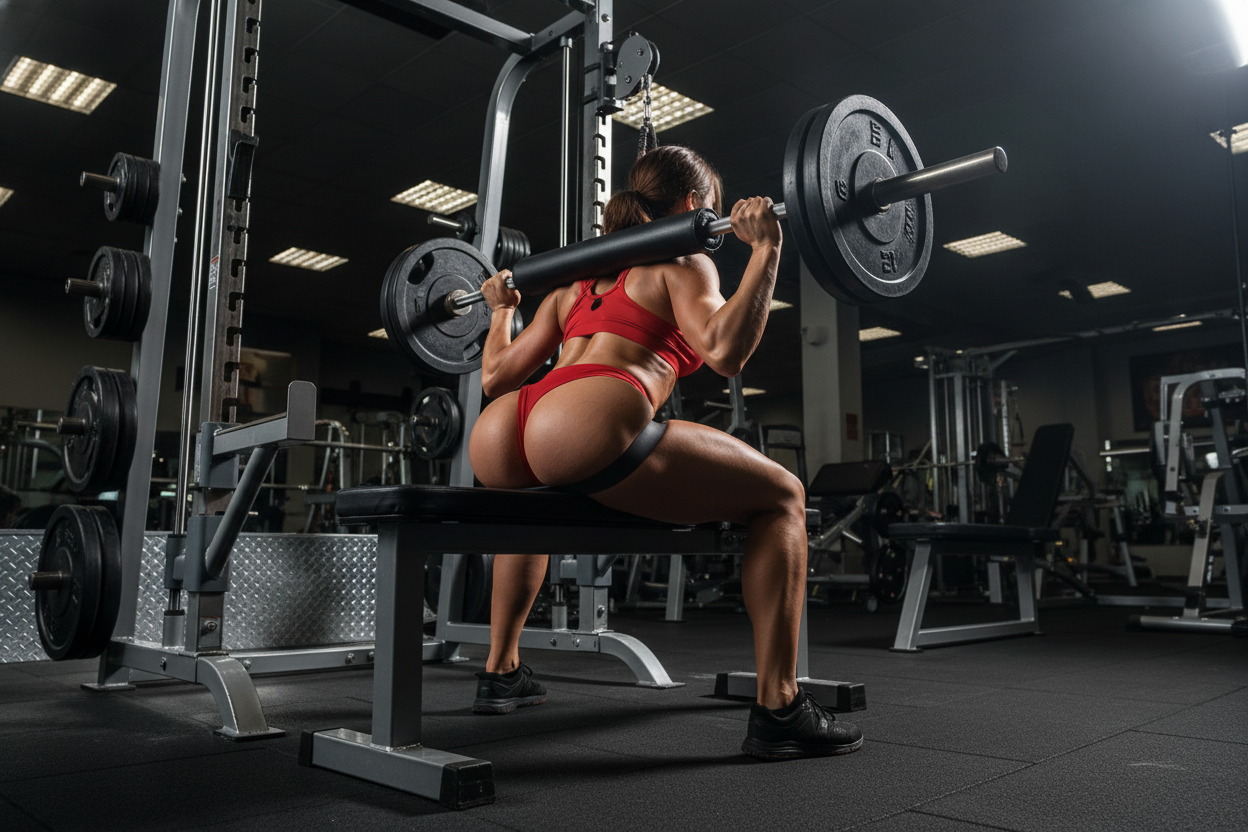
Place a sturdy bench parallel to the bar. When you sit on the floor with your upper back against the bench, the bar should be directly over your hip crease. If the bench is too high, stack some plates under your butt or use a stepper to elevate your starting position.
2. Padding is Non-Negotiable
The Smith machine bar is often thinner and harder than a standard Olympic barbell. Use a thick squat pad or a folded yoga mat. Without it, the smith machine thrust can be incredibly painful on your hip bones.
3. Foot Position
Sit with your upper back against the bench and roll the bar over your hips. Place your feet shoulder-width apart. When you drive up, your knees should form a 90-degree angle. If your feet are too far forward, you’ll use too much hamstring. Too close, and you’ll use too much quad.
Proper Hip Thrust Form Smith Machine
Once you have nailed the hip thrust smith machine set up, execution is straightforward. Follow these cues for the perfect rep:
- Brace Your Core: Take a deep breath and brace your abs as if someone is about to punch you.
- The Scoop: Don't just arch your back. Think about "scooping" your hips up and forward.
- Lockout: Drive through your heels until your hips are fully extended. Squeeze your glutes hard at the top.
- Controlled Eccentric: Lower the weight under control. Do not crash the weight down.
Handling the Angled Smith Machine
Not all gyms have a vertical rail. If you are doing a hip thrust on angled smith machine, the setup changes slightly. You should position yourself so that you are pressing the weight slightly back towards your head, rather than pushing it away from you.
This mimics the natural arc of a glute bridge. If you face the wrong way, the bar will drift away from your center of gravity, causing you to slide down the bench.
Common Mistakes to Avoid
Hyperextending the Lower Back
The goal is full hip extension, not spinal extension. If your ribs flare out at the top, you went too high. Keep your ribcage down and your chin tucked. Eye contact should be maintained with your knees or the wall in front of you throughout the set.
Bench Sliding
Since you are pushing backward against the bench, it might slide. Ensure the bench is braced against a wall or heavy plates. This is a common issue when learning how to do smith machine hip thrust with heavy loads.
My Training Log: Real Talk
I’ve been training for over 15 years, and I used to be a "free weights only" purist. I avoided the Smith machine because I thought it was cheating. That changed the day I decided to test my 1RM on hip thrusts.
With a free barbell, getting 405lbs into position was a nightmare. I spent more energy shimmying the bar up my legs than I did lifting it. Switching to the Smith machine was a game-changer. The first thing I noticed wasn't the ease of movement—it was the bruising.
The knurling on most Smith bars is aggressive. Even with a cheap foam pad, I felt the bar digging into my hip pointers instantly. I had to invest in a high-density pad specifically for this. Another thing usually left out of tutorials: the "lockout wobble." On my gym's machine, if you don't rotate the wrists fully to disengage the hooks, they click-clack against the safety rails on every rep. It kills the rhythm.
Now, I set the safeties about two inches below my active range. I can fail a rep without being crushed, and I don't have to roll a heavy bar over my stomach when I'm done. It’s not "easier" work; it’s just more focused work.
Conclusion
Learning how to use smith machine for hip thrust exercises is one of the best decisions you can make for your leg day routine. It offers safety, high loading potential, and incredible isolation. Stop worrying about the "functional" police and start loading up the plates. Your glutes will thank you.
Frequently Asked Questions
Can you do hip thrusts on a Smith machine effectively?
Absolutely. The Smith machine is arguably better for hypertrophy (muscle growth) than a barbell because the stability allows you to focus purely on the glute contraction without balancing the weight.
How do I stop the bench from sliding?
This is the most annoying part of the hip thrust set up smith machine. Place the bench against a wall, or put heavy dumbbell pairs/plates behind the legs of the bench to anchor it in place.
Is the Smith bar heavier than a normal barbell?
It depends. A standard Olympic bar is 45lbs. Smith machine bars often have a counterweight system, making them feel lighter (around 15-20lbs), while others have high friction and feel heavier. Treat the starting weight as a variable and adjust based on feel.