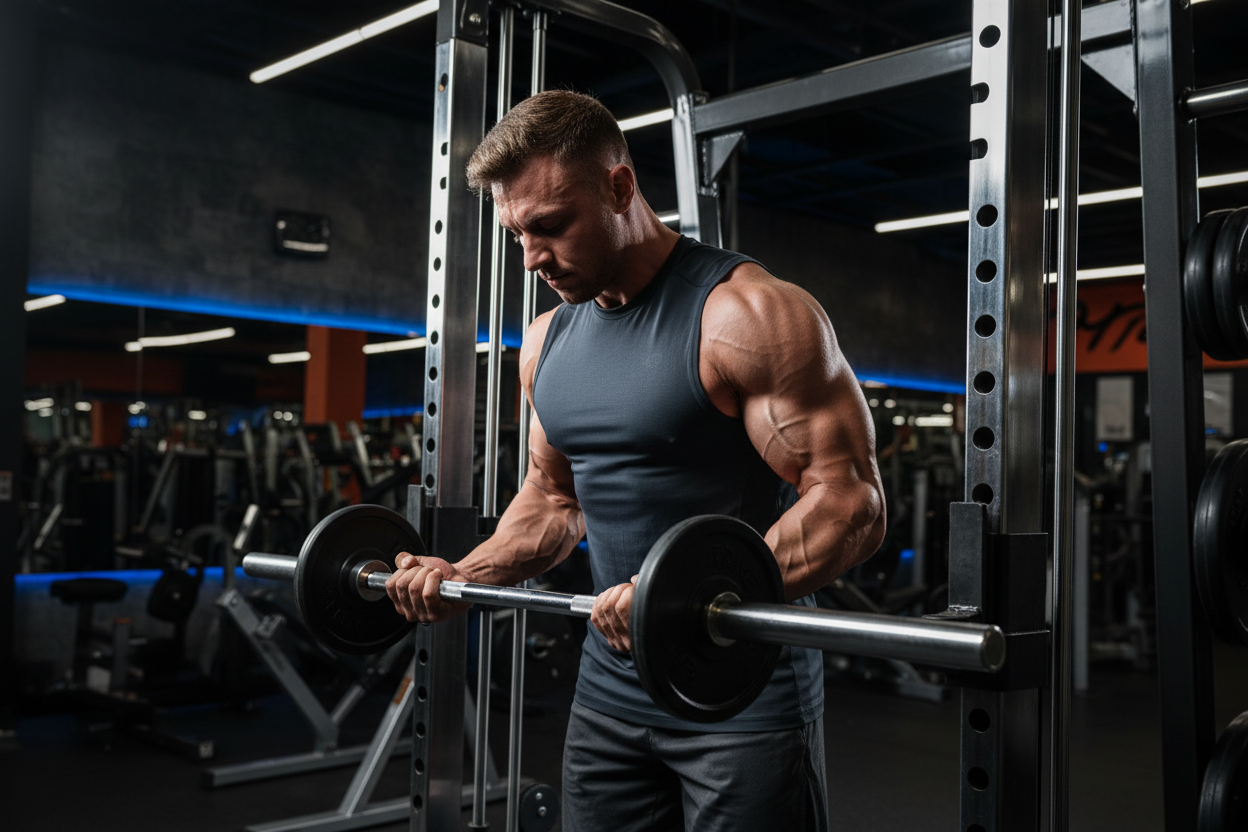
Smith Machine Bicep Curl: The Secret to Isolating Peak Growth
If you ask a gym purist about training smith machine bicep curl variations, they might roll their eyes and tell you to grab a free weight barbell. Ignore them. While free weights are king for stabilizers, they allow for a lot of "body English" (swinging) that robs your biceps of tension.
The Smith machine isn't a crutch; it is a precision tool. By fixing the bar path, you remove the need to balance the load, allowing you to direct 100% of your neural drive directly into flexing the elbow. If your arms have plateaued using standard curls, the strict isolation of the Smith machine might be the missing variable in your programming.
Key Takeaways: Why Use the Smith Machine?
- Eliminates Momentum: The fixed vertical path prevents you from swinging your hips to move the weight.
- Constant Tension: Unlike dumbbells where tension drops at the bottom, the friction and path of the Smith machine keep the muscle loaded.
- Safety at Failure: You can push to absolute mechanical failure without worrying about dropping a barbell on your thighs.
- Superior Drag Curls: It is arguably the best piece of equipment for performing drag curls, which target the long head of the bicep.
Why the "Fixed Path" Actually Builds Muscle
The primary argument against the smith machine bicep workout is that the movement pattern is unnatural. This is only true if you try to replicate the exact arc of a free-weight curl. You cannot stand in the same spot you would for a standard barbell curl.
When you perform biceps on smith machine equipment, you are prioritizing hypertrophy (muscle growth) over functional stability. Because the machine handles the stabilization, your central nervous system doesn't need to waste energy keeping the bar level. This allows for a stronger mind-muscle connection and a harder contraction at the peak of the movement.
The King of Smith Exercises: The Drag Curl
If you are going to do one exercise here, make it the smith machine drag curl. A standard curl moves the weight in an arc (away from the body then up). A drag curl moves the weight strictly vertically, grazing your torso.
Because the Smith machine moves on vertical (or near-vertical) rails, it is mechanically perfect for the drag curl. You simply pull your elbows back behind your body and drag the bar up your shirt. This removes the front deltoid from the equation almost entirely, isolating the bicep peak.
How to Execute the Perfect Smith Machine Curl
Proper setup is non-negotiable here. If your feet are wrong, you will hurt your lower back.
1. The Setup
Set the bar to thigh height. Stand inside the machine. Unlike a barbell curl smith machine setup where you might stand directly under the bar, take a half-step forward. This slight forward position allows for better biomechanics as the bar rises.
2. The Grip
Take an underhand grip, shoulder-width apart. Keep your wrists neutral. Do not flex your wrists inward at the top, as this shifts tension to the forearms.
3. The Movement
Initiate the lift by flexing the elbows. If doing a standard curl, keep elbows pinned to your sides. If doing a drag curl, drive elbows backward. Squeeze hard at the top for a one-second count. Lower the weight slowly—take three seconds to return to the start. The smith machine bicep response relies heavily on this eccentric (lowering) phase.
Common Mistakes to Avoid
Even with a fixed path, you can mess this up. Here is what usually goes wrong with smith machine bicep exercises.
Standing Too Far Back
If you stand too far back, you turn the movement into an upright row. This engages the traps and shoulders, stealing gains from the arms. Your chest should be up, and your shoulders depressed (pulled down).
Using the Wrong Lockout
Avoid fully locking out your elbows at the bottom if you have hyper-mobility. Keep a slight bend to maintain tension on the bicep muscle belly. Conversely, don't stop halfway down; you need the stretch for growth.
My Training Log: Real Talk on the Smith Machine
Let's be honest about the quirks of this machine. I’ve incorporated the smith machine curl into my arm days for the last five years, specifically as a finisher, but it feels different than iron.
The specific thing nobody tells you is about the "wrist clip." On a standard Olympic barbell, the sleeves rotate independently of the bar. On most commercial Smith machines, the entire bar is one solid piece. When I first started going heavy on these, I found that as I curled up, my natural wrist rotation would actually rotate the bar hooks backward, causing them to clip the safety latch on the way up. It makes a jarring metal-on-metal clank that kills your rhythm.
I had to learn to keep a "dead wrist"—gripping the bar loosely enough that it could rotate in my hand without me engaging the safety hooks. It feels weird at first, almost like the bar is slipping, but once you get that grip dialed in, the isolation is unmatched. Also, be prepared for the friction. If the rails haven't been oiled recently, you'll feel a gritty vibration on the eccentric portion. Don't let that distract you; just focus on the burn.
Conclusion
The Smith machine isn't a replacement for heavy barbell curls, but it is an exceptional accessory movement for hypertrophy. It allows you to safely fail and utilize the drag curl technique more effectively than free weights. Add 3 sets of 12-15 reps at the end of your arm workout, focus on the squeeze, and watch your arms respond.
Frequently Asked Questions
Is the Smith machine effective for biceps?
Yes, absolutely. While it recruits fewer stabilizer muscles than free weights, it allows for greater isolation of the bicep brachii, making it excellent for hypertrophy (muscle growth) and focusing on the "squeeze" of the rep.
What is the difference between a Smith machine curl and a barbell curl?
The main difference is the path of motion. A barbell curl requires you to stabilize the weight in three-dimensional space, engaging the core and stabilizers. The Smith machine locks you into a vertical path, removing stability requirements so you can focus entirely on elbow flexion.
Should I do drag curls or standard curls on the Smith machine?
The drag curl is generally superior on the Smith machine. Because the machine moves vertically, it perfectly mimics the mechanics of a drag curl (elbows back, bar close to body). Standard arcing curls can sometimes feel awkward on a vertical rail system.