
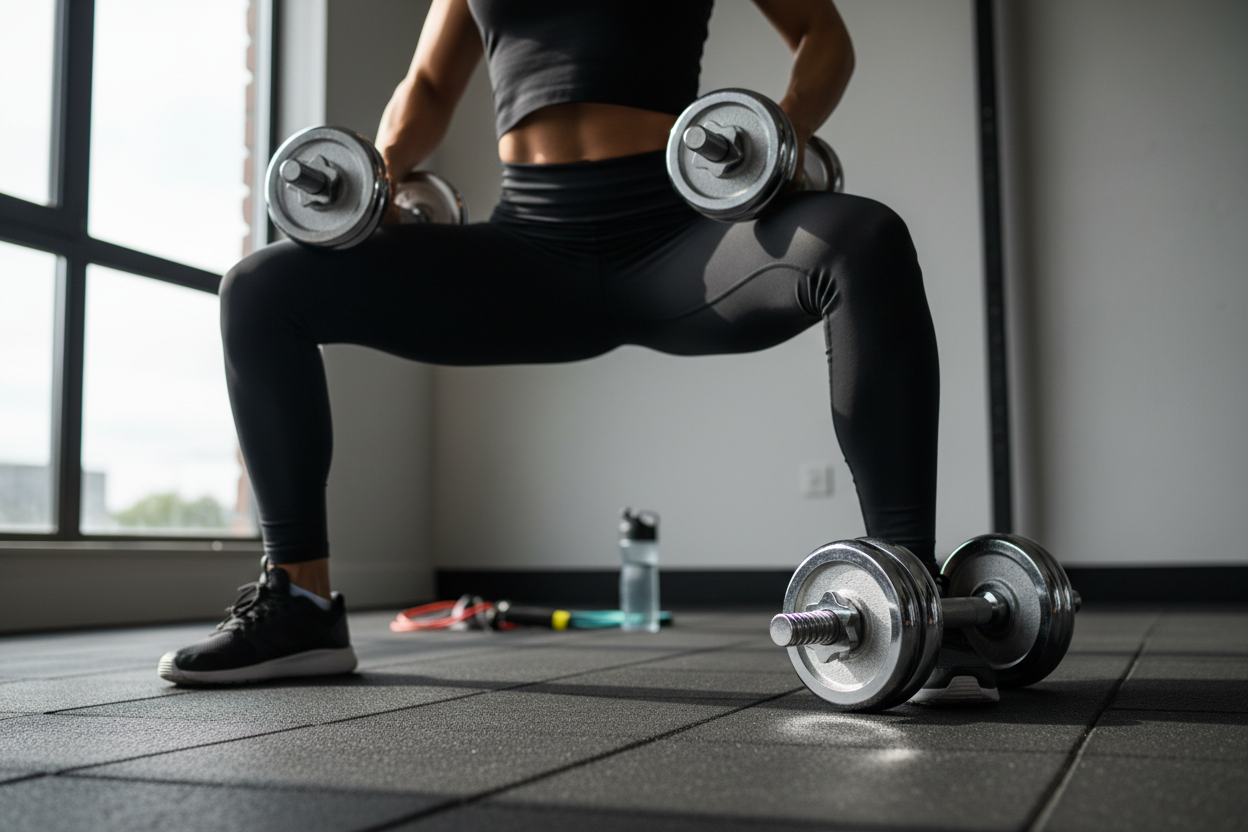
Skip the Squat Rack: How to Build Strong Legs with Just Two Dumbbells
You do not need a gym membership, a massive barbell, or complex machinery to build a strong, athletic lower body. In fact, for most people starting their fitness journey, relying on free weights is often safer and more effective for learning proper movement patterns. A well-structured beginner dumbbell leg workout focuses on the fundamental human movements—squatting, hinging, and lunging—without the spinal compression or intimidation factor of the squat rack.
To get straight to the point, the most effective approach is a routine consisting of Goblet Squats, Romanian Deadlifts, and Reverse Lunges. These three movements cover your quads, hamstrings, glutes, and calves while challenging your core stability. If you execute these with proper form and progressive resistance, you will see significant muscle development and strength gains.
Why Dumbbells Beat Machines for Beginners
When you sit on a leg press machine, the equipment stabilizes the weight for you. You can push a lot of weight, but your stabilizer muscles—the smaller ones around your hips and knees—remain dormant. Dumbbells force you to control the weight in three-dimensional space. This builds functional strength that translates to real life, whether you are carrying groceries or climbing stairs.
I remember my first few months attempting to train legs. I walked into a crowded weight room, took one look at the guys loading 45-pound plates onto barbells, and immediately felt out of place. I tried to squat with the bar, but my balance was terrible, and my lower back hurt almost instantly. Switching to a lower body dumbbell workout for beginners changed everything for me. Holding the weights in my hands allowed me to adjust my center of gravity naturally. I could focus on the muscle contraction rather than worrying about getting crushed by a heavy bar. That shift in tools gave me the confidence to stay consistent, which is the only "secret" that actually matters.
The Essential Routine
This routine is designed to hit every major muscle group in your legs. Perform this workout twice a week with at least two days of rest in between sessions.
1. The Goblet Squat
This is the king of the beginner lower body dumbbell workout. By holding one dumbbell vertically against your chest, you naturally keep your torso upright, which protects your lower back and allows for greater depth.
Hold a dumbbell with both hands cupping the top end, keeping your elbows tucked in close to your ribs. Stand with your feet slightly wider than shoulder-width, toes pointed slightly out. Take a deep breath into your belly, brace your core, and lower your hips down between your heels. Imagine you are trying to sit on a low stool behind you. Go as deep as your mobility allows without your heels lifting off the floor, then drive back up to the starting position.
Aim for 3 sets of 10 to 12 repetitions. If your lower back rounds or your heels pop up, you are likely going too low or your stance needs widening.
2. Dumbbell Romanian Deadlift (RDL)
While the squat targets the front of your legs (quads), the RDL targets the back (hamstrings and glutes). This is a hip-hinge movement, not a squat, and mastering it is crucial for long-term back health.
Hold a dumbbell in each hand in front of your thighs, palms facing your body. Stand with feet hip-width apart and knees slightly bent. Keep your knees locked in that soft bend—they should not bend further during the movement. Push your hips backward as if you are trying to close a car door with your butt. Let the weights slide down your thighs toward your shins. Stop when you feel a deep stretch in your hamstrings (usually just below the knees) and squeeze your glutes to pull yourself back up.
Perform 3 sets of 10 to 12 repetitions. The most common mistake here is reaching for the floor with the weights rather than pushing the hips back. Range of motion is dictated by your flexibility, not by how close the dumbbells get to the ground.
3. Dumbbell Reverse Lunge
Unilateral training (working one leg at a time) fixes muscle imbalances. If your right leg is stronger than your left, a barbell squat lets the right leg take over. Lunges force both legs to work equally.
Hold a dumbbell in each hand by your sides. Stand tall, then take a controlled step backward with your right foot. Lower your hips until your back knee hovers just an inch above the floor and your front thigh is parallel to the ground. Drive through the heel of your front foot to return to the standing position. Complete all reps on one leg before switching to the other.
Do 3 sets of 10 repetitions per leg. Reverse lunges are generally superior for a beginner dumbbell leg workout compared to forward lunges because they place significantly less shearing stress on the knee joint.
Progressive Overload: How to Get Stronger
Doing the same workout with the same weight forever will result in a plateau. To change your body, you must apply progressive overload. This doesn't always mean grabbing a heavier dumbbell. If you are working out at home with limited weights, you can increase the intensity by slowing down the tempo.
Try taking three full seconds to lower yourself into the squat, pause for one second at the bottom, and then explode up. This increases "time under tension" and makes a light weight feel heavy. Once you can comfortably perform 12 reps with perfect form and a controlled tempo, it is time to move to a heavier dumbbell.
Common Form Traps to Avoid
Ego lifting is the fastest way to get injured. In a lower body dumbbell workout for beginners, technique must supersede weight. A common issue is "knee cave" (valgus collapse), where the knees collapse inward during a squat or lunge. This puts immense strain on the ligaments. Actively think about pushing your knees outward to track over your toes throughout the movement.
Breathing also plays a massive role in stability. Do not hold your breath randomly. Inhale and brace your core before you lower the weight, and exhale forcibly as you push against gravity (the difficult part of the lift). This creates intra-abdominal pressure that acts as a natural weight belt for your spine.
Recovery and Frequency
Leg training is demanding on the central nervous system. You might experience Delayed Onset Muscle Soreness (DOMS) a day or two after your first session. This is normal and usually subsides as your body adapts to the new stimulus. Ensure you are eating enough protein to support muscle repair and sleeping 7-9 hours a night. Without recovery, all the effort you put into your squats and lunges is wasted.
Consistency over intensity is the rule for the first three months. Showing up twice a week and doing the work perfectly is infinitely better than showing up once, going too hard, and being unable to walk for a week.
Frequently Asked Questions
Can I really build big legs with just dumbbells?
Yes, absolutely. Your muscles do not know the difference between a barbell, a machine, or a dumbbell; they only understand tension. As long as you progressively increase the weight or reps over time to challenge the muscles, you can build significant size and strength with dumbbells alone.
What should I do if my grip gives out before my legs do?
This is common when starting a lower body dumbbell workout for beginners. Your legs are naturally stronger than your hands. You can use lifting straps to help hold the weights, or simply view it as an opportunity to improve your grip strength, which will catch up to your leg strength within a few weeks.
How do I know what weight to start with?
Select a weight that allows you to complete your target reps (e.g., 10-12) with good form, but leaves you feeling like you could maybe do 2 more reps if you absolutely had to (RPE 8). If you finish the set and feel like you could have done 10 more, it is too light; if your form breaks down at rep 6, it is too heavy.


