Skip the Gym, Not Leg Day: How to Build Strong Legs in Your Living Room
Building impressive leg strength and definition doesn't require a squat rack or hundreds of pounds of iron. The most effective way to train your lower body at home is by manipulating leverage, tempo, and volume. By shifting your focus to unilateral exercises—movements that work one leg at a time—you instantly double the intensity of your body weight. This approach, combined with plyometrics and strict tension control, forces your muscles to adapt just as they would under a heavy barbell.
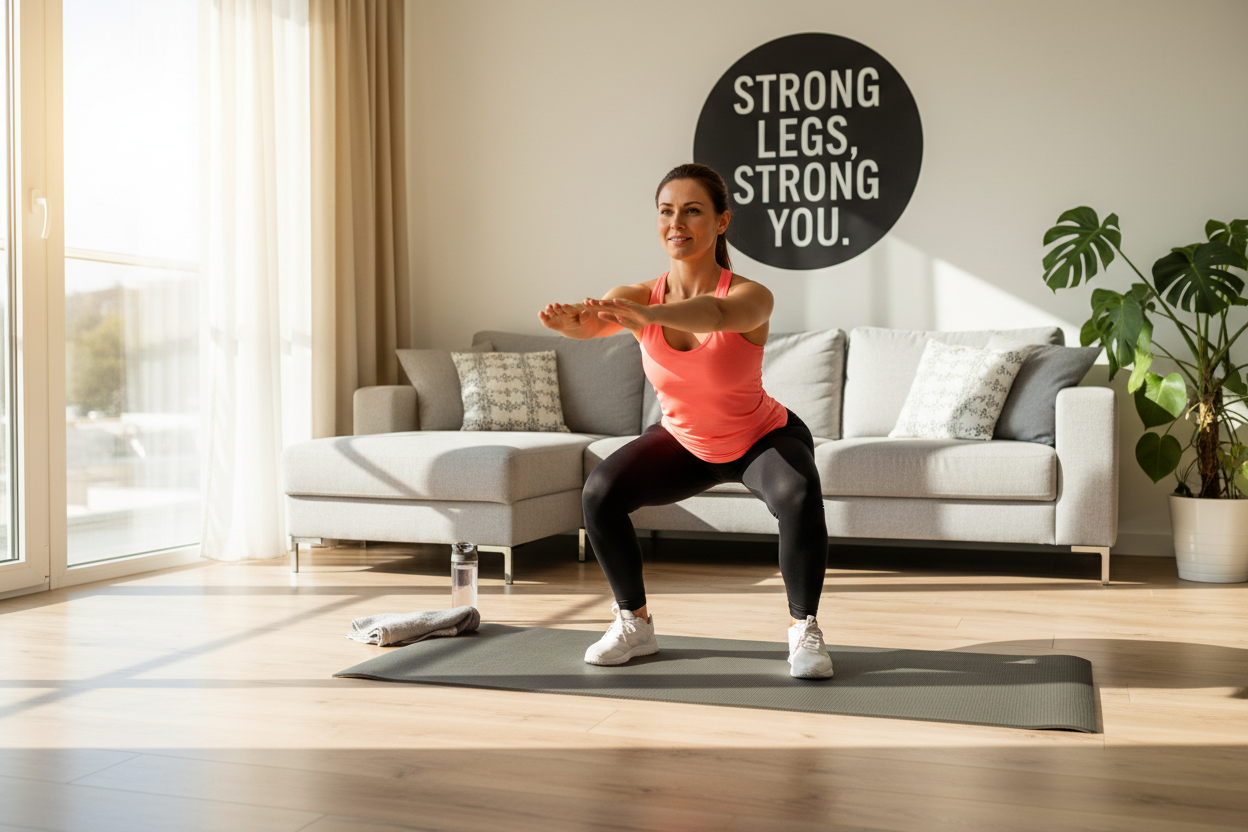
Finding good at home leg workouts often feels like sifting through endless videos of people doing air squats that look far too easy. The reality is that air squats alone won't trigger significant growth unless you are a complete beginner. To simulate the mechanical tension necessary for muscle building (hypertrophy), you need to put your legs in mechanically disadvantageous positions. This means deep ranges of motion, single-leg stability work, and explosive movements that recruit fast-twitch muscle fibers.
My Real-World Wake Up Call
I learned the hard way that bodyweight training isn't just for warm-ups. A few years ago, I was stuck in a hotel room for a week with zero gym access. I prided myself on a heavy back squat, so I assumed a living room workout would be a breeze. I decided to do ten sets of walking lunges and single-leg box squats using the bed frame for support.
By the fourth set, my legs were shaking uncontrollably. The next morning, I could barely walk down the stairs to the lobby. That experience shattered the myth that I needed external load to get a stimulus. It wasn't the weight that crushed me; it was the instability and the sheer volume of time my muscles spent under tension. Since then, I’ve integrated these movements into my regular routine, even when I have access to a gym, simply because they build a type of functional stability that machines can't replicate.
The King of Living Room Lifts: The Bulgarian Split Squat
If you only do one exercise, make it the Bulgarian Split Squat. This movement is the cornerstone of any good workout for legs at home because it effectively isolates the quadriceps and glutes while removing the lower back from the equation. Unlike a standard squat where your stronger leg can compensate for the weaker one, the split squat forces symmetry.
To perform this correctly, stand a couple of feet in front of a couch or sturdy chair. Place the top of your rear foot on the surface behind you. Lower your hips until your front thigh is parallel to the floor. The key here is not just going up and down, but controlling the descent. Take three full seconds to lower yourself. Pause at the bottom. Then drive back up. If you lean your torso forward slightly, you will target more glute. Keep your torso upright, and you will torch your quads.
Don't Neglect the Posterior Chain
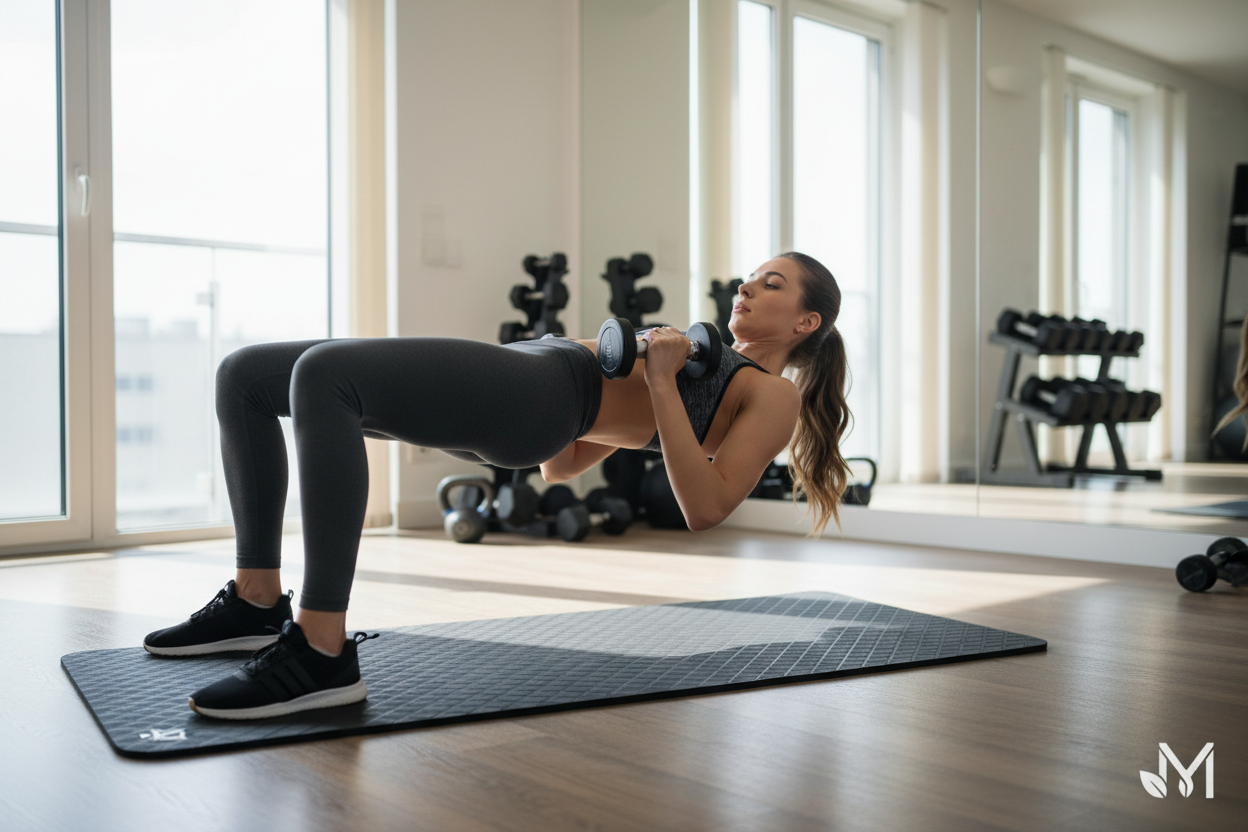
Most at-home routines are quad-dominant, leading to muscle imbalances and potential knee issues. Your hamstrings and glutes need just as much attention. The single-leg glute bridge is your best defense against weak posterior muscles. Lie on your back, bend one knee with your foot flat on the floor, and extend the other leg straight out. Drive through the heel of the planted foot to lift your hips until your body forms a straight line from shoulder to knee.
For the hamstrings specifically, the sliding leg curl is brutal and effective. You need a slick floor (wood or tile) and a towel, or paper plates on a carpet. Lie on your back with your heels on the towel. Lift your hips into a bridge position. Slowly slide your feet away from you until your legs are straight, then pull your heels back toward your glutes while keeping your hips elevated. This movement mimics the leg curl machine but requires significantly more core engagement.
Plyometrics for Power
Strength is one component of fitness, but power is another. Because we lack heavy loads at home, we replace mass with acceleration. Plyometric exercises recruit high-threshold motor units that are usually only activated when lifting near-maximal weights. Jump squats are the standard, but lunge jumps are the upgrade.
Start in a lunge position. Explode upwards, switching your legs in mid-air, and land softly in a lunge with the opposite leg forward. The landing mechanics are crucial here; you want to absorb the impact with your muscles, not your joints. This constant deceleration and acceleration create a massive metabolic demand, burning calories and building explosive power simultaneously.
Structuring Your Routine for Maximum Impact
Randomly selecting exercises won't yield results. You need a structure that fatigues the muscle fibers completely. A circuit-style approach works well to keep the heart rate up while maintaining muscular tension. Here is a structure that covers all bases:
- A1. Bulgarian Split Squats: 4 sets of 12 reps per leg (Tempo: 3 seconds down, 1 second up).
- A2. Sliding Leg Curls: 4 sets of 15 reps (keep hips high).
- B1. Single-Leg Glute Bridges: 3 sets of 15 reps per leg (squeeze hard at the top).
- B2. Alternating Lunge Jumps: 3 sets of 20 total reps.
- C1. Calf Raises on a Step: 3 sets of 20 reps (hold the stretch at the bottom).
Perform the "A" exercises back-to-back, rest for 90 seconds, then repeat for 4 sets before moving to the "B" exercises. This density makes the workout feel significantly harder than the rep counts suggest.
Progressive Overload Without Weights
The biggest challenge with home training is progression. In the gym, you add 5 pounds. At home, you must change the physics. Once the routine above becomes manageable, you have three levers to pull:
First, increase the range of motion. Elevate your front foot during split squats using a thick book or a step. This allows the knee to travel deeper, stretching the muscle fibers under load, which is a potent trigger for growth. Second, reduce stability. Perform your lunges or squats with your eyes closed, or stand on a folded pillow. The micro-adjustments your muscles make to keep you upright add significant intensity. Finally, remove the rest. Turn the circuit into a continuous flow where you only rest after completing a full round of all exercises.
Frequently Asked Questions
Can I actually build muscle mass without heavy weights?
Yes, provided you train close to failure. Research shows that lighter loads can build muscle just as effectively as heavy loads if the volume is high enough and the sets are taken to the point where you cannot complete another rep with good form.
How often should I do this leg workout?
Twice a week is ideal for most people. Legs are large muscle groups that require significant recovery, especially when doing high-volume eccentric movements like split squats. Allow at least 48 to 72 hours between sessions.
What if I have bad knees?
Focus on posterior chain exercises like glute bridges and Romanian deadlifts first, as these place less stress on the knee joint. For squat patterns, reduce the depth and focus on a slow tempo rather than explosive movements until your joint stability improves.